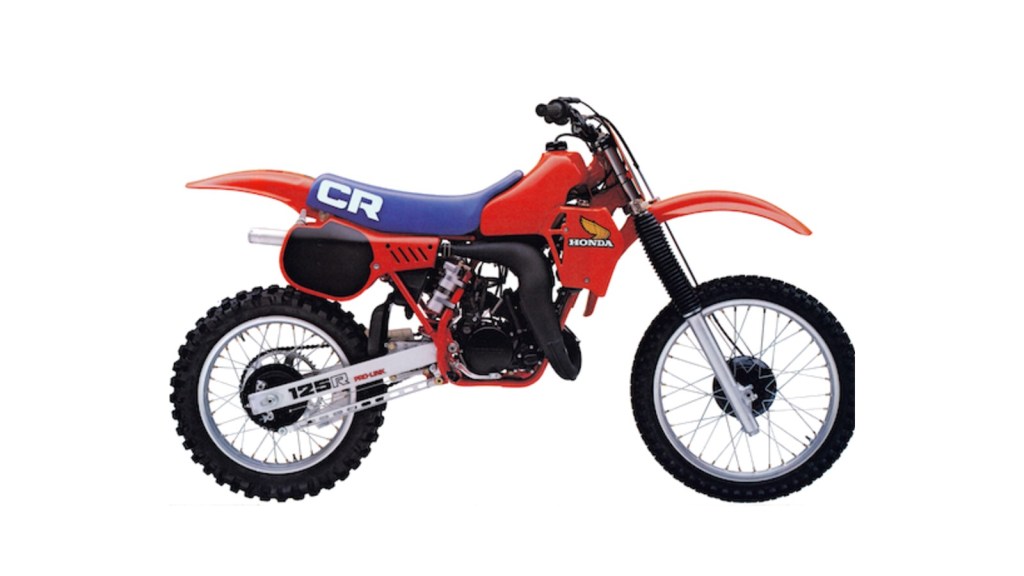
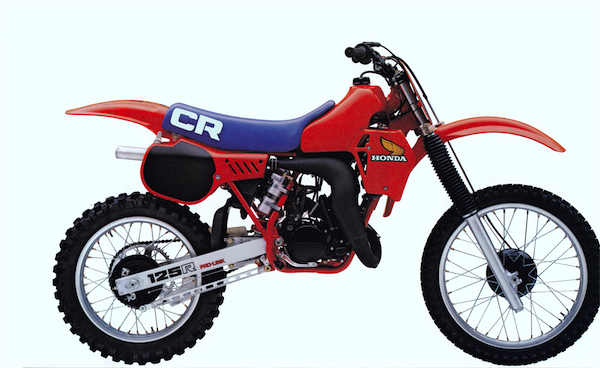
For this week’s GP’s Classic Steel we are going to take a look back at the bike that helped spark Honda’s 1980’s renaissance, the 1983 CR125R.
In 1973, Honda shocked the motocross world with their first 125 two-stroke race bike, the CR125M Elsinore. The little Elsie was faster, better suspended and better built than anything ever seen in the small-bore class and a colossal success for Honda. Virtually overnight, starting lines from coast to coast were awash in the little silver-tanked buzz bombs.
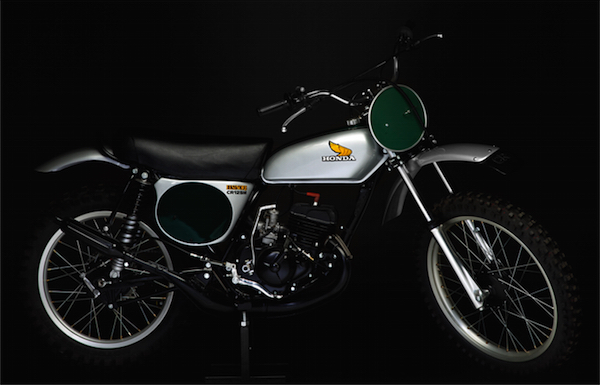
Interestingly, after this immense initial success, Honda would more or less take the rest of the decade off. Stale retreads and mild makeovers would be all that Elsinore fans would have to look forward to for the next five years. As Honda faltered, those early seas of silver quickly gave way to yellow, as Suzuki and Yamaha took up the torch of 125 supremacy.
In 1979, Honda would finally pony-up for a redesign of the old girl, but the results would be less than spectacular. A bizarre 23’ front wheel, anemic motor and pathetic suspension would once again relegate the Elsinore to back of the pack status in ’79. The ’80 model would fix the CR’s power deficiency, but do little to alleviate its suspension woes. A complete ’81 redesign would bring the red tiddler into the new decade with radical styling, a water-cooled motor and a revolutionary monoshock suspension system Honda labeled “Pro-Link”. While the new bike was certainly modern, it was also overweight, underpowered and poorly suspended. Once again, Honda was relegated to eating roost from the awesome RM125.
The ’82 model would bring with it another redesign, and for the first time in nearly a decade, the Honda would actually be in the hunt. Power was improved, but the bike’s handling, suspension and ergonomics were still a step behind the best in the class. For Honda, things looked to be finally moving the right direction, but there was still some work to be done if they were going to wrest the crown of top tiddler away from Suzuki.
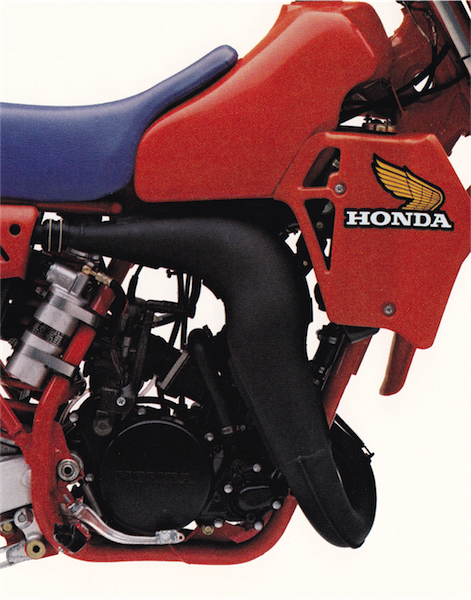
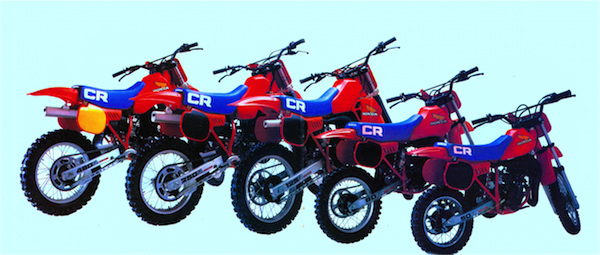
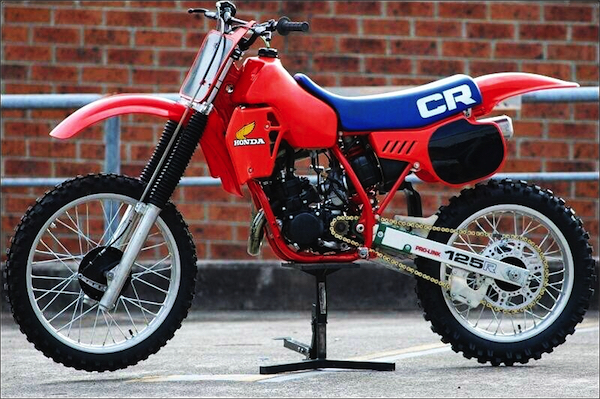
With the ’83 CR125R, Honda took a clean sheet approach. Virtually nothing was carried over from he ’82 model and literally everything was scrutinized in an attempt to extract more performance. An all-new chassis improved handling and lowered weight. Revised suspension lowered seat height (a full two inches over the ’82), improved control (more adjustments) and further lowered weight. An all-new motor was lighter, narrower and more powerful than before, offering a wider spread and more torque. All-new bodywork improved ergonomics with a new safety seat, low-boy tank and lowered radiators. Topping off the improvements for ’83, was a new coat of orange-mist paint for the plastic and frame taken directly from the ’82 Factory bikes. On paper, the new bike looked to be a world beater, but as always, the true test would be on the track.
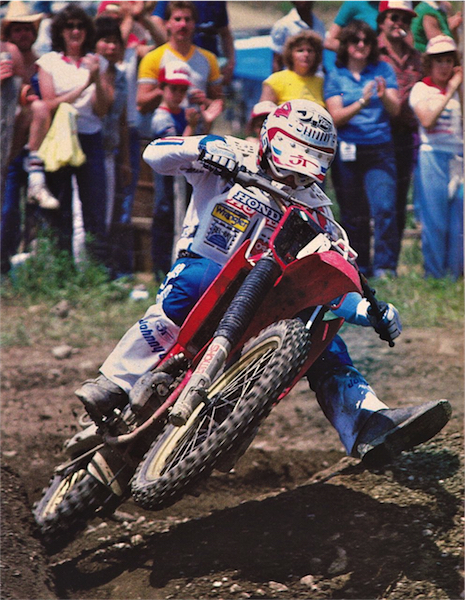
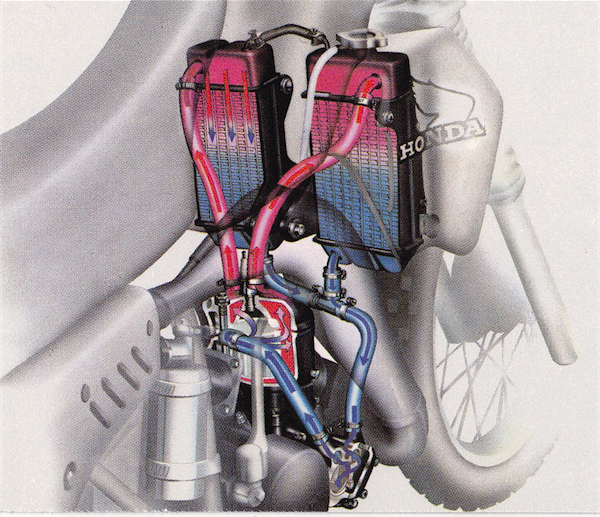
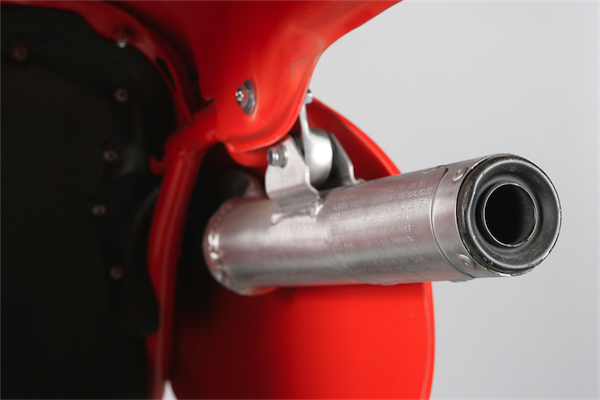
In 1982, Honda had delivered a fun-to-ride, but difficult-to-race powerband on their 125. Nearly every tester enjoyed its punchy mid-range and lively hit, but found its rather narrow spread difficult to manage in the heat of battle. It was fast for a short period of time, but difficult to keep in its narrow sweet spot. For ’83, Honda tried to broaden the torque curve on their 122cc reed-valve racer. All-new cases moved the final drive from the right to the left (done to give the motor a narrower profile) and a new cylinder and head lowered the exhaust ports, enlarged the transfers and bumped the compression ratio from 8.3:1 to 8.6:1. A new reed-valve improved breathing and a new pipe (with a trick alloy silencer) enhanced exhaust flow. Topping off the motor changes were a new coolant system that was both lighter (two pounds) and less power sapping, a new clutch and revised ratios in the transmission.
So what did all these changes add up to on the track? In truth, the ’83 CR125R mill was notably improved, but still no world-beater. Power off the line was still merely adequate enough to get the bike in motion and far from the CR’s strong suit. Midrange, however, was improved over ’82 and plentiful. After its strong midrange hit, there was little pull to be had as the power tapered off notably on top-end. Just as in ’82, it was necessary to have a fast left foot to keep CR surfing that midrange surge. If you flubbed a shift and fell off the pipe, you were in trouble, but if you could keep the red tiddler on the bubble, it was more than competitive with the other 125’s.
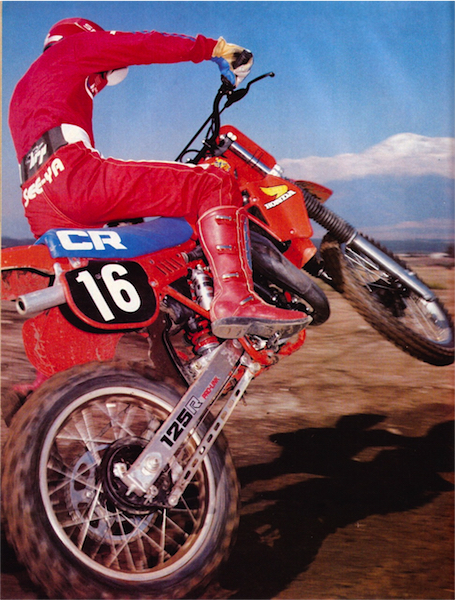
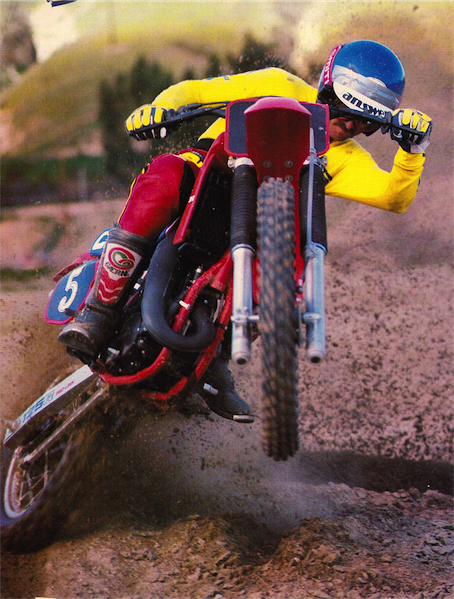
While the motor on the new CR was nothing to write home to Lovely Louella about, the rest of the bike was a superstar. First up on the list of the little Honda’s list of virtues, was its incredible handling. Over the years, Honda had done itself no great favors with the chassis dynamics of its eighth-liter racers. Early Elsinore’s suffered from too little suspension, while later iterations went the other direction with skyscraper seat heights and floppy front ends. For ’83, Honda finally got it right with a nearly perfect juggling of materials, geometry and design.
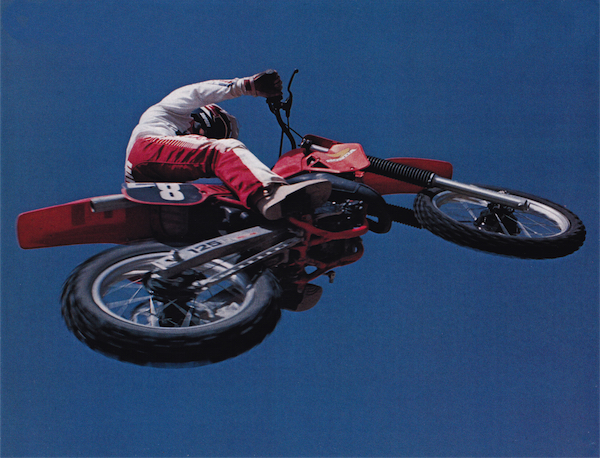
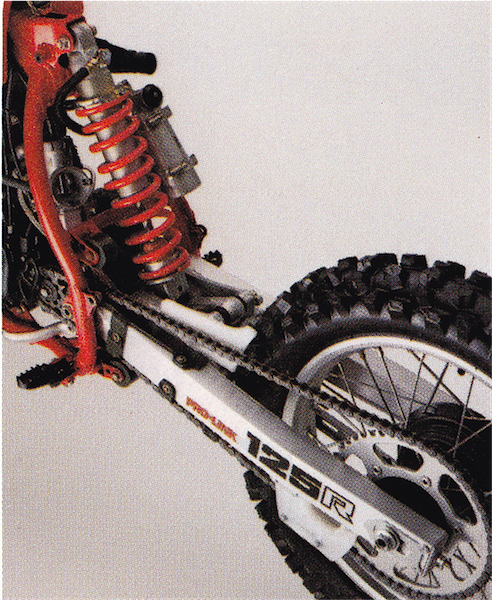
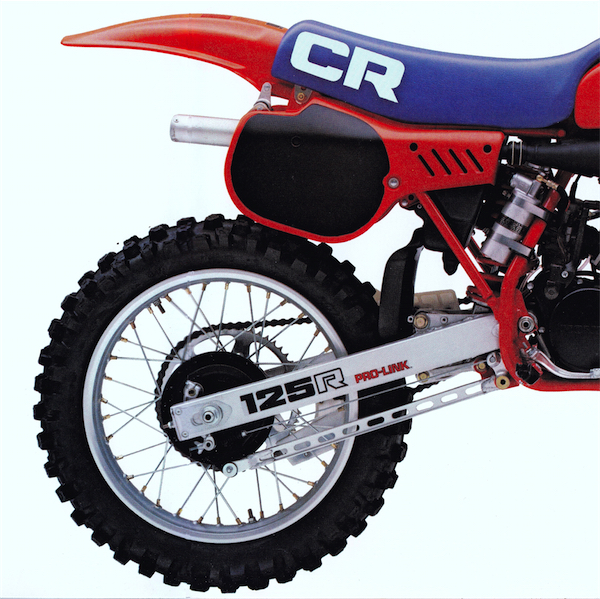
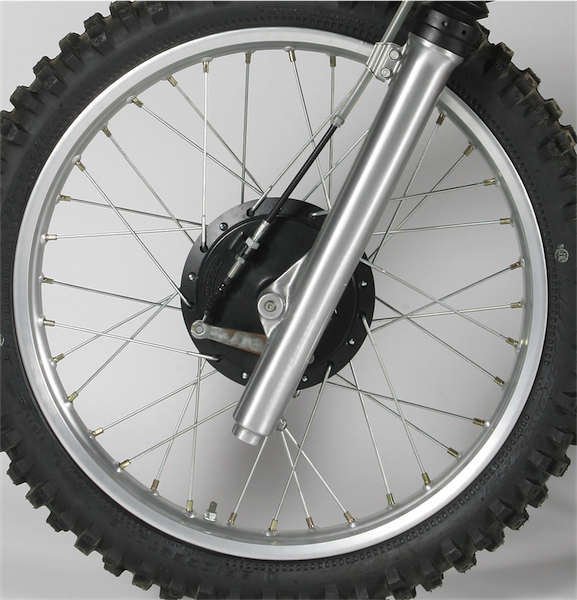
Some of the credit for the handling prowess of the ’83 CR certainly went to the bike’s feather-light 192-pound fighting weight. This was a full six pounds lighter than the ’82 model (which was four pounds lighter than the porky ’81). Literally everything was scrutinized for ’83 in an effort to trim unwanted pork. Components like the silencer, Pro-Link linkage, brake lever and clutch plates were all changed from heavy steel to lightweight alloy alternatives. The wheels and brakes were both shaved down for ’83 and shorn with Bridgestone’s latest lightweight rubber. Suspension front and rear was also lighter, with slightly less travel than 1982.
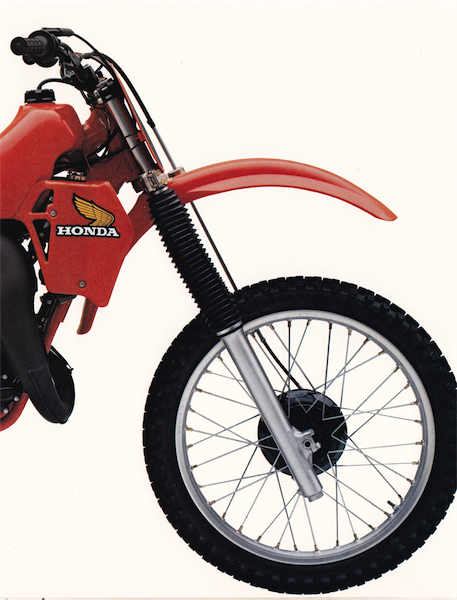
The new chrome-moly frame was stronger for ’83 and offered a fully removable rear subframe for the first time. This new design was slightly less aggressive for ’83, offering more trail, less rake and a half-inch longer wheelbase. In addition to the new angles, a greatly improved center of gravity also aided handling. The new bike mounted the radiators a full two inches lower in in the chassis and mated that with a works-style “drop-tank” that drooped on one side to allow the fuel to sit lower on the chassis. With the narrower tank, two inch lower seat height and up-the-tank saddle, it was easier than ever to get forward on the bike and find the optimal riding position in turns.
On the track, all that engineering alchemy came together to produce a machine that MXA labeled “the best handling 125 motocrosser ever built.” In one fell swoop, Honda wiped away a decade of handling mediocrity and indignation. The new CR offered a level of turning prowess never before seen on a red machine (unless of course, you counted Maico) and combined it with a light and airy feel that made attacking the track a joy. The little CR tracked straight in the rough, carved turns with precision and flew straight and true off the jumps. It was the best handling bike in the 125 class by a wide margin and a quantum leap forward for Honda.
The other half of the ’83 CR’s excellent handling story was its suspension package. For ’83, Honda made the rather interesting choice to use two separate suppliers for the CR’s suspension components. Up front, Kayaba handled the forks, while Showa handed the shock out back. While this may have seemed like a bit of an oddball combination, it actually ended up working quite well.
The new 38mm KYB forks (the CR250R and CR480R got much beefier 43mm stanchions) were actually 13mm shorter for ’83 and offered 5mm less travel than ’82. This was to address one of the biggest complaints riders had voiced about CR125’s since 1979, that they were too tall. The new forks while shorter, actually performed far better than the old units and offered a wide range of compression setting via a screw mounted at the forks (’82 offered a mere 3 settings). While there was no adjustment for rebound (and no fancy cartridge internals), they did come equipped with air caps on each leg to allow fine-tuning of the spring rate.
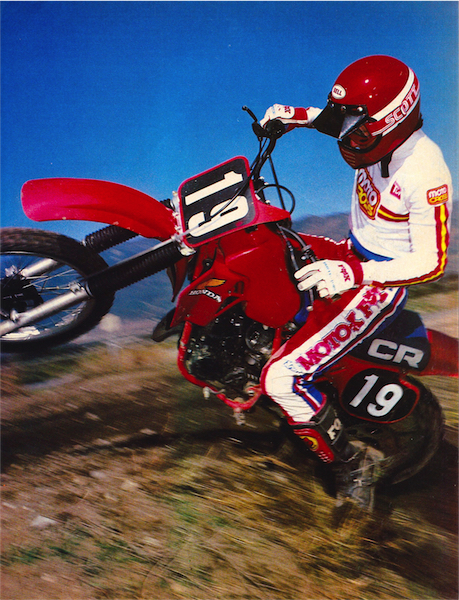
In terms of performance, the Honda’s KYB forks were rated the best of 1983 in the 125-class. Due to the limitations of the simple damper-rod system none of the fork class of ’83 could be considered without flaw, but the Honda did the best job of combining bump absorption with a degree of plushness. Some riders felt the forks were too soft initially and could use stiffer springs, but they were raceable in stock condition and less harsh than the competition.
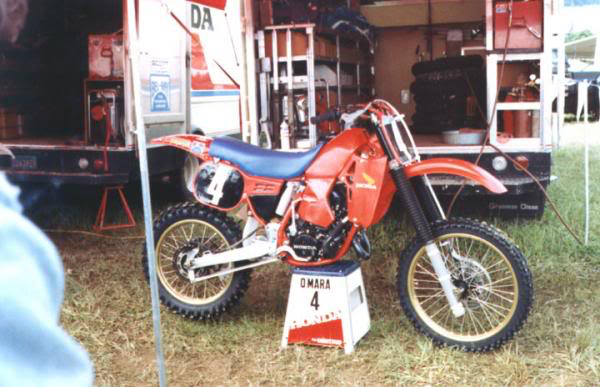
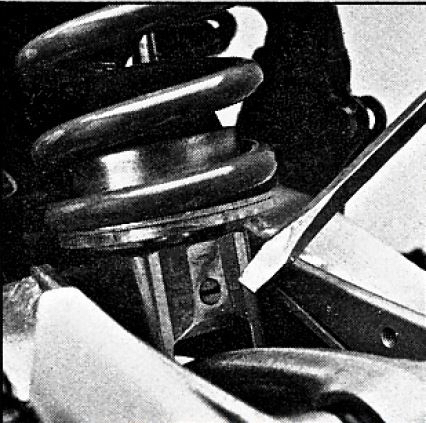
Like the forks, the new remote reservoir Showa shock offered 5mm less travel than ’82 and a great deal more adjustment. Where the ’82 model had offered only 4-way compression adjustment (and no rebound adjustment), the new shock ponied up a 12-way compression adjustment and 20 adjustable rebound settings. Like the rest of the bike, the rear suspension was also lighter with a new swingarm that trimmed ounces and lightweight alloy linkage that replaced the heavy forged steel components of ’82.
On the track, the little Honda’s suspension worked well for anyone less than 160 pounds. The rear end was plush and took small hits well, but could be bottomed with a “thud” on big hits. In these situations, the bike took the hit well and never hopped, bucked, or did anything weird. For heavier guys, a step up in spring rate and perhaps even an aftermarket alternative were recommended. Overall, the CR’s shock was much improved and certainly the best ever seen on a 125 Honda, but still not in the same league as the omnipotent Suzuki Full-Floater.
As for detailing, the little Honda was a step ahead of the class in most areas. Plastic quality, fit and finish were all world class for the time and a huge improvement over the industrial grade workmanship seen on the Kawasaki and Suzuki. Things like the bars, grips, perches and levers showed Honda’s attention to detail and were a step above anything else available at the time (and would continue to be so for the next decade). Touches like the fully removable rear subframe were taken directly off the Honda Factory race bikes and greatly aided maintenance.
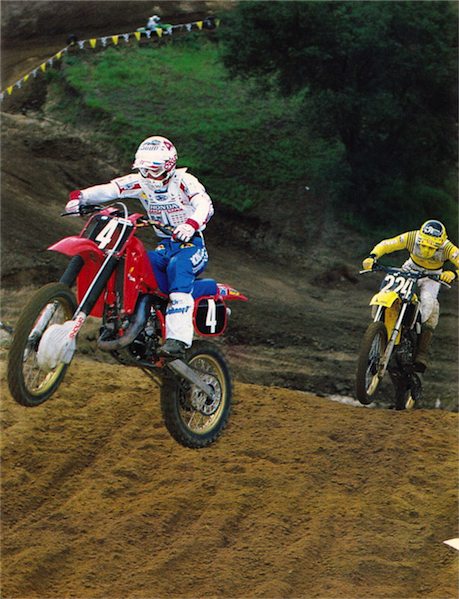
One area where the Honda did lag behind was in the braking department. Unlike the 250 and 480, the CR125R had to make do without the trick dual-leading-shoe binder found on David Bailey’s works bike. Instead, the little CR had to make do with the same single-action brake system in use since the turn of the century. While it was the best of the drums, it was no match for the awesome power of the KX125’s hydraulic disc.
In 1983, Honda introduced a line of machines that would turn the tide from yellow to red for the first time in a decade. The all-new CR125R was the first shot in a barrage that would see Honda go from also-ran, to top dog in all three classes. The new CR125R signaled that Honda was indeed serious about motocross and determined to take the top spot in the showrooms, as well as the racetrack. While it did not yet possess the horsepower advantage it would gain in later years, the ’83 CR125R sowed the seeds for a decade of dominance with faultless handling, perfect ergos and sano looks. It was not perfect, but it was the best 125 of ’83 and the progenitor of a dynasty.
For your daily dose of old-school moto goodness, make sure to follow me on Twitter and Instagram -@TonyBlazier
This story first ran in my Classic Steel column on PulpMX. Read the original at PulpMX.com.