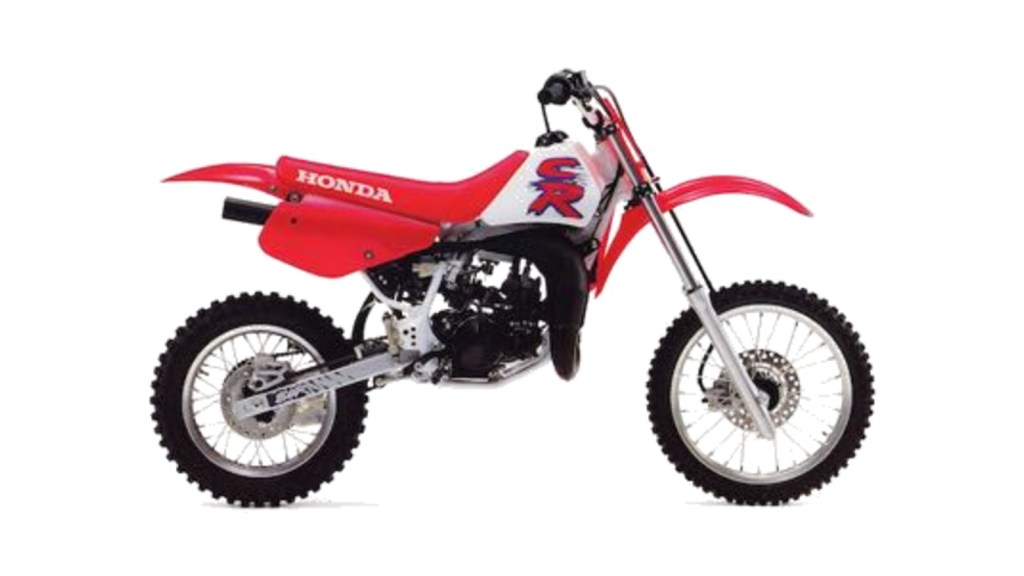
Honda built the CR80R from 1980 to 2002 and the CR85R from 2003 to 2007, and I’ve seen more of them handed down from kid to kid than just about any mini. Now a lot of the guys who raced one want one back, either for the shelf or for their own kids. The catch is that Honda changed the CR80R almost every year early on, and minis get crashed, swapped and re-plasticked more than anything else. So it pays to know exactly what you’re looking at. Here’s how I’d shop for one.
Found one for sale? Send me the listing before you buy → Bike Check
I’ll look over the photos, numbers and price and tell you what I see. Starts at $29.
The short answer: which years to buy
- For a rider: 1996–2007. The 1996 redesign brought 37mm inverted Showa cartridge forks, an aluminum swingarm, a removable subframe and a 220mm front disc, and it was 1 or 1a in the class. The 1999 frame is 20% stiffer, and the 2003–2007 CR85R got 84.7cc and a stronger third gear.
- For a classic you can still ride hard: 1992–1995. 1992 finally got a rear disc brake and much better suspension, on the same strong motor Honda introduced in 1986.
- The pick of the ’80s: 1987. The 1986 motor was the best in the class, and 1987 fixed the flexy forks with 35mm tubes. For most riders above novice, it was the bike to buy.
- Think twice if you want to race it: 1980–1985. The 1980 was fast but poorly suspended, and the 1984–1985 ATAC bikes got smoked by the KX80. They’re great to restore, not to race.
- For the shelf: the first-year 1980, the 1983 in flash red with a blue seat (my favorite color of all time), the 1985 with its box-section downtube, and the 1989, which wears my favorite Honda graphics ever.
Year-by-year changes that matter
- 1980: First CR80R. Air-cooled 79.7cc, twin remote-reservoir shocks, six-speed. Very fast, poorly suspended, no low end.
- 1981: All-new suspension, a longer swingarm, a full 80cc and more low end. It looks almost the same as the 1980.
- 1982: Pro-Link single shock and 31mm forks, still air-cooled.
- 1983: Liquid cooling, center-port exhaust, flash red with a blue seat.
- 1984–1985: The ATAC exhaust chamber. 1985 adds the box-section downtube, 83cc and a Kayaba shock.
- 1986: All-new motor without ATAC, Nikasil cylinder, new frame and the first front disc.
- 1987: 35mm forks, new porting and pipe.
- 1988–1991: Low-boy bodywork and an unpainted cylinder, still with a rear drum. 1989–1991 were graphics only.
- 1992: Rear disc brake and much better suspension.
- 1996: Inverted Showa forks, aluminum swingarm and triple clamps, removable subframe and a piggyback shock. The CR80R Expert arrives.
- 1999: New frame, 20% stiffer.
- 2003–2007: The CR85R: 84.7cc, a stronger third gear and a faux radiator shroud on the right side.
Every year, with the original brochures and my video, is in my Honda CR80R and CR85R history.
Common problems and weak points
The Nikasil top end (1986 and later). This is the big one. The 1986 CR80R got Honda’s first Nikasil cylinder, and you can’t just bore it like an old iron-sleeved barrel. If it’s been seized, you’re not simply going to an oversize piston. Plan on a new cylinder, or a shop that replates cylinders. Ask when the top end was last done, look for a receipt, and listen to it start cold.
Soft suspension on the ’80s bikes. The 1986 forks were too soft and flexed. 1987 fixed the flex with 35mm tubes, but on the 1988 the forks were still too soft for the shock. It wasn’t until 1992 that Honda really got the suspension right. Plan on springs and fresh oil for a bigger or faster kid.
Drum brakes. The front brake is a drum until 1986, and the rear is a drum on everything through 1991. Check the shoes and the brake arms, and don’t expect modern stopping.
Faded “nuclear red” plastic on the 1992. That pinkish red faded fast in the sun. Original 1992 plastic with good color is rare, so expect fade or reproduction plastic.
The steel silencer. The 1988–1995 bikes have a loud steel silencer you can’t rebuild. A rusted one means hunting for a good used one or a replacement.
A kid’s life. Most CR80s were raced, crashed and handed down. Check the frame, pipe, bars and levers for crash damage and old welds. One 1982 that sold on eBay had the shift lever welded to the shaft after it started slipping in a race.
How to spot a correct bike vs a Frankenstein
Check the hard parts first and the colors last, because plastic is the easiest thing to swap.
- Dual shocks mean 1980–1981. A single shock with no radiator is a 1982.
- A radiator with flash red plastic and a blue seat is a 1983. An ATAC chamber on the exhaust means 1984–1985, and a box-section downtube means 1985.
- A front disc with no ATAC is 1986 or later. 35mm forks mean a 1987, so a “1986” with 35mm forks has a 1987 front end.
- Low-boy bodywork and a silver cylinder with a rear drum is 1988–1991. A rear disc on one of those has been swapped.
- A rear disc with conventional forks is 1992–1995. Inverted forks on one of those, or conventional forks on a 1996-up bike, mean something was changed.
- Inverted forks, an aluminum swingarm and a silver-painted engine are 1996–2002. CR85R graphics and a fake radiator shroud on the right side are 2003–2007.
- Know whether it’s a standard CR80R or the CR80R Expert (CR80RB, 1996–2002), and make sure it fits the rider.
Frame numbers. On the bikes I could check, 1980–1982 frames carry the HE02 code (a 1980 sold as HE02-5011621, a 1982 as JH2HE020XCK200577), and from 1983 the code is HE04 (a 1983 as JH2HE0402DK005555, a 1989 as JH2HE0403KK600458). On the 17-digit numbers used from 1981, the 10th character is the model year: B is 1981, C 1982, D 1983, E 1984, F 1985, G 1986, H 1987, J 1988, K 1989, M 1991, N 1992, P 1993, R 1994 and V 1997. If the number says 1984 and the bike has a front disc, the front end isn’t from a 1984.
Engine numbers. Get a clear photo and make sure it hasn’t been ground off or restamped. I don’t have a reliable engine-number table for every year, so if the frame and engine look like they came from different eras, send them to me.
The original brochures help a lot with the details. Check my 1981 Honda CR brochure, my look back at the 1987 Honda lineup, the 1995 brochures and the 2000 brochure.
What to pay
These are rough ranges from the few public sales I could verify, not a price guide. Most CR80s change hands locally on Facebook Marketplace and Craigslist, where the sold price never gets recorded.
- A 1982 CR80R with reproduction graphics, aftermarket fenders and that welded shifter sold on eBay in late 2020 for $2,235.
- A c.1983 CR80R, complete with original plastics and running but sold as a refurbishment project, sold at Iconic Auctioneers in England in July 2023 for £1,580.
- A 1989 CR80R sold at Mecum’s Orlando auction in July 2022 for $4,400.
- A 1989 CR80R described as highly original sold at Mecum Kissimmee in January 2025 for $3,300.
- Later CR85Rs are riders more than collectibles. MotoHunt showed an average listing price of about $1,500 for a 2007 CR85R, and that’s an asking price, not a sale.
So a clean, original ’80s CR80R has been bringing roughly $3,000 to $4,500 at auction, a rough or modified early bike around $2,000, and a later rider less than that. What moves the price: correct hard parts for the year, original vs reproduction plastic, a sought-after year like the ’83 or ’89, and a fresh top end vs “ran when parked.” If you’re not sure about a price, send me the listing.
Parts availability
The 1986-and-later bikes are the easy ones, because that motor stayed in production for about 20 years. Wiseco still lists piston kits for the 1986–2002 CR80R and the 2003–2007 CR85R, and a complete bottom-end kit (crank, main bearings and gaskets) for the 1986–2002 CR80R and the 2003–2004 CR85R. For the 1980–1985 bikes, wear parts are out there, but year-correct pieces like tanks, shrouds, side panels, seats and the ATAC parts are much harder to find. If you want a correct early bike, buy the most complete one you can find.
CR80R pre-purchase checklist
- Photos of the frame number and the engine number. Does the 10th character match the claimed year?
- Hard parts match the year: shocks, cooling, ATAC, brakes, fork type, swingarm. Colors last.
- When was the top end done? On a 1986-up bike, has it ever been seized? Any receipts?
- Cold start while you watch, and a ride if you can.
- Shift through all six gears, and check the clutch.
- Fork seals and tubes, shock body and linkage.
- Brakes: drum shoes on the older bikes, discs and calipers on the newer ones.
- Silencer and pipe: rusted through or dented?
- Frame, bars, levers and pegs for crash damage and old welds.
- Plastic: original, faded or reproduction, and is the seller honest about it?
- Is it the right size for the kid (or adult) who’ll ride it?
For the full list, see my vintage dirt bike buyer’s checklist. Comparing minis? Read my Yamaha YZ80 buyer’s guide, my Kawasaki KX80 buyer’s guide and my Suzuki RM80 history, or see how the first CR80R stacked up in the 1980 Mini Motocross Shootout.
Prefer video? Here’s my CR80R and CR85R history on YouTube.
FAQ
What’s the best year Honda CR80R to buy?
For riding, a 1996–2002 CR80R or a 2003–2007 CR85R, with the inverted forks and aluminum swingarm. For the best of the conventional-fork bikes, 1992–1995. For the classic ’80s look, 1987. For the shelf, the 1980, 1983 or 1989.
What year did the Honda CR80R get disc brakes?
The front disc came with the all-new 1986 model. The rear stayed a drum until 1992.
Does the Honda CR80R have a power valve?
No. Honda never put an exhaust power valve on the CR80R or CR85R.
When did the CR80R become the CR85R?
For 2003, when the rules let displacement grow and Honda took it from 83cc to 84.7cc. 2007 was the last CR85R.
How can I tell a 1986 CR80R from a 1987?
Look at the forks. The 1986 has 33mm forks and the 1987 has 35mm forks. Both have a front disc and a rear drum.
Found one for sale? Send me the listing before you buy → Bike Check
I’ll look over the photos, numbers and price and tell you what I see. Starts at $29.