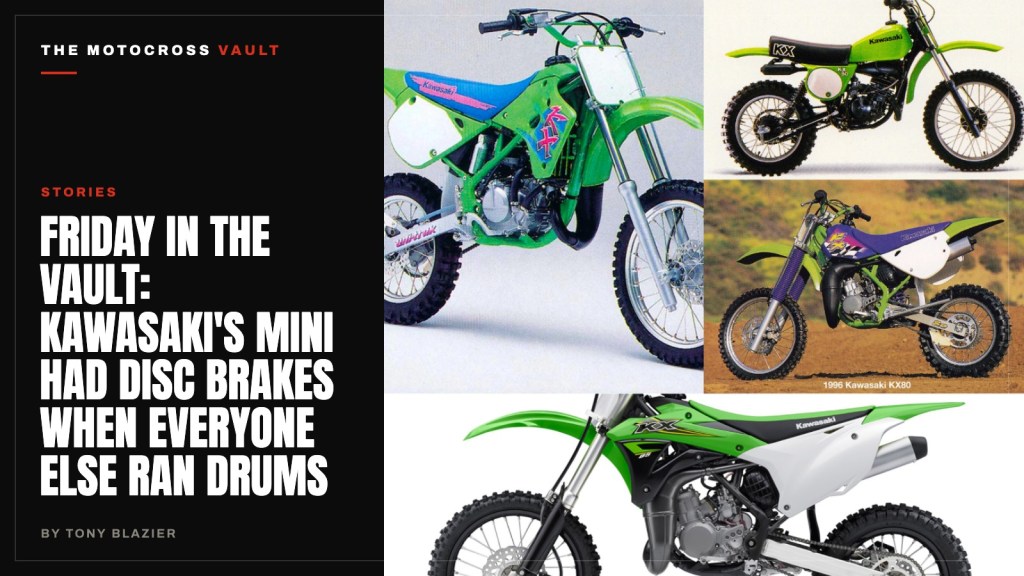
Line up the 1984 80cc minis on a starting gate and only one of them had a disc brake up front. It was green. Kawasaki was a little late to the mini party, but by the early ’80s Team Green had turned the KX80 into the bike to beat.
The disc brake nobody else had
The first KX80 showed up in 1979 as an air-cooled two-stroke. The all-new 1983 model added liquid cooling, long-travel suspension and new styling, and it dominated the mini class. Then for 1984 Kawasaki bolted on a front disc brake while every one of its 80cc rivals was still running drums at both ends. That same year brought 33mm Kayaba air forks with 10 inches of travel, a 29mm Mikuni oval-slide carb and a blue seat. The rear disc followed in 1988.
Why it mattered
In my 1984 KX80 review, the KX had the strongest low end and midrange in the class and only gave up top end to the RM80. The weak spot was the suspension: stock, it was soft at both ends, and all three rivals rated better there. Didn’t matter. The motor alone carried Kawasaki to the end of a three-year run of mini dominance in 1984.
The all-new 1986 KX80 flipped the script, with a much better chassis but power that came in high and was harder to use, and most riders picked the Honda CR80R that year. Kawasaki kept innovating anyway, pushing the big-wheel idea with the KX80 Big Wheel in 1987 and then the KX100, which became a Supermini favorite. The list of riders who started on Team Green minis reads like a who’s who of professional motocross.
If you’re buying one today
- Hard parts first, colors second. Minis get swapped, rebuilt and re-plasticked more than any other bikes.
- 1983 is the first KX80 with radiators and shrouds, but it still has a drum front brake and a black seat.
- 1984–1985: blue seat and a front disc with a rear drum, plus the early “dog bone” Uni-Trak and a steel swingarm painted silver.
- 1986–1987: alloy swingarm and a remote-reservoir shock. 1988 and later have discs at both ends, with inverted forks from 1992.
- On the early liquid-cooled bikes, listen for popping at the top end. Air leaks were a known Kawasaki issue back then, so check the intake and the crank seals.
- Ask when the top end was last done, and look for crash damage to the frame and pipe. These bikes almost always had a hard life with a kid on board.
Every model year from 1979 on is in the full story: Kawasaki KX80, KX85 and KX100 Mini-Class History, 1979–2017. Or watch my 1984 KX80 review:
Thinking about buying one? Send me the listing first: https://themotocrossvault.com/bike-check/
Ask me anything inside The Vault: https://themotocrossvault.com/the-vault/