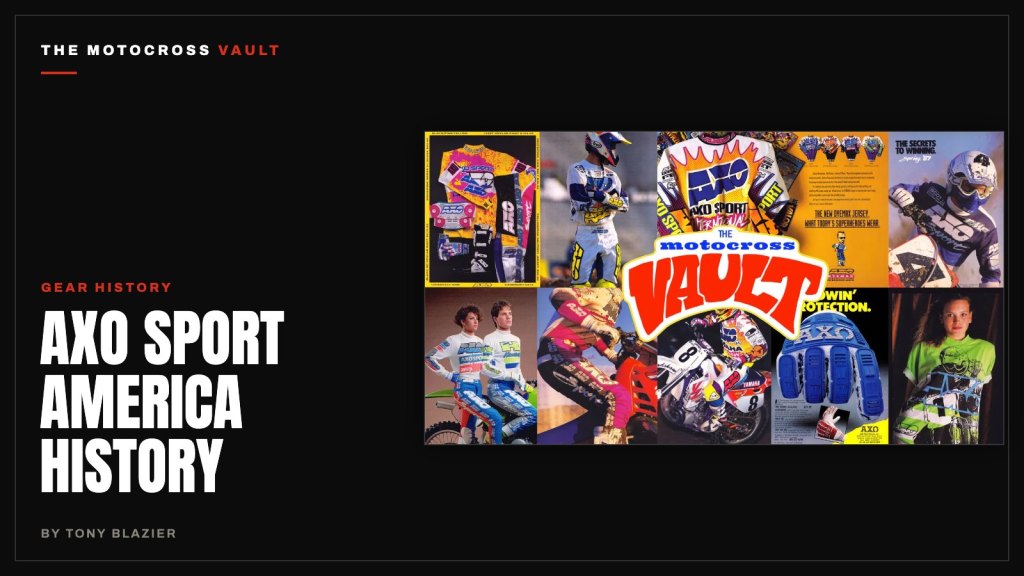
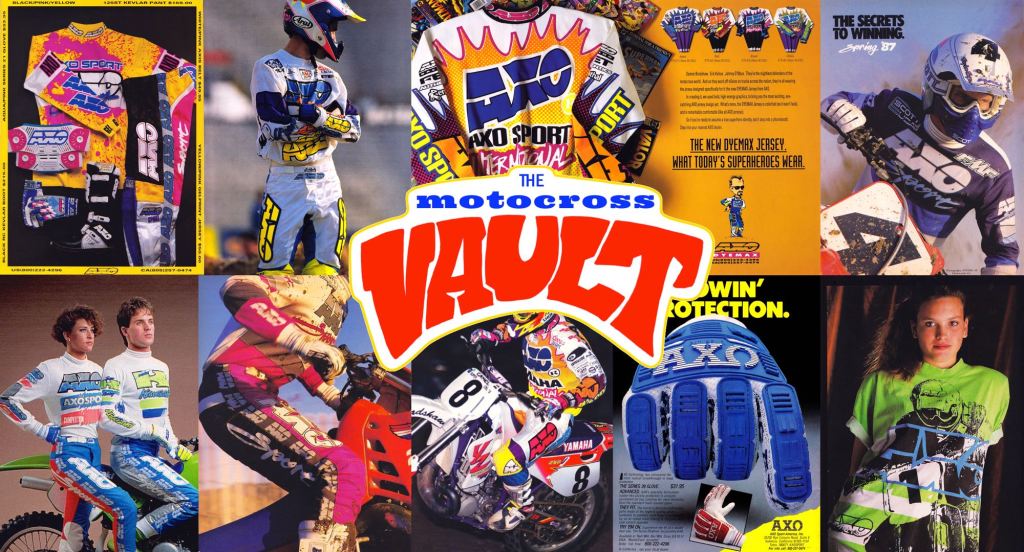
AXO Sport America was the U.S. arm of the Italian boot maker AXO, started by former pro racer Jim Hale in 1984 and run by him until he sold out in 1998. In those years AXO went from a boot company to one of the hottest gear brands in motocross, with the Super Belt, the Turbo boots, the Pentagon chest protector, the gel-print jersey and riders like Jeff Ward, Damon Bradshaw and Jeff Stanton. Below you’ll find my video history, a year-by-year table, how to date old AXO gear, and a short FAQ.
This is my look back at Jim Hale’s AXO Sports America. AXO was one of the most influential gear companies of the late eighties and early nineties. From the time of their inception in 1984 through their sale in 1998 they were one of the most high-profile brands in the industry. This is a look back at the brand through its amazing products in this era.
Moto Gear History: AXO Sport in the 1980s
Moto Gear History: AXO Sport in the 1990s
How AXO started: Italian boots and Jim Hale
AXO began in Italy in the late 1970s as a boot company. Its founder, Remo Berlese, first called it Easy Rider, then changed the name to AXO, taken from the Italian word “asso,” meaning ace. His idea was a boot that mixed the comfort of leather with the protection of plastic. At first AXO didn’t sell under its own name in the U.S. Fox and O’Neal sold the boots, and you can even find early ads for a Fox-branded version. The first real hit was the 1982 Malherbe boot, named for 500cc world champion André Malherbe, with Velcro closures and a quick-lace system.
Jim Hale was a former pro racer who had worked his way up at O’Neal. In 1983 he tried to start his own gear business with Yoko of Finland, and when that fell through, Berlese offered him the U.S. rights to AXO. AXO Sport America was formed in 1984, and Hale turned a boot brand into a full line of gear.
AXO Sport America year-by-year at a glance
| Year | Key products and riders |
|---|---|
| 1984 | AXO Sport America formed. The Super Belt, a kidney belt with an injection-molded plastic back, is the brand’s first big hit. |
| 1985 | Rinaldi boot replaces the Malherbe: lighter “Fibrelyte” construction, about two pounds lighter. Series 29 glove with a hard plastic back. |
| 1986 | Turbo 139 boot (the name was the price) and the vented A.I.R. boot. Bolder colors and the new italic “Super AXO” logo on the jerseys. |
| 1987 | Shiny Series 135 pants, the new logo finally on the pants, SC-2 chest protector, Series 40 glove. |
| 1988 | 1987 Supercross champion Jeff Ward signs for boots and belt. Turbo Plus boot and Super Belt 2. |
| 1989 | Pinstriped 125 ST pants. The Series 36 glove replaces the Series 29. AXO and Answer both make Honda’s TX-10 team gear. |
| 1990 | Turbo RC boot and the Pentagon chest protector. Kevlar knee panels on the 125 ST. Erik Kehoe “Earthquake” limited edition. |
| 1991 | Damon Bradshaw leaves Fox for AXO. Gel-print jersey, the first all-over-print jersey in motocross. Foam-backed Series 21 glove. AXO starts dressing Mitch Payton’s Peak/Pro Circuit Honda team. |
| 1992 | Bradshaw and Jeff Stanton, who wins the Supercross and outdoor titles. RX2 Kevlar helmet, AXO’s first. RC2 boot, Aquator jersey, Series 131 pants. |
| 1993 | Dyemax jersey replaces the gel print. Padlock glove. Bradshaw retires at the end of the season. |
| 1994 | Wild, cartoon-style graphics and Team Issue gear. Stanton’s last season. |
| 1995 | 909 pants and RC3 boot. Bradshaw comes back mid-season on a factory Yamaha in AXO. |
| 1996 | Yamaha goes to Fox, so Bradshaw can’t wear AXO. Damon Huffman leads the team. Hale sells half the company to Bruno Zago. |
| 1997 | New stylized “A” logo. Bradshaw returns on the Hale-backed Manchester Honda. Rookie Ricky Carmichael wins in AXO with Pro Circuit. |
| 1998 | Hale sells his remaining half to Zago and focuses on Mechanix Wear. Bradshaw retires again. |
| 1999 | AXO and Pro Circuit split after eight years, and AXO has no big-name riders left in the U.S. |
How to date vintage AXO gear
If you’re buying old AXO stuff, or trying to figure out what you’ve got in the garage, the logo and the materials tell you a lot:
- Plain block logo: the early gear, through 1986 on pants. Pretty plain styling.
- Italic “Super AXO” logo: on jerseys from 1986 and on pants from 1987 on.
- Hard plastic glove backs: Series 29 (1985–1988) and Series 36 (1989–1990). Foam backs start with the Series 21 in 1991.
- Velcro boots vs. buckles: the ’80s Turbo boots use Velcro uppers. The 1990 Turbo RC switched to buckles with ratchet levers on top, and the 1992 RC2 went to four full lever-lock buckles.
- Umlauts over the O’s: the 1990 jerseys put dots over the O’s in the logo, and I only remember it for that one year.
- Gel prints: the thick, shiny all-over print jerseys arrived in 1991. In 1993 the Dyemax jersey took over the main line.
- Single stylized “A”: the new logo from 1997 on, after the brand’s best years.
Why AXO mattered
From about 1987 to 1997, AXO was right up there with Fox Racing for style, design and star power. The plastic kidney belt and plastic-backed gloves started trends that other brands copied, and the gel print made everyone else’s jerseys look dull. I wore a lot of this stuff. I had the Series 29 gloves, a pair of Turbo RCs and the RC2s, which I still have in the garage. For my money, the 1992 line is the best year of gear any company ever made. Those gel prints were basically sweatshirts and didn’t breathe at all, but they looked fantastic.
Things slipped once Hale started selling the company in 1996. The designs got more subdued, the riders moved on, and after he was gone AXO faded fast in the U.S. Hale moved on to Mechanix Wear, and he passed away in 2018. When it shined, though, AXO shined brighter than just about anybody.
AXO FAQ
Who founded AXO?
AXO was founded in Italy in the late 1970s by Remo Berlese as a boot company. Jim Hale started AXO Sport America, the U.S. company that built AXO into a full gear brand, in 1984.
What does AXO mean?
It comes from the Italian word “asso,” meaning ace or winner, respelled AXO for the international market. Lots of us read it in magazines as letters, A-X-O, for years before we heard anyone say it out loud.
Which famous riders wore AXO?
Jeff Ward (boots and belt from 1988), Damon Bradshaw (1991–1993, 1995 and 1997), Jeff Stanton, Erik Kehoe, Damon Huffman, and the Pro Circuit riders including Jeremy McGrath, Ryan Hughes and a rookie Ricky Carmichael.
When did Jim Hale sell AXO?
He sold half of the company to Bruno Zago in 1996 and the other half in 1998, then focused on Mechanix Wear.
More motocross gear history in The Vault
- Fox Racing gear history, 1974–2000
- O’Neal USA in the 1980s, where Jim Hale got his start, and O’Neal in the 1990s
- 1986 JT Racing gear catalog
- 1992 Sinisalo gear catalog
- See the old gear and bike ads on the Ad Wall, or find the bikes these guys rode in the Bike Finder.