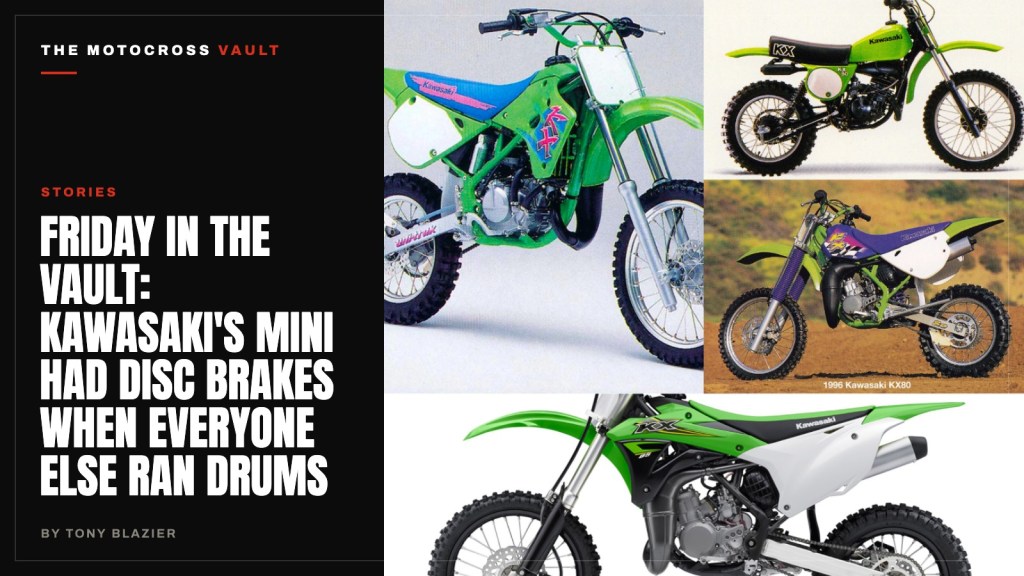
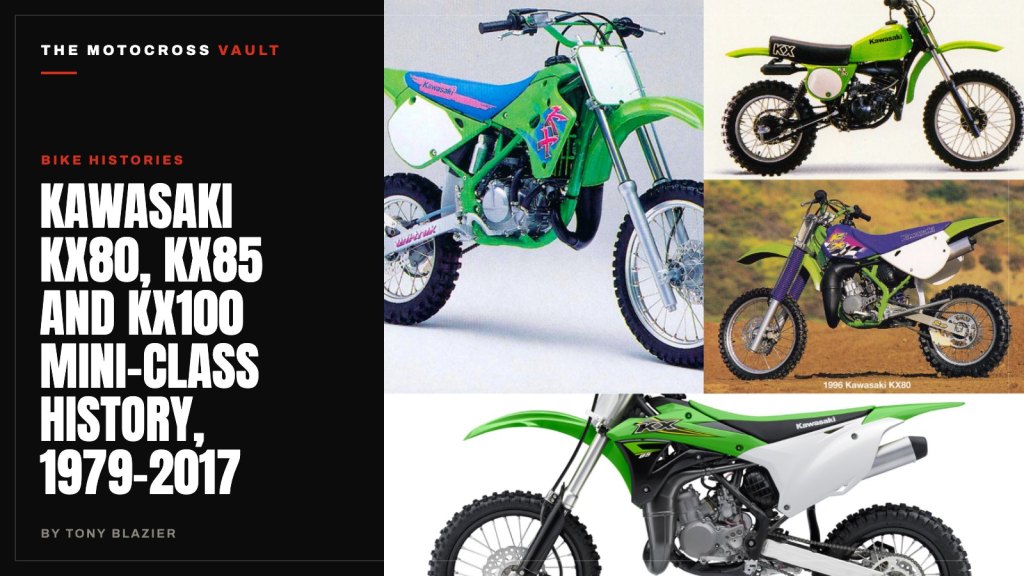
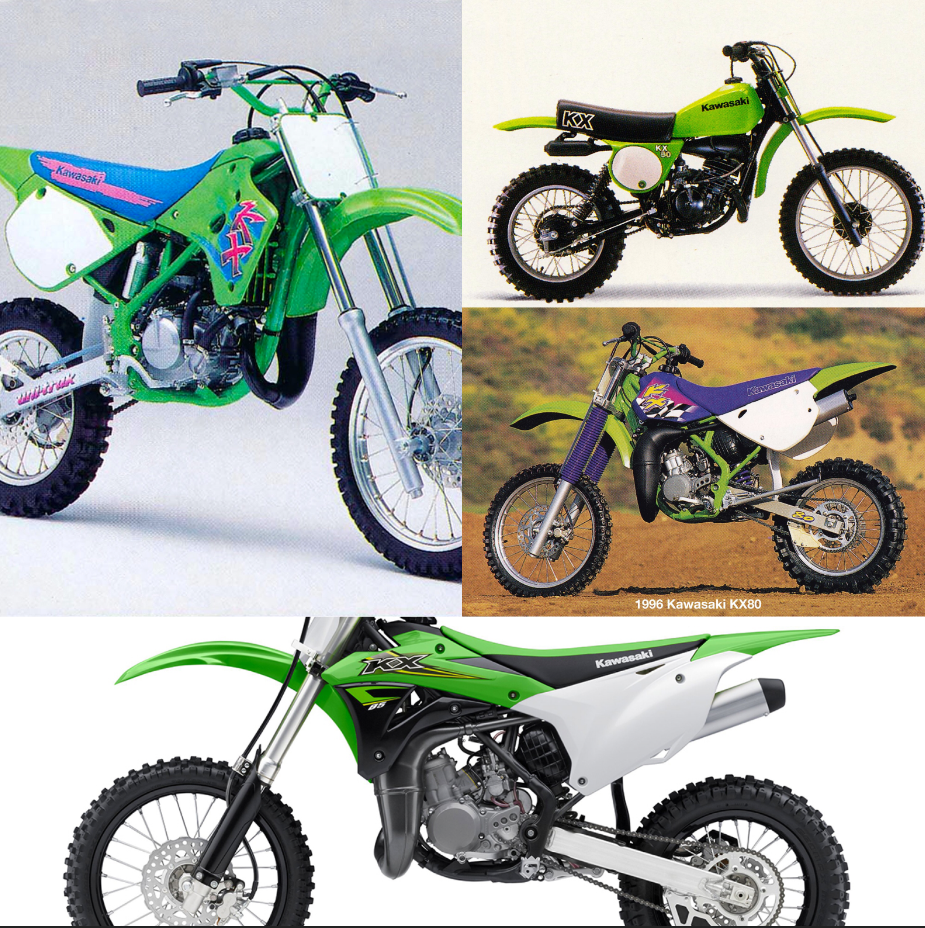
The Kawasaki KX80 was Team Green’s 80cc two-stroke mini motocross racer, built from 1979 until the KX85 replaced it for 2001, with the KX80 Big Wheel and later the KX100 covering the bigger kids. It’s the bike that first made Kawasaki a winner at the grassroots level: it went liquid-cooled in 1983, and in 1984 it got a front disc brake while all of its 80cc rivals were still on drums. Below you’ll find every model year in the PDF, a year-by-year summary, how to tell the years apart, and answers to the questions I get most about these little green rockets.
Here is another in my series on motocross bike history. This installment covers Kawasaki’s mini class racers from the first KX80 in 1979 through the current KX85 and KX100 models. While slightly late to the mini party, Kawasaki quickly asserted itself as a mini-class power in the early 1980s. Their KX80 and KX60 mini racers have powered countless riders to amateur national titles and the roster of riders that started on Team Green reads like a who’s who of professional motocross.Shopping for a Kawasaki KX80, KX85 or KX100? Send Tony the listing before you buy. He checks the year, the parts and the price within 48 hours. Bike Check from $29 →
They were the first manufacturer to add features like a disc brake (front in 1984, and rear in 1988) to their minis and the first brand to embrace the move toward larger “big-wheeled” versions of their 80s. Today, they continue to innovate and support the mini class with new models that can go toe-to-toe with the best from Austria and Japan. For this post, I have once again placed all the models in chronological order and labeled them by model and year. I have tried to be as thorough as possible, but sometimes it can get a bit confusing in the mini class. Because manufacturers often end up with leftover mini inventory, they tend to skip a year here and there to help dealers move it all out. Still, I think this is pretty complete and comprehensive. Once again, I have included the YouTube presentation I produced a few years ago as well if you prefer your minis to roll on by without your assistance. This one was done back in 2015, so a few of the latest models are not included. I hope everyone enjoys this look at Kawasaki mini-history. Blaze out. Kawasaki KX80, KX85 and KX100 models 1979-2018Kawasaki KX80, KX85 and KX100 year-by-year at a glance
Here are the big changes, from the brochures in the PDF and the magazine tests of the day. Years not listed were mostly graphics and small updates.
| Year | Key change |
|---|---|
| 1979 | First KX80 (KX80-A1), an air-cooled two-stroke mini |
| 1981 | Uni-Trak single-shock rear suspension (it’s printed right on the swingarm) |
| 1983 | All-new KX80: liquid cooling, long-travel suspension and new styling. It dominated the mini class. |
| 1984 | Front disc brake, blue seat, new 33mm Kayaba air forks (10 in. of travel), 29mm Mikuni oval-slide carb, alloy silencer. 82cc, 48.0 x 45.8mm. |
| 1986 | All-new chassis: bottom-link Uni-Trak, alloy swingarm, remote-reservoir Kayaba shock with nearly 11 in. of travel, 35mm forks with 10.8 in., removable subframe, four-petal reeds, gear-driven water pump |
| 1987 | KX80 Big Wheel joins the lineup for taller riders |
| 1988 | Rear disc brake |
| 1992 | Inverted forks |
| 1995 | KX100 appears in the lineup, taking over the big-wheel spot |
| 1998 | Redesigned KX80/KX100 engine with a two-way power valve, stronger clutch, two-piece clutch cover and fully adjustable 36mm inverted forks. The KX100 got a longer frame for its bigger wheels. |
| 2001 | The KX80 becomes the KX85 |
| 2014 | Updated KX85 and KX100: new head, piston and power valve (about 20% more peak power on the KX85), petal rotors, new bodywork and six handlebar positions |
How to identify the year of a Kawasaki KX80, KX85 or KX100
Minis get swapped, rebuilt and re-plasticked more than any other bikes, so check the hard parts first and the colors second.
- 1979–1982: Air-cooled, so no radiators. From 1981 the swingarm says Uni-Trak.
- 1983: The first KX80 with radiators and shrouds. It still has a drum front brake and a black seat.
- 1984–1985: Blue seat and a front disc, with a drum at the rear. The rear linkage is the early “dog bone” Uni-Trak with a steel swingarm painted silver.
- 1986–1987: Alloy swingarm and a remote-reservoir shock, the KX logo moved to the top of the seat, and side panels without the old handholds.
- 1988 and later: A disc brake at both ends.
- 1990s: The loud pink, purple and blue graphics, with inverted forks from 1992.
- 2001 and later: Called the KX85. Bikes from 2014 on have a flatter two-tone seat, white rear fender, brushed aluminum swingarm and wrap-around fork guards.
A big-wheel KX80 or KX100 is easy to spot next to a standard KX80 or KX85: the frame and wheels are taller. The KX100 runs a 19-inch front and 16-inch rear, while the 85 class usually uses 17 and 14 inches.
How the KX80 stacked up against the CR80, YZ80 and RM80
In the early ’80s the KX80 had the motor. In my 1984 KX80 review, the KX had the strongest low end and midrange in the class and only gave up top end to the RM80. The weak spot was the suspension. Stock, it was soft at both ends, and all three of its rivals rated better for suspension and handling. Still, the motor alone was enough for Kawasaki to finish a three-year run of mini dominance in 1984.
The all-new 1986 KX80 flipped that around. It had a much better chassis, but the power came in high and was harder to use, and most riders picked the Honda CR80R that year. The 1986 KX80 review covers that bike in detail. From there, Kawasaki kept pushing the big-wheel idea, first with the KX80 Big Wheel and then with the KX100, which became a Supermini favorite.
Buying a vintage Kawasaki KX80 or KX85 today
Start with the year checks above. The disc brakes, swingarm and fork style tell you a lot about which frame and engine you’re really looking at. On the early liquid-cooled bikes, listen for popping at the top end. Air leaks were a known Kawasaki issue back then, so check the intake and the crank seals. On any two-stroke mini, ask when the top end was last done and look for crash damage to the frame and pipe, because these bikes almost always had a hard life with a kid on board. If you’re not sure, send me the listing through Bike Check before you hand over the cash.
Kawasaki KX80, KX85 and KX100 FAQ
What year did the Kawasaki KX80 get a disc brake?
The front disc came in 1984, when every other 80 still used drums at both ends. The rear disc followed in 1988.
When did the KX80 become liquid cooled?
In 1983. That all-new KX80 had liquid cooling, long-travel suspension and the sharpest styling in the KX line.
What year did the KX80 become the KX85?
For 2001. The 2000 KX80 was the last one.
What is the difference between the KX85 and the KX100?
They share most of their parts. The KX100 has a bigger bore (52.5mm vs. 48.5mm, same 45.8mm stroke) for 99cc instead of 85cc, plus bigger wheels and a taller frame. On the 2014 models the seat heights were 34.3 inches for the KX100 and 32.7 inches for the KX85.
More mini motocross history in the Vault
- Honda CR80R and CR85R history 1980–2007
- Yamaha YZ80 and YZ85 history 1974–2019
- Suzuki RM80 and RM85 history 1977–2019
- 1987 80 Class Motocross Shootout
- 1997 Kawasaki KX brochure (KX60, KX80, KX100)
- Find any bike by year in the Bike Finder, or browse old Kawasaki ads on the Ad Wall.