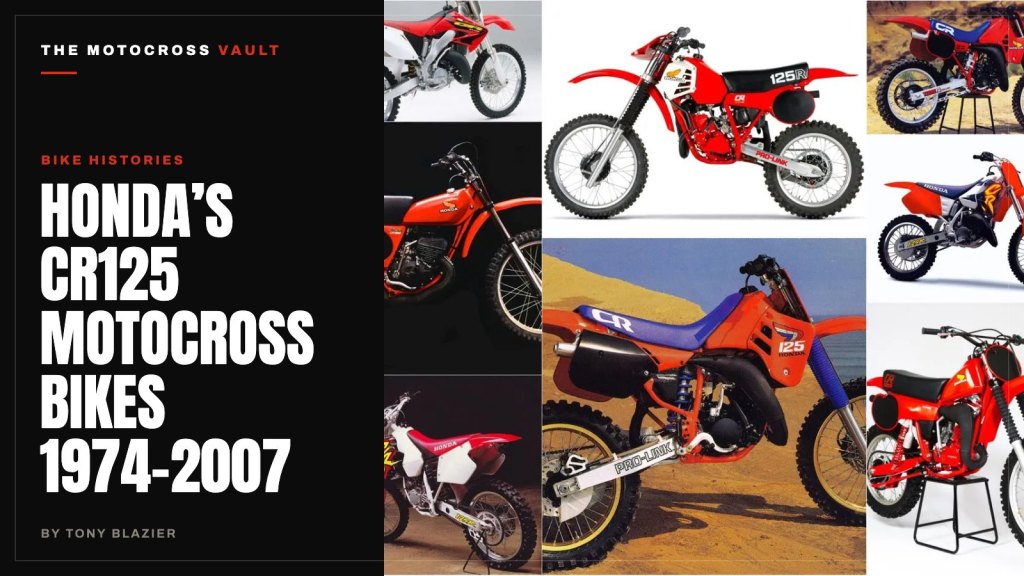

The Honda CR125R was Honda’s 125cc two-stroke motocross racer, built from the first CR125M Elsinore in 1974 until the last CR125R in 2007. From the mid-1980s through 1997 it was the horsepower king of the 125 class, and it won Supercross and National titles along the way. The big milestones were liquid cooling and Pro-Link in 1981, the case-reed motor and rear disc in 1987, inverted forks in 1990, the aluminum frame in 1998 and the RC power valve in 2000.
Shopping for a Honda CR125? Send Tony the listing before you buy. He checks the year, the parts and the price within 48 hours. Bike Check from $29 →
These are Honda’s 125 motocross machines from 1974 until the model was discontinued in 2007. This PDF and video cover the CR125M Elsinores and later CR125R two-stroke models. Honda CR125 motocross bikes 1974-2007Honda CR125 and CR125R year-by-year at a glance
Here are the changes that mattered, pulled from the brochures in the PDF, the magazine tests of the day and my own Classic Steel research. Years not listed were mostly graphics and small updates.
| Year | Key change |
|---|---|
| 1974 | First CR125M Elsinore. It caught the competition flat-footed and dominated small-bore racing. |
| 1975–1978 | Mild refreshes while Yamaha, Suzuki and Kawasaki caught up and passed it. |
| 1979 | All-new CR125R Elsinore: up pipe, 11 inches of non-adjustable Showa travel, a 23-inch front wheel and “Claw Action” tires. |
| 1980 | New dual-downtube frame, center-port exhaust, air-adjustable forks, remote-reservoir shocks, a plastic tank, and back to a 21-inch front. |
| 1981 | Liquid cooling and Honda’s first Pro-Link single-shock rear end, with an all-new frame, motor and bodywork. |
| 1983 | The best Honda 125 in a decade, with solid handling and good suspension. |
| 1984 | ATAC exhaust sub-chamber added to boost low end. |
| 1985 | New motor with a revised bore and stroke (ATAC kept). |
| 1987 | Case-reed motor replaced the piston-port design used since 1974. Cartridge forks, a rear disc brake, a new Kayaba shock and new bodywork. |
| 1988 | Deeper red plastic and a natural-finish cylinder. |
| 1989 | New bodywork styled after the 1988 CR250R. Last year of conventional forks. |
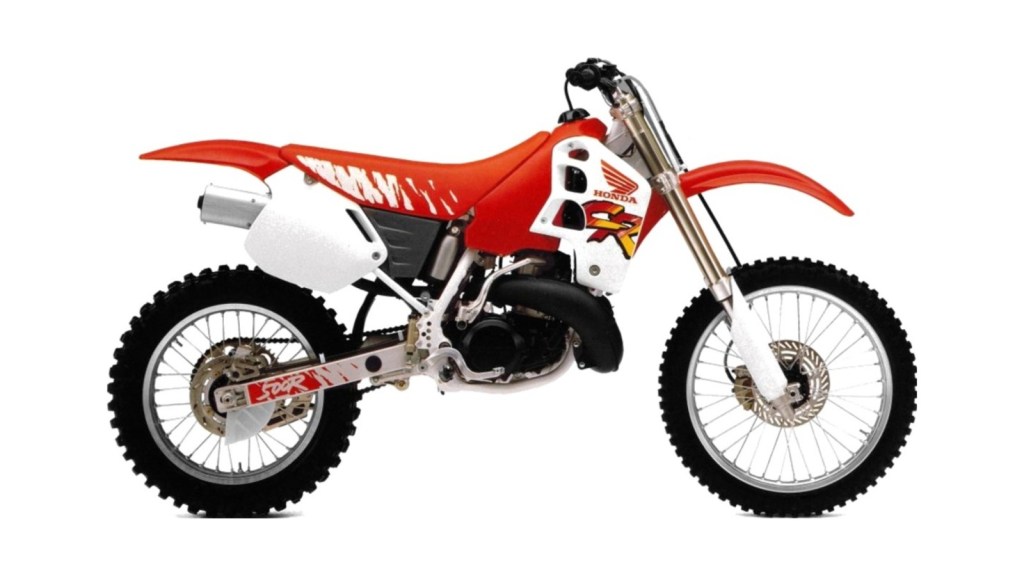
| 1990 | All-new motor with the HPP power valve in place of ATAC, and the first inverted Showa forks on the 125. Orange-red with a white frame. |
| 1992 | “Nuclear Red” plastic, white tank, silver motor and new 43mm Showa forks. |
| 1993 | All-new frame and bodywork, compression down from 9.9:1 to 8.8:1, 12.2 inches of fork travel and 12.6 rear. |
| 1994 | Kayaba forks, more frame gusseting and a longer, stronger swingarm. |
| 1995 | Purple “Uranus Violet” trim and a 19-inch rear wheel. |
| 1996 | Red and black, digital ignition, new porting and a lighter piston. |
| 1997 | 46mm Kayaba forks and a stronger third gear. Last steel-framed CR125R. |
| 1998 | First aluminum twin-spar frame. Redesigned motor, and the six-speed became a five-speed. |
| 2000 | Second-generation aluminum frame with a single downtube, the rotary-flap RC power valve in place of HPP, and a Mikuni carb. |
| 2002 | Third-generation aluminum frame, new bodywork, a Mikuni TMX-x carb and a claimed 11 pounds lighter. |
| 2005 | Six-petal reed, new cylinder, head and crank, thicker radiators and a new swingarm with a cast aluminum cross member. |
| 2007 | Last year of the CR125R. |
How to identify your Honda CR125R’s year
- Air-cooled with dual shocks: 1974–1980. A 23-inch front wheel means 1979.
- Liquid-cooled with Pro-Link and a rear drum: 1981–1986. An ATAC chamber on the pipe means 1984 or later.
- Rear disc with conventional forks: 1987–1989. Deep red plastic with an unpainted cylinder points to 1988.
- Inverted forks in a steel frame: 1990–1997. A white frame is a 1990, tiger-stripe graphics are a 1991, pinkish Nuclear Red with a white tank is a 1992, purple is a 1995, and red and black is a 1996 or 1997.
- Aluminum frame: 1998–2007. Double downtubes are a 1998–1999, a single downtube with the older wide spars is a 2000–2001, and the slimmer third-generation frame is 2002–2007.
Always confirm with the frame and engine numbers, because a lot of these bikes have swapped plastic over the years.
2005–2007 Honda CR125R specs at a glance
| Engine | 125cc liquid-cooled two-stroke single, case reed, RC power valve |
| Bore x stroke | 54 x 54.5mm |
| Compression | 8.6:1 |
| Carburetor | 38mm Mikuni TMX with throttle position sensor |
| Transmission | Five-speed |
| Suspension | 46mm inverted Kayaba cartridge fork, 12.0 in. travel; Pro-Link Kayaba shock, 12.5 in. travel |
| Dry weight | 197 lb. (claimed, 2007) |
| Original MSRP | $5,499 (2007) |
The Honda CR125R story in a nutshell
From 1986 through 1997, if you wanted the most horsepower in the 125 class, you rode red. The CRs hit like a ton of bricks and pulled forever on top. They weren’t always the easiest to ride, and the suspension was often harsh, but the motor was nearly unbeatable in the right hands. Jeremy McGrath won the 1992 125 West Coast Supercross title on one, and Doug Henry took the 125 East Coast Supercross title and the 125 National title on the all-new 1993 model.
Things changed in 1996 when Yamaha’s new YZ125 showed up with broad, easy power. Then the first aluminum CR125R in 1998 lost the high-rpm power that had defined Honda’s 125s for a decade. Honda kept refining it, and the 2002 bike was light, beautifully built and had the best suspension ever on a red machine, but it was still down on power to the Yamaha and KTM. Travis Preston proved it could still win when he took the 2002 125 West Coast Supercross title.
If you’re buying one today, decide what you want it for. The 1990–1997 steel-framed bikes are the fast ones, but the HPP power valve is a pain to service, so ask when it was last cleaned. The 1992 flat-top piston was fragile, and many riders went back to a domed piston. The 2002–2007 bikes are the most comfortable and best suspended. On any CR, ask when the top end was last done, check for crash damage to the frame and pipe, and send me the listing through Bike Check if you want a second opinion.
Honda CR125R FAQ
What year did the Honda CR125R become liquid cooled?
1981. That was also the first year of the Pro-Link single-shock rear suspension.
When did the CR125R get an aluminum frame?
For 1998, one year after the CR250R. The 1997 was the last steel-framed CR125R.
What was the last year of the Honda CR125R?
2007 was the final model year. The CR125R ran from the first 1974 Elsinore to 2007, a 34-year run.
Which Honda CR125R is the fastest?
For raw top-end power, the steel-framed bikes from the late 1980s through 1997 are the ones people remember. The 1998 and 1999 aluminum bikes were the slowest of the modern CRs.
More Honda CR125R history in the Vault
- 1979 Honda CR125R Elsinore review
- 1993 Honda CR125R review
- 2002 Honda CR125R review
- 1986 Honda CR125R, CR250R and CR500R brochure
- Honda CR250 history 1973–2007
- Find any bike by year in the Bike Finder, or browse old Honda ads on the Ad Wall.