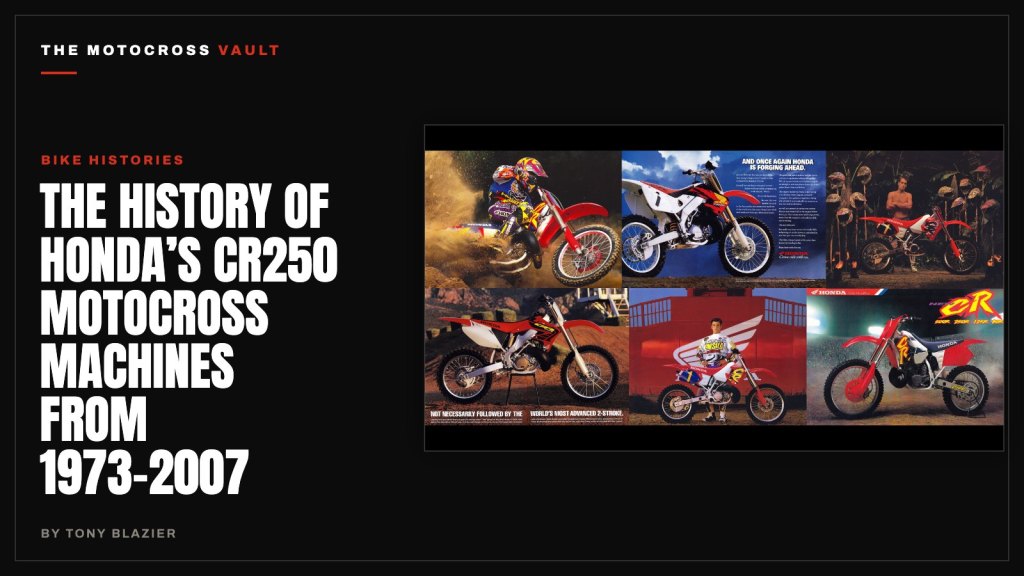
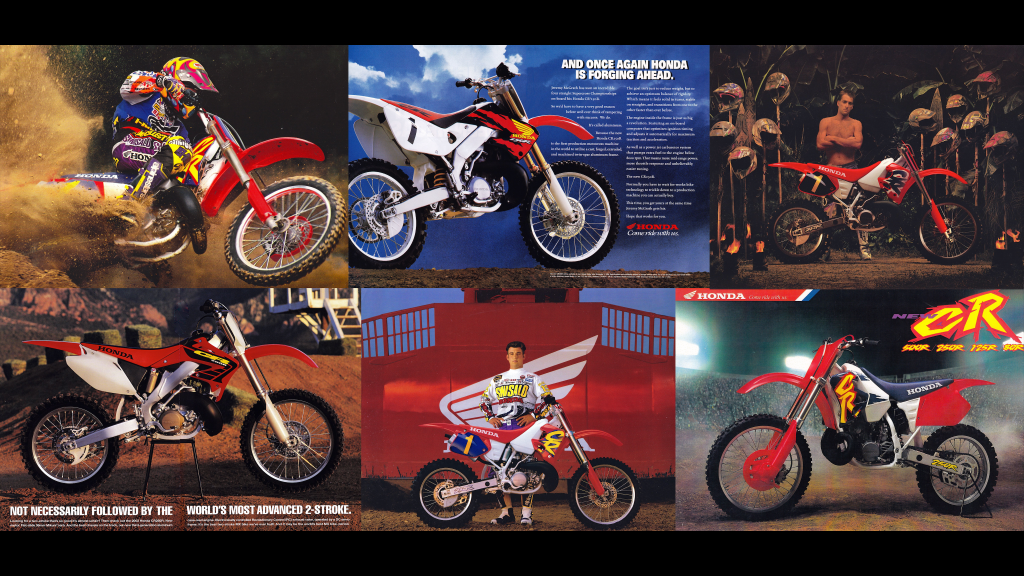
The Honda CR250 was Honda’s 250cc two-stroke motocrosser, built from the 1973 CR250M Elsinore through the final 2007 CR250R. It won the AMA 250 National title in its very first year with Gary Jones, introduced Pro-Link, liquid cooling and an aluminum frame to the class along the way, and it’s still one of the most collected motocross bikes out there. Below you’ll find my two-part video history, a year-by-year table, how to tell the years apart, and what to check before you buy one.
Here is my two-part series covering the history of Honda’s iconic CR250 Motocrossers. Part 1 covers 1973-1989 and part 2 covers 1990-2007.
Trying to figure out what year your CR250R is? Start with my guide: What Year Is My Honda CR250R? How to Identify Every Year.
Wondering what one is worth? See Honda CR250R Value: What a Classic CR250R Is Worth Today.
Honda CR250R year-by-year at a glance
Here’s the short version of what Honda changed each year. These are the big changes I cover in the two videos above. The small stuff (jetting, valving, graphics tweaks) is left out unless it helps you tell one year from another.
| Year | Key change |
|---|---|
| 1973 | CR250M Elsinore debuts: 248cc piston-port two-stroke, five-speed, race-ready from the crate. Gary Jones wins the AMA 250 National title on one. |
| 1974 | Carried over with no real changes. |
| 1975 | CR250M1: shocks moved forward for about an inch more travel, new “up” pipe, red accents and white plastic fenders replace the green trim and silver fenders. |
| 1976 | New red bodywork and red frame styled after the works bikes; only minor engine changes. |
| 1977 | No new CR250. Dealers were still selling leftover ’76s. |
| 1978 | All-new CR250R Elsinore “works replica”: magnesium cases painted red, first Honda reed valve, chrome bore, 37mm Showa forks, nearly a foot of travel, aluminum tank. |
| 1979 | Refinements: new porting and reed valve, revised fork and shock valving. |
| 1980 | New frame with a split front downtube, center-port exhaust, plastic tank, remote-reservoir shocks and rear-mounted side number plates. |
| 1981 | Total redesign: first liquid-cooled CR250R and first with Pro-Link single-shock rear suspension. |
| 1982 | New chassis and bodywork, 43mm forks (up from 41mm), new Pro-Link shock, lower radiators. |
| 1983 | All-new again: works-style orange-red with a blue seat, fully removable rear subframe. Still a front drum brake. |
| 1984 | Redesigned engine with the ATAC exhaust valve, first front disc brake on a CR250R. |
| 1985 | Clean-sheet bodywork plus reliability fixes (metal main-bearing cages, bridged exhaust port). Last year for ATAC and damper-rod forks on the 250. |
| 1986 | Honda Power Port (HPP) exhaust valve and cartridge forks. |
| 1987 | New chassis and Pro-Link, first rear disc brake, piggyback shock, two-piece clutch cover. |
| 1988 | All-new ultra-slim low-boy layout and new rear linkage, blood-red plastic, unpainted cylinder. |
| 1989 | First inverted Showa forks, revised porting and gearing, new steering geometry. |
| 1990 | New frame (painted white), bodywork and suspension; HPP engine carried over. |
| 1991 | Least-changed year in a decade: Kayaba shock replaces the Showa, new tiger-stripe graphics. |
| 1992 | Clean-sheet bike: the CRV power valve replaces HPP, new chassis, 43mm forks, fluorescent red plastic. |
| 1993 | Airbox about 20% larger, beefed-up frame, bigger shock shaft (14mm to 16mm). |
| 1994 | Revised geometry: 12mm longer wheelbase, 10mm longer swingarm, engine and steering head moved. Bigger silencer. |
| 1995 | Purple graphics, new side panels, wider footpegs, first 19-inch rear wheel. |
| 1996 | Last steel frame. Forks grow from 43mm to 46mm. |
| 1997 | First aluminum twin-spar frame; Keihin carb with the electronic Power Jet circuit. |
| 1998 | Longer shock and new linkage (rear travel from 12.6 to 12.9 inches), geometry tweaks. |
| 1999 | New cylinder, head, power valve and reed valve; Power Jet dropped. |
| 2000 | Second-generation aluminum frame with a single downtube and dual radiators, Keihin PWK carb, new bodywork. |
| 2001 | Mikuni TMX carb, new porting, ignition, reed valve and pipe, stiffer springs. |
| 2002 | Third-generation aluminum frame and an all-new engine with case-reed induction and a new RC power valve. |
| 2003 | New 8-petal reed valve, porting and pipe; revised frame and swingarm pivot. |
| 2004 | New reed valve, slight porting changes, minor suspension updates. |
| 2005 | New cylinder and head, revised RC valve, new pipe and shift parts. |
| 2006 | No changes. |
| 2007 | Final year of the CR250R, with new graphics. |
Identify the year: how to tell Honda CR250Rs apart
On 1981 and later bikes, start with the frame number on the steering head: the 10th character is the model year. I lay out the full code table in What Year Is My Honda CR250R? After that, these are the quick tells I look for:
- Cooling and shocks: air-cooled with twin shocks means 1980 or earlier. Water-cooled with a single shock means 1981 or later.
- Brakes: a front drum means 1983 or earlier. A rear drum means 1986 or earlier.
- Forks: conventional forks mean 1988 or earlier. Upside-down forks arrived in 1989.
- Frame: steel through 1996, aluminum from 1997. A white frame is a 1990-style tell.
- Carburetor: a Mikuni TMX means 2001 or later. A Mikuni on a 2000 frame number tells you the carb has been swapped.
- Colors: 1973–74 have green trim and silver fenders, 1975 has red accents with white fenders, and 1976 has a red frame. The ’83–’84 bikes wear an orange-red with a blue seat. 1988 is a deep blood red, 1991 has the tiger stripes, and 1992 is a fluorescent red that fades to salmon (reproduction plastic is the ’93 shade). 1995 is the purple year, and 1996 has white side panels.
Buying a used Honda CR250R today
My first real motocross bike was a 1978 CR250R. It was a rocket and, honestly, a handful for me. Since then I’ve owned a 1990 and a 1996, among plenty of other CRs. The engines and gearboxes have been good to me, but every era has its weak spots. Here are the ones I’d check first:
- 1973–1980: Stock shocks fade, and the steel swingarms flex. The first Elsinores used nylon swingarm bushings that wear out quickly.
- 1981: A weak clutch and a fairly fragile transmission.
- 1984: Cracked pistons from a weak exhaust-port bridge, plus main bearing and crank failures. Honda fixed both for 1985.
- 1986–1991 (HPP): The Power Port valve works great but is a pain to service and easy to put back together wrong. On the ’86, check the magnesium water pump cover for corrosion.
- 1988: The rear linkage bolts bend if the bike was ridden hard.
- 1989–1994: Stock suspension was the CR’s weak point. A bike that has had a proper revalve is worth more to me than one that hasn’t.
- 1992: Look for a cracked swingarm.
- 1997–1999: The first aluminum frames are very stiff and vibrate a lot, so ride one before you buy.
- 2001–2007: The Mikuni carbs are finicky to jet. On the 2002, check that the power valve is adjusted and the airbox seals.
For originality, check the frame number against the parts listed above. CRs got raced hard, so swapped engines, forks and plastic are common. That matters most on collectible years like the ’73 and the ’78. My vintage dirt bike buyer’s checklist covers the rest.
Honda CR250R FAQ
What year did the Honda CR250R become water-cooled?
1981. It was also the first year for the Pro-Link single-shock rear suspension.
When did the CR250R get disc brakes?
The front disc came in 1984 and the rear disc in 1987. Earlier bikes use drums.
What was the first Honda CR250R with an aluminum frame?
The 1997. Every CR250R from 1997 to 2007 has an aluminum frame, in three generations: 1997–1999, 2000–2001 and 2002–2007. The 1996 was the last steel-framed CR250R.
When did Honda stop making the CR250R?
2007 was the last year. Honda had already moved to four-strokes, and the 2006 carried over with no changes before the CR250R got one last set of graphics for 2007.
More Honda CR history in The Vault
- 1978 Honda CR250R Elsinore brochure
- 1992 Honda CR250R Motocross Action race test
- My 1990 Honda CR250R project
- Honda CR125 history, 1974–2007
- Honda CR and CRF motocross machines, 1973–2021
- Browse every Honda in the Bike Finder, or see the old Honda ads on the Ad Wall.