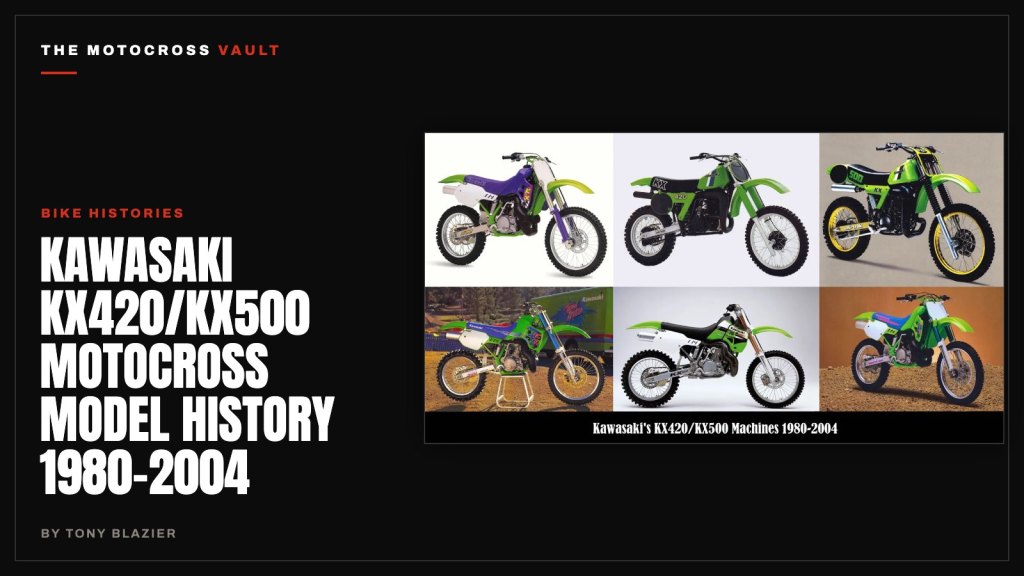
The Kawasaki KX500 was Kawasaki’s open-class two-stroke motocross bike, sold from 1983 to 2004, and it took over from the air-cooled KX420 of 1980 and 1981. It started out as one of the worst big bores ever built, but once Kawasaki got it sorted in the late 1980s it was the best Japanese 500 you could buy. It carried Jeff Ward, Mike Kiedrowski and Mike LaRocco to AMA 500cc National titles and finished its life as a legendary desert sled.
Here are Kawasaki’s Open Class motocross racers from its introduction in 1980 through its retirement in 2004.Trying to decide between a KX500 and its big rival? See my Honda CR500R vs Kawasaki KX500 comparison.
Shopping for a Kawasaki KX500? Send Tony the listing before you buy. He checks the year, the parts and the price within 48 hours. Bike Check from $29 →
Kawasaki KX420 and KX500 year-by-year at a glance
Here are the changes that mattered, pulled from the brochures in the PDF, the magazine tests of the day and the research for my video above. Years with only graphics changes are noted as such.
| Year | Key change |
|---|---|
| 1980 | All-new KX420: a 422cc air-cooled, reed-valve single in a new chassis with Kawasaki’s first Uni-Trak linkage rear suspension and about 12 inches of travel at both ends. |
| 1981 | Same look as 1980, but with an I-beam style swingarm in place of the box-section arm, extra gusseting around the steering head after 1980 frame cracking, and a lighter aluminum-body shock that was easier to adjust. Still 38mm forks. |
| 1982 | No open-class KX at all. Kawasaki dropped the KX420 and went back to the drawing board. |
| 1983 | All-new KX500: a 499cc air-cooled motor, 43mm forks, an aluminum Uni-Trak link, a front disc brake (Kawasaki was the only one in the class with one) and the rear number-plate fender. The motor was badly prone to detonation. |
| 1984 | New tank and blue seat, silver trim instead of gold, new forks and shock linkage, a flat-slide Mikuni carb, and a lower-compression dual-plug head to fight the detonation. |
| 1985 | All-new from the ground up and liquid-cooled for the first time, with a new frame, new forks and slim, conventional bodywork. |
| 1986 | KIPS power valve, making it the first production 500 motocross bike with a power valve. Rear disc brake, seat and tank moved 15mm forward, and a new shock. Last year of the original “dog bone” Uni-Trak. |
| 1987 | A one-year-only design: new frame with a removable subframe, slim new bodywork, bottom-link Uni-Trak, new pipe and porting, and a bigger front caliper. |
| 1988 | The basic design that would run to 2004: green frame, new bodywork with a 2.6-gallon tank, 43mm Kayaba cartridge forks, a new Uni-Trak, a 39mm Keihin PWK carb and a new head. |
| 1989 | Three-valve KIPS with a new cylinder, 46mm conventional forks on US bikes (Europe and Japan got 41mm inverted forks), a 19-inch rear wheel, a steeper steering angle and almost five pounds less weight. |
| 1990 | The 41mm inverted forks finally reached US bikes, with extra steering-head gusseting. Lighter blue seat and new graphics. |
| 1991 | 43mm inverted forks with blue anodized tubes, a stiffer swingarm and a new, more adjustable shock. |
| 1992 | Graphics only: a green handlebar and graphics that run into the seat. |
| 1993 | Bold new graphics. Otherwise only minor tweaks. |
| 1994 | Purple seat with green plastic. Revised calipers, front pads, rear master cylinder and brake hoses, and new fork settings. |
| 1995 | New graphics and brake pad material. |
| 1996 | The all-purple look. The 43mm fork from the 1995 KX250 with new valving, a lower handlebar and stiffer calipers. |
| 1997 | 46mm inverted fork, stronger chain, check-valve gas cap, new front hub with three bearings, steel steering stem and a green tank again. |
| 1998–2000 | No mechanical changes. Green seat, with works-replica style graphics in 1998 and new graphics each year after. |
| 2001 | Black seat and new graphics. |
| 2002 | New graphics. Last year of the green tank. |
| 2003 | Black tank, gunmetal frame (the first frame color change since 1988) and amber-gold anodized fork tubes. |
| 2004 | The final KX500. The four-stroke KX450F took over Kawasaki’s open-class slot. |
How to identify your Kawasaki KX500’s year
- KX420, 1980–1981: air-cooled with a big dog-bone Uni-Trak. A box-section swingarm points to 1980, a thinner I-beam style arm to 1981.
- Air-cooled KX500, 1983–1984: the rear number plate sits on the fender. Gold trim and swingarm is a 1983, silver trim with a blue seat is a 1984.
- Liquid-cooled with a dog-bone Uni-Trak, 1985–1986: a rear drum is a 1985, a rear disc is a 1986.
- Slim one-year bodywork with a bottom-link shock, 1987.
- Green frame with conventional forks, 1988–1989: a 1989 US bike has fat 46mm forks and a 19-inch rear wheel.
- Inverted forks, 1990–2004: a light blue seat is a 1990, blue anodized fork tubes start in 1991, a purple seat with green plastic is a 1994, an all-purple tank is a 1996, a green seat is 1998–2000, a black seat with a green tank is 2001–2002, and a black tank with a gunmetal frame is a 2003 or later.
Always confirm with the frame and engine numbers, because these bikes have been raced, swapped and re-plasticked for decades.
2004 Kawasaki KX500 specs at a glance
| Engine | 499cc liquid-cooled two-stroke single, reed valve, KIPS power valve |
| Bore x stroke | 86 x 86mm |
| Compression | 8.3:1 (low speed) / 7.4:1 (high speed) |
| Carburetor | Keihin PWK39 |
| Transmission | Five-speed |
| Suspension | 46mm inverted cartridge fork, 12.2 in. travel; Uni-Trak shock, 13.0 in. travel |
| Dry weight | 220.4 lb. (claimed) |
| Fuel capacity | 2.6 gal. |
| Original MSRP | $4,999 (2004) |
The Kawasaki KX500 story in a nutshell
Kawasaki’s early big bores were a mess. The KX450 and KX400 of 1974 to 1976 were slow and handled poorly, and the KX420 was heavy and vibrated like a paint shaker. In Cycle World’s 1981 test it lost drag races to Honda’s CR450R and Yamaha’s YZ465. Kawasaki skipped 1982 entirely, then came back with the 1983 KX500, which was even worse. It detonated so badly that it would blow itself apart in stock form, and it made my list of the worst motocross bikes ever.
The turnaround came in 1985 with liquid cooling, and in 1986 KIPS gave the KX500 a broad, manageable powerband that the hard-hitting CR500R couldn’t match. By 1988 it had cartridge forks and real suspension, and the 1989 model was hailed as the best open-class bike of the year, helped by Honda’s troubled inverted forks. Jeff Ward won the AMA 500cc title in 1989 and 1990, Mike Kiedrowski won it in 1992, and Mike LaRocco won the last one in 1993 before the AMA dropped the class. After that Kawasaki mostly changed graphics, but the KX500 kept winning in the desert, and the 2004 brochure talked about Baja and Hare & Hound wins rather than motocross.
If you’re buying one today, the 1988–2004 bikes are the ones to ride. The motor is smoother and easier to manage than a CR500R’s, the suspension is excellent, and a top end is simple and cheap compared with any modern four-stroke. The weak spots are the brakes, which felt mushy through the early 1990s, and jetting that usually needs some tweaking. The air-cooled 1980–1984 bikes are collector pieces rather than riders, so check for frame cracks and ask whether the motor has been reworked. On any KX500, ask when the top end was last done, and send me the listing through Bike Check if you want a second opinion.
Kawasaki KX500 FAQ
What year did the Kawasaki KX500 become liquid cooled?
1985. The 1983 and 1984 KX500s, and the KX420 before them, were air-cooled.
When did the KX500 get inverted forks?
US bikes got 41mm inverted forks in 1990. Bikes sold in Europe and Japan already had them in 1989, while US 1989 models used 46mm conventional forks. The forks grew to 43mm in 1991 and 46mm in 1997.
Was there a 1982 Kawasaki KX500 or KX420?
No. The KX420 was sold for 1980 and 1981, Kawasaki skipped the open class in 1982, and the KX500 arrived for 1983.
What was the last year of the Kawasaki KX500?
2004. That makes 22 model years, and the KX500 outlived Honda’s CR500R in the US. The four-stroke KX450F replaced it.
More Kawasaki and open-class history in the Vault
- 1985 500cc class review, with the all-new liquid-cooled KX500
- 1985 Kawasaki KX125, KX250 and KX500 brochure
- Kawasaki’s 1988 KX lineup
- 1998 Open Class shootout: KX500 vs. CR500R, KTM 380SX and the YZ400F
- Buying a used Honda CR500R, the KX500’s great rival
- Find any bike by year in the Bike Finder, or browse old Kawasaki ads on the Ad Wall.