If you want a classic open-class two-stroke, it almost always comes down to two bikes: the Honda CR500R and the Kawasaki KX500. Suzuki left the US 500 class after 1984 and Yamaha was gone by 1991, so for most of their lives these two had the big-bore motocross market to themselves. They went head to head in magazine shootouts for almost two decades, and they’re still the two I get asked about most. Here’s how they compare, era by era, and which one I’d buy depending on what you want to do with it.
Found a CR500R or KX500 for sale? Send me the listing before you buy → Bike Check
I’ll look over the photos, numbers and price and tell you what I see. Starts at $29.
The short answer
- Buy the CR500R if you want the hardest-hitting motor, the sharper turning bike and the simplest engine to maintain. The 1991–2001 bikes are the best riders.
- Buy the KX500 if you want smoother, easier-to-use power and, through much of the late ’80s and early ’90s, the better suspension. The 1988–2004 bikes are the ones to ride.
- For collecting, the 1985 CR500R is the one most people want. Early air-cooled bikes from both brands are collector pieces, not riders.
How long each was built
Kawasaki sold the KX500 from 1983 to 2004, after the air-cooled KX420 of 1980 and 1981 (there was no open-class KX in 1982). Honda sold the CR500R from 1984 through 2001. That means the KX500 outlived the CR500R in the US by three model years, and if you want one of these two built after 2001, it has to be a KX500. I cover every KX year in my Kawasaki KX420/KX500 model history, and the Honda side in my Honda CR and CRF history.
The engines: brute force vs. a power valve
This is the biggest difference between the two, and it never really changed. The liquid-cooled CR500R motor that arrived in 1985 was a 491cc single with no exhaust valve of any kind. It was big, brawny and bulletproof, with a huge hit of low-to-mid power. In the 1985 shootouts the Honda made 7.4 more peak horsepower than the KX500, and nobody ever accused it of being slow.
Kawasaki went the other way. In 1986 the KX500 got KIPS, making it the first production 500 motocrosser with a power valve, and it gave the Kawasaki a broad, manageable powerband the CR couldn’t match. The KX was always easier to hook up out of a turn and less likely to loop you. Some riders always preferred the Kawasaki’s smoother delivery, even if the Honda pulled harder.
For an owner today, the Honda’s simplicity is a real plus. Without a power valve, CR500R top ends are infrequent and simple compared with a KX500’s. On the Kawasaki, ask when the top end was last done and plan on some jetting work.
Era by era
1983–1984: The air-cooled years
Neither brand’s early 500 was a good motorcycle. The 1983 KX500 detonated so badly it could blow itself apart in stock form, and it made my list of the worst motocross bikes ever. Kawasaki tried to fix it in 1984 with a lower-compression dual-plug head. The 1984 CR500R, Honda’s only air-cooled year, was a rattling, pinging rocket that shredded tires and roached crankshafts. Today both are collector pieces. Buy one because you want that specific bike, not because you want to ride a 500.
1985–1988: Honda’s motor, Kawasaki catches up
Both bikes were all-new and liquid-cooled for 1985. In my 1985 500cc class review, Motocross Action ranked the CR500R first of six and the KX500 fourth, while Dirt Bike put the Honda second and the Kawasaki third. The CR had the harder-hitting motor and could turn under everything in the class, but its Showa shock faded badly once it got hot and it shook its head coming down from speed. The KX was slim and easy to ride, but it pushed the front end in flat turns and its very adjustable suspension was easy to get wrong.
Kawasaki kept improving. KIPS and a rear disc came in 1986, the 1987 was a one-year-only design, and in 1988 the KX got the green frame, cartridge forks and Keihin PWK carb that formed the basic bike it would stay until 2004. Honda added a rear disc brake for 1987. If you’re comparing bikes from this era, a rear drum means a 1985 KX500 or a 1984–1986 CR500R.
1989–1990: Kawasaki’s best years against Honda’s fork problem
Honda gave the CR500R its last major redesign in 1989: a slimmer “low boy” layout, a stiffer frame, Delta Box linkage and 45mm inverted Showa forks. Everything was a hit except those forks, which were harsh. Kawasaki went with three-valve KIPS and, on US bikes, fat 46mm conventional forks, and the 1989 KX500 was hailed as the best open-class bike of the year. As I wrote in my 1991 CR500R review, the Honda still turned better and had better ergonomics, but many less-skilled riders preferred the KX’s smoother power and far better suspension. You can read the period tests in my 1989 500cc motocross shootouts post. Jeff Ward won the AMA 500cc title on a KX500 in 1989 and 1990.
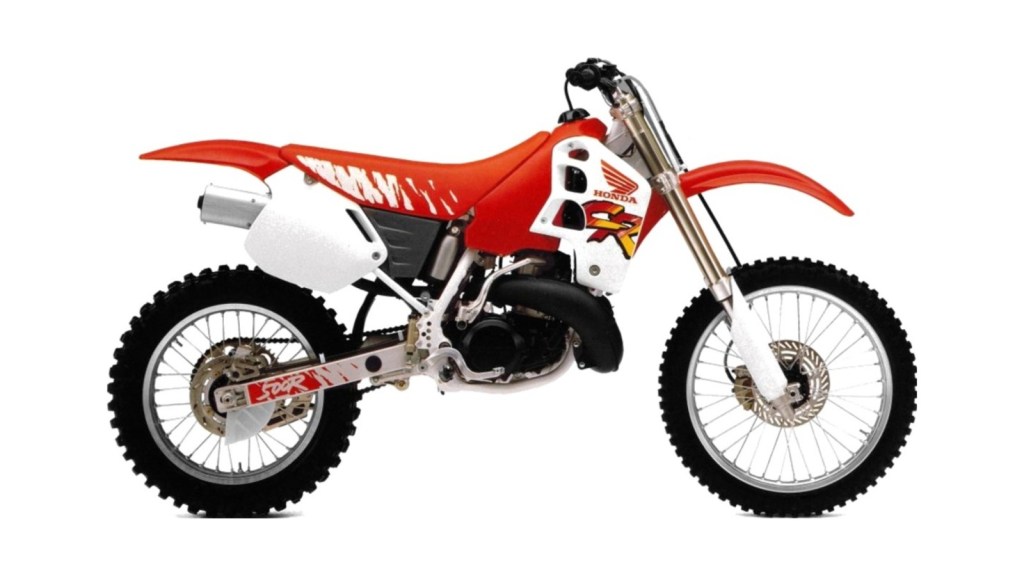
For 1990, Honda added the white frame, a heavier crank and revised geometry to calm the headshake, and US KX500s finally got 41mm inverted forks.
1991–2001: Two refined bikes
This is the sweet spot if you want to ride. Honda reworked the forks in 1991, switched to a Kayaba shock with a new linkage and smoothed out the motor. The KX500 got 43mm inverted forks, a stiffer swingarm and a new shock the same year. Honda moved to 46mm KYB forks in 1996, and Kawasaki went to a 46mm inverted fork in 1997. After that, both bikes changed mostly graphics. Mike Kiedrowski (1992) and Mike LaRocco (1993) won the last two AMA 500cc titles on KX500s before the class was dropped, and the KX went on to a long career as a desert sled.
By the end, the CR and KX were facing the new four-strokes. My 1998 Open Class shootout post has Dirt Bike’s test of the CR500R and KX500 against the KTM 380SX and the new Yamaha YZ400F.
2002–2004: KX500 only
With the CR500R gone after 2001, the KX500 ran three more years. The 2003 got a black tank and a gunmetal frame, the first frame color change since 1988, and 2004 was the last one before the KX450F took over.
Weak spots to check on each
CR500R: Suspension is the weak spot almost every year: the ’85 shock fade, the harsh ’89–’90 forks and the one-year 1995 fork, whose damping rods were prone to breaking. Every CR500R shakes its head coming down from speed, so worn steering head bearings or a bent tube make it worse. Look under the engine for crushed frame tubes, and ask the seller to start it cold while you watch. My CR500R buyer’s guide covers all of this in detail, along with rough prices from recent public sales.
KX500: The brakes felt mushy through the early 1990s, and the jetting usually needs some tweaking. Find out when the top end was last done. On the air-cooled 1983–1984 bikes, check for frame cracks and ask whether the motor has been reworked.
Both: These bikes have been raced, swapped and re-plasticked for decades, so read the frame and engine numbers and make sure the year-specific parts match: cooling, rear brake, fork type and frame color. My vintage dirt bike buyer’s checklist covers the rest.
So which one should you buy?
If you’re going to ride it on a motocross track and you’re a strong rider, I’d lean toward a 1991–2001 CR500R. It turns better, the motor is simpler to keep alive, and nothing else feels like it. If you’re going to trail ride, ride the desert or just want a 500 that won’t wear you out, a 1988–2004 KX500 is the easier bike to live with, and you can get one as new as 2004. If you’re collecting, the ’85 CR500R is the icon, and the air-cooled bikes from both brands are history pieces.
Want to see every year of both side by side? The Bike Finder lets you browse every bike in The Vault by brand and year.
FAQ
Which is faster, the CR500R or the KX500?
The CR500R had the harder-hitting motor. In 1985 it made 7.4 more peak horsepower than the KX500. The KX’s power valve gave it smoother, broader power that many riders found easier to use.
Does the CR500R have a power valve?
No. The CR500R never had an exhaust valve. The KX500 got its KIPS power valve in 1986.
Which lasted longer, the CR500R or the KX500?
The KX500. It was sold from 1983 to 2004. The CR500R ran from 1984 to 2001.
What are the best years to buy?
For riding, 1991–2001 for the CR500R and 1988–2004 for the KX500. For collecting, the 1985 CR500R.
Still deciding between the two? Send me the listing before you buy → Bike Check
I’ll look over the photos, numbers and price and tell you what I see. Starts at $29.