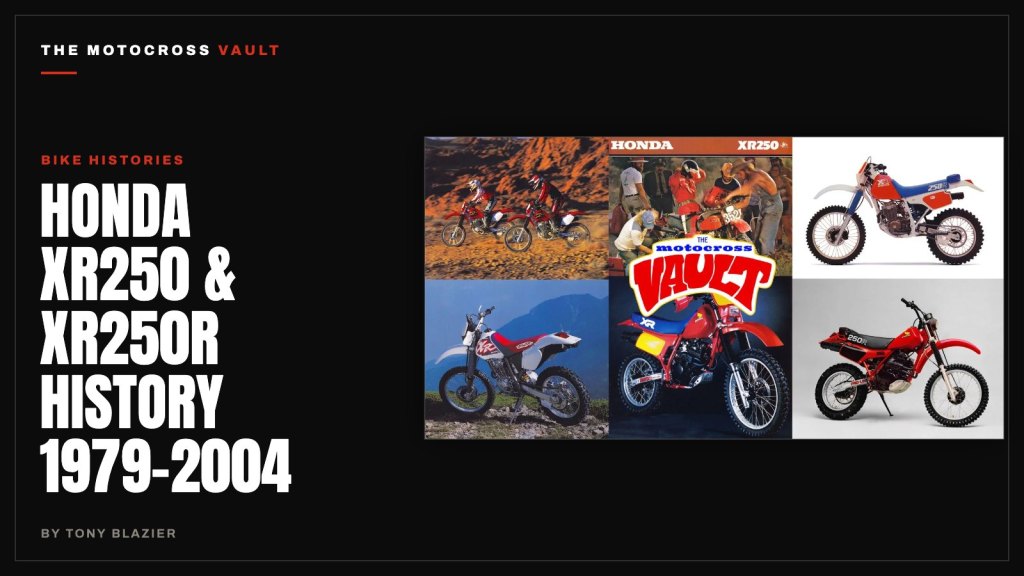
The Honda XR250R was Honda’s air-cooled 250cc four-stroke off-road bike, sold from 1979 (as the XR250) through 2004. It was never a pure racer, but it became one of the most loved trail bikes ever built because it was simple, torquey and almost impossible to kill if you changed the oil. The big milestones were Pro-Link in 1981, the RFVC head in 1984, the long-stroke motor with an oil cooler in 1986, a rear disc in 1990 and the dry-sump redesign in 1996.
This is a look back at Honda’s iconic 250cc four-stroke Enduro machine from its introduction in 1979 through its eventual retirement in 2004.Shopping for a Honda XR250 or XR250R? Send Tony the listing before you buy. He checks the year, the parts and the price within 48 hours. Bike Check from $29 →
1979 Honda XR250 history 1979-2004Honda XR250 and XR250R year-by-year at a glance
Here are the changes that mattered, from the brochures in the PDF and the magazine tests of the day. A lot of XR years were just new graphics, so if a year isn’t a big deal, I say so.
| Year | Key change |
|---|---|
| 1979 | First XR250: 249cc single overhead cam, four-valve pent-roof single, dual shocks, a 23-inch front wheel and Honda’s “Claw Action” tires. Honda claimed 252 pounds. |
| 1980 | Basically unchanged. Still on the 23-inch front wheel. |
| 1981 | Total redesign and the new XR250R name: Pro-Link single-shock rear end with a remote-reservoir shock, a 21-inch front wheel and a 17-inch rear. |
| 1982 | Graphics only. The side panels went from black to white. |
| 1983 | No XR250R. Honda launched the XR350R with the new RFVC head instead. |
| 1984 | All-new XR250R built on the smaller XR200 platform: RFVC four-valve head, dual carbs, front disc brake and 34 pounds lighter than the ’82. Still a wet-sump motor. |
| 1985 | Red, white and blue Honda wing graphics, blue fork boots and a blue shock spring, plus minor jetting changes. |
| 1986 | All-new: long-stroke 73 x 59.5mm motor, a single 30mm carb, an external oil cooler, a new frame, 41mm forks, an aluminum swingarm and 11 inches of travel. The wheelbase grew about 3.5 inches. |
| 1987–1988 | Graphics only. The 1988 got a red rear fender and red fork boots. |
| 1989 | Graphics only, but a great look: all-red CR-style plastic with the Honda wing back on the tank. |
| 1990 | Cartridge 41mm forks, a rear disc brake in place of the drum and a revised exhaust. |
| 1991 | White tank, drilled brake rotors and a redesigned rear hub. The street-legal XR250L joined the lineup. |
| 1992–1995 | Graphics only. The side plates drifted toward purple and were fully purple by 1995. |
| 1996 | All-new: dry-sump motor with the oil carried in the frame (no more oil cooler), new internals, a new frame with a removable subframe, a new low-overhang 41mm Kayaba cartridge fork, a piggyback shock and 10.6 inches of travel at both ends. |
| 1997–2004 | Graphics only. Red and black at first, a tool bag on the 2000 only, then the all-red look from 2001. 2004 was the last year. |
Honda XR250 and XR250R year by year
This is the story I tell in the video above, era by era.
Before the XR: the XL250 and the MR250 Elsinore (1972–1976)
Honda’s first off-road focused 250 was the 1972 XL250, really more of a dual sport with a 250cc single overhead cam single. Honda was a four-stroke company first, but it built the two-stroke CR250M Elsinore in 1973, and in 1976 it added the CR-based MR250 Elsinore enduro. Honda only built the MR250 that one year, so it’s a rare bike today.
1979–1980: the first XR250
After a couple of years off, Honda came back to the 250 enduro market in 1979 with the all-new XR250. What set it apart was the motor: a 249cc single overhead cam, four-valve single with a pent-roof head, at a time when Husqvarna, KTM and the rest were two-strokes. Honda claimed 252 pounds, but I think it was really closer in weight to the 500. It had dual shocks that were long travel for an enduro bike, but the suspension was very soft, and it was way down on power next to a serious two-stroke. The upside was reliability. As long as you kept oil in it, it ran and ran and ran.
The first XR had a few quirks. Its 23-inch front wheel gave it a strange feel and limited your tire choices, and Honda’s own Claw Action tires were gone by 1981. For 1980 the XR250 was basically unchanged. That was the year the XR185 grew into the XR200, and I had one of those. I tried to motocross it and broke the frame repeatedly.
1981–1983: Pro-Link, the R badge, and a year off
1981 brought the first major redesign. The XR250 and XR500 got all-new chassis and bodywork, and a single-shock Pro-Link rear end very similar to the CR motocross bikes. The shock had a remote reservoir and rebound adjustment, but no compression adjustment. Both bikes also picked up the R in their names, which Honda used to mark them as the more race-ready models. The 23-inch front wheel was gone, replaced by a 21, but Honda went with another oddball choice in back: a 17-inch rear. The motor was still the same pent-roof four-valve, so even with the trick suspension it wasn’t much more competitive against the two-strokes. 1982 was just new graphics, with the side panels switching from black to white. For 1983 there was no XR250R at all. Honda put its effort into the new XR350R and its RFVC (radial four-valve combustion) head.
1984–1985: lighter, RFVC, and the wet-sump problem
The XR250R came back for 1984 with an all-new design based on the smaller, nimbler XR200 platform instead of the 500. That cut a whopping 34 pounds compared with the ’82. It got the RFVC head and the dual-carb setup from the 350 and 500, shared the XR200’s 53.7-inch wheelbase, and had 10 inches of travel up front and 9.6 in the rear. There was a new front disc brake, the rear was still a drum, and the shock now had compression and rebound adjustment. It was very nimble in the trees, but still soft.
The big flaw was the wet-sump motor. These early-’80s XRs ran hot, the valve springs were a little soft, and once it got hot it was easy to float the valves and hurt the motor. So while XRs have a bulletproof reputation, the 1983–1985 bikes were not the best, and if you’re buying one, be careful. For 1985 the 250 only got minor updates: the red, white and blue Honda wing graphics I love, blue fork boots, a blue shock spring and jetting changes. Output was only about 20.8 horsepower.
1986–1989: the long-stroke motor and the oil cooler
For 1986 Honda dropped the XR350R and poured what it learned into an all-new XR250R. The motor kept its 249cc displacement but went to a 73 x 59.5mm bore and stroke for more torque. It was still air-cooled, but it added an external oil cooler and a little more oil capacity, and it swapped the fussy dual carbs for a single 30mm carb. The frame was new and the wheelbase grew a full three and a half inches. The forks went from 38mm to 41mm, there was a new aluminum swingarm, and travel went from 9.6 inches to 11. On paper it only gained a little over one horsepower, but the torque curve was much flatter, it ran cleaner and it was a whole lot more reliable. This basic design would stay for about ten years, and it was also the basis for the XR250L.
From 1986 to 1988 the bikes were mechanically identical. 1987 got a new seat font and tank graphics, and 1988 got a red fender, red fork boots and a deeper bronze side case. 1989 was also just cosmetic, but it’s my second-favorite XR ever: all-red, monochrome CR-style plastic with the Honda wing back on the tank.
1990–1995: cartridge forks and a rear disc
The 1990 XR250R got an all-new 41mm cartridge fork for more consistent damping, a few tweaks out back, a revised exhaust, and finally a rear disc brake. The old drum went away when it got wet or hot. For 1991 the tank went from orange to white, the brake rotors switched from slotted to drilled, and the rear hub was redesigned. That was also the year Honda launched the street-legal XR250L, a bike I’ve always wanted to own. From 1992 to 1995 it was graphics only, with the blue side plates drifting toward purple until they were fully purple in 1995, the last year of that body style.
1996: the dry-sump redesign
1996 was all-new, from the fenders to the wheels to the motor. It kept the RFVC head, but it went dry sump, with the oil carried in a tank in the frame, so the oil cooler was gone. Inside, it had new valve timing, a smaller relocated spark plug, lighter rings, a new clutch and a new transmission, and the motor was half an inch shorter. The new frame got a removable subframe for the first time, and the new 41mm Kayaba cartridge fork had less overhang below the axle so it wouldn’t catch in ruts. The tank was narrower but held the same amount of fuel. The new XR400R arrived alongside it with a more aggressive setup, and the 250 stayed the soft-sprung trail bike of the family.
1997–2004: graphics to the end
After 1996 the XR250R never got another major update. No upside-down fork, no new motor. The purple went away for red and black, the 2000 model had a tool bag for some reason (the 2001 went back without one), and from 2001 it had an all-red look that reminds me of the ’89. 2002, 2003 and 2004 were identical. Honda retired the XR250R after 2004 and replaced it with the CRF250X, a bike with much more racing ambition. The XR was never much of a racer, but it was made for having fun, which is what riding dirt bikes is all about in my book.
How to identify your Honda XR250R’s year
Because so many years share the same frame and motor, you’ll want the VIN and engine numbers to be sure. These visual checks will get you close fast:
- Dual shocks and a 23-inch front wheel: 1979–1980 XR250.
- Pro-Link with a 17-inch rear wheel and a dark red tank: 1981–1982. Black side panels are a 1981, white are a 1982.
- Front disc, rear drum, two carbs, no oil cooler: 1984–1985. The red, white and blue wing and blue fork boots mean 1985.
- Oil cooler up front, single carb, rear drum: 1986–1989. White fenders are a 1986 or 1987, a red rear fender is a 1988, and all-red plastic with the wing on the tank is a 1989.
- Oil cooler plus a rear disc: 1990–1995. A white tank and drilled rotors mean 1991 or later, and fully purple side plates mean 1995.
- No oil cooler, oil in the frame, removable subframe: 1996–2004. Purple trim is a 1996, a factory tool bag is a 2000, and the all-red bikes are 2001–2004.
1996–2004 Honda XR250R specs at a glance
These are Honda’s published figures for the 2004 model. The 1996–2004 bikes are mechanically the same, so they cover the whole last generation.
| Engine | 249cc air-cooled, dry-sump, four-stroke single (RFVC four-valve head) |
| Bore x stroke | 73 x 59.5mm |
| Compression | 10.2:1 |
| Carburetor | 30mm piston-valve |
| Transmission | Six-speed |
| Suspension | 41mm Kayaba cartridge fork and Pro-Link Kayaba shock, 10.6 in. of travel front and rear |
| Brakes | Disc front and rear |
| Seat height | 36.0 in. |
| Fuel capacity | 2.4 gal. (including 0.5 gal. reserve) |
| Dry weight | 240 lb. (claimed) |
What the XR250R was like, and buying one today
Let’s be honest about what this bike was. Honda marketed the XR250R as an enduro racer, but next to the two-strokes from KTM, Husqvarna and the converted motocrossers, it was way down on power. Where it shined was everywhere else. It was nimble in the trees, it started easily, and as long as you kept clean oil in it, it ran and ran and ran. I had the XR200 and a good buddy of mine had the 250, and we had a ton of fun on them. The suspension was always soft, though. Try to motocross one and you’ll bottom it hard, and both of our frames cracked more than once from that kind of abuse.
If you’re shopping for one, the 1996–2004 bikes are the pick for most riders. They have the best suspension, the dry-sump motor and no oil cooler to bash. The 1986–1995 bikes are great, simple machines too, and the rear disc on the 1990-and-later bikes is a real upgrade over the drum. Be careful with the 1984–1985 wet-sump bikes. They ran hot, and the valve springs were soft, so it was easy to float the valves and hurt the motor.
On any XR, ask how often the oil and air filter were changed, look for blue smoke, and listen for valve train noise. Be wary of a high-compression build or a radical cam, and check the frame for cracks around the welds if it looks like it was jumped a lot. Not sure about a bike? Send me the listing through Bike Check before you buy it.
Honda XR250R FAQ
What year did the Honda XR250R get a rear disc brake?
1990. The same year it got cartridge forks. Every XR250R before that used a rear drum.
What’s the difference between the XR250R and the XR250L?
The XR250L, introduced in 1991, is the street-legal dual-sport version with lights and turn signals. It’s heavier, with softer, lower-spec suspension and a lower seat. The XR250R is the off-road-only model.
When did Honda stop making the XR250R?
2004 was the last year. The new CRF250X took its spot in the lineup, a bike with a lot more racing ambition than the XR ever had.
Is the XR250R dry sump or wet sump?
Both, depending on the year. The early bikes are wet sump, the 1986–1995 bikes are wet sump with an external oil cooler, and the 1996–2004 bikes are dry sump, with the oil carried in the frame.
More Honda XR history in the Vault
- Honda XR350R and XR400R history 1983–2004
- Honda XR500R and XR600R history 1979–2000
- Honda XR75, XR80 and CRF80 history 1973–2013
- 1979 Honda XR185 test
- Find any bike by year in the Bike Finder, or browse old Honda ads on the Ad Wall.