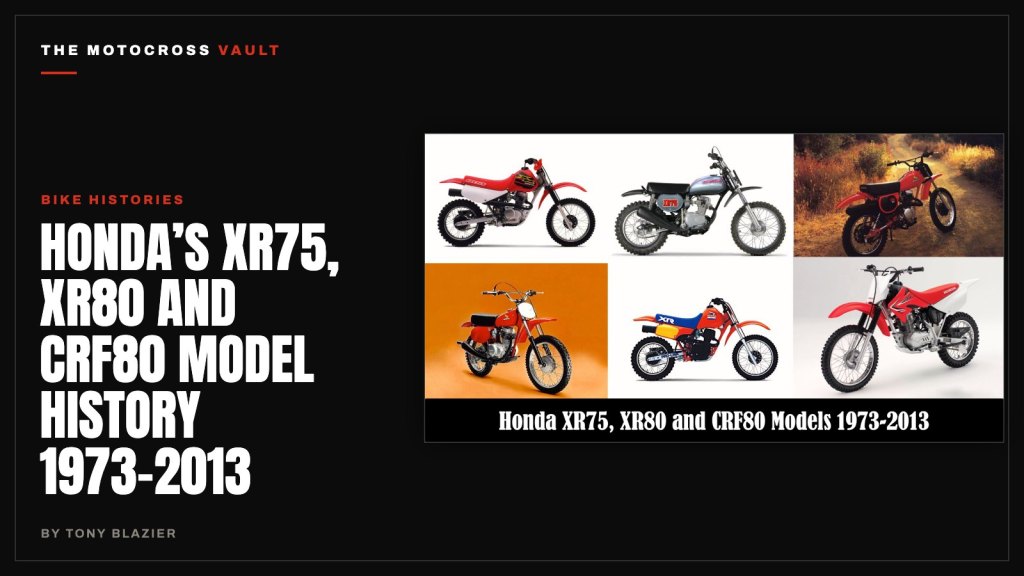

The Honda XR75 was Honda’s first mini motocross bike, a 72cc four-stroke that arrived as a 1973 model and could beat the two-strokes of its day. It grew into the XR80 in 1979, became the CRF80F in 2004 and stayed in Honda’s lineup until 2013. That’s forty years for one little four-stroke, and along the way it went from mini racer to the bike a whole generation learned to ride on. Below you’ll find the key changes by year, how to tell the years apart, the full story and the original brochures.
In 1973, Honda launched their first mini-class racer, the original XR75. Using a 72cc four-stroke single, the XR was actually quite a performer for its time. At the time of its introduction, it was the most refined mini racer available and actually capable of besting most of its two-stroke competitors. Throughout the seventies, the XR remained Honda’s mini racing entry, but by the end of the decade, its performance was no longer capable of keeping up with its racier competitors.Shopping for a Honda XR75, XR80 or CRF80? Send Tony the listing before you buy. He checks the year, the parts and the price within 48 hours. Bike Check from $29 →
With the introduction of the CR80R in 1980, the XR’s focus would be shifted from racing to recreation. Over the years, it would receive suspension and chassis updates, but always retain the same basic four-stroke mill it had employed since its introduction. In 2013, the renamed CRF80F would finally be retired after forty years of production and replaced with the slightly larger CRF125F. Honda’s XR75, XR80 and CRF80 models 1973-2013Honda XR75, XR80 and CRF80F year-by-year at a glance
The big changes from 1973 to 2013. Years not listed were graphics only, or the same bike carried over.
| Year | Key change |
|---|---|
| 1973 | First XR75: 72cc SOHC four-stroke, four-speed with a manual clutch, $325 new |
| 1974 | Elsinore-style tank with the Honda wing, round number plate, yellow side-plate logos |
| 1975 | Tahitian Red tank with a black frame |
| 1976 | Red fenders; last year of the first generation |
| 1977 | Big redesign: 75cc, five-speed, forward-mounted shocks, 5 in. front and 4.7 in. rear travel, red frame |
| 1978 | Silver fork lowers, black hubs, blue side-panel logo |
| 1979 | Becomes the XR80 (79.7cc) with a rounder XR-style tank, now sold as a trail bike |
| 1980 | Tucked-in exhaust with a heat shield replaces the downpipe |
| 1981 | Tank grows to 1.2 gallons, CR80-style knobbies |
| 1983 | Leading-axle forks, 1.6-gallon tank, new bodywork, black engine |
| 1985 | Pro-Link single-shock rear, new frame and bodywork, 5.5 in. of fork travel |
| 1987 | First year of white plastic |
| 1988 | XR600-style side panels, brush guards, red fork boots |
| 1989, 1992 | No XR80 offered |
| 2001 | Stronger frame with thicker tubing, CR-style bodywork, keyed ignition |
| 2004 | Renamed CRF80F, with CR-style shrouds |
| 2011 | Updated rear end |
| 2014 | CRF125F replaces both the CRF80F and CRF100F |
Honda XR75 and XR80 year by year
The PDF above has the brochures, but here’s the short version of how the XR changed over its run, from the first XR75 in 1973 to the last XR80R in 2003, and what came after as the CRF80F.
1973–1976: the XR75 mini racer
1973: The first XR75 was released in the fall of 1972, about a month before the CR250M Elsinore, and it was the most off-road-ready machine in Honda’s lineup. It was all-new: a 72cc single overhead cam four-stroke with a claimed 7 horsepower. The motor shared some DNA with the SL70, but Honda gave it larger valves, a bigger carburetor and airbox, an ignition that revved higher, and a close-ratio four-speed with straight-cut gears and a manual clutch. It cost $325 new. The suspension was built to handle full-size adults, the chassis handled well, and that four-stroke actually out-performed the two-strokes in Yamaha’s GT80 MX and Suzuki’s TM75 while being incredibly easy to ride. Dirt Bike said it had the best-sorted forks of any stock motorcycle you could buy. The 1973 is unique for its SL-style tank with red pinstripes, and it has no Honda wing, just “Honda” spelled out in red letters.
1974: Cosmetic updates only. The new tank is basically a shrunken version of the Elsinore’s, a round number plate replaces the square one, the Honda wing shows up on the tank for the first time, and the XR75 side-plate logos go from red to yellow. Mechanically it’s identical. This was the year the YZ80 arrived, but in the tests of the day the stock XR was still faster.
1975: The XR75 K2 is the first XR with a Tahitian Red tank, paired with a black frame. No other significant changes.
1976: The last year of the first generation. The only real change is red fenders front and rear. Even now it was competitive if you put money into it (think of the trick XR75s Jeff Ward was racing), but Suzuki’s RM was right on the horizon.
1977–1978: the big redesign
1977: The first serious redesign. The motor grows from 72cc to 75cc with a slightly bigger bore, compression goes to 9.5:1, and the ignition allows 500 more rpm on top. It also gets a new camshaft, a redesigned combustion chamber, larger cylinder fins, a bigger inlet valve, a new carburetor with a straighter manifold, new roller bearings and a new big-end bearing. Honda claimed 30% more power, and the transmission went to a five-speed. The chassis is new too: the shocks moved forward, and travel went up 0.9 inch at both ends, to 5 inches up front and 4.7 inches in the rear. With a thicker seat, seat height rose 2 inches. You also get larger fenders, side plates that bulge out to clear the shocks, a red frame and a long stinger muffler. It was whisper quiet at 76 dB. Even with all of that, the stock XR was outclassed by the YZ and RM in the shootouts.
1978: Cosmetic only. The fork lowers go silver and the hubs go black (the reverse of 1977), the side-panel logo changes from yellow to blue, and you get red grips. The magazines left the XR out of the mini shootout this year and compared it with the GT80 MX and Kawasaki’s KD100 instead.
1979–1984: the XR80 becomes a trail bike
1979: The XR80 debuts at 79.7cc with a claimed 8.8 horsepower, roughly half what the fastest 80s were making. The same year Honda added the XR500, XR185 and XR250, and the brochures now called the 80 an enduro model. The slim tank gives way to a rounder XR-style tank like the XR185’s. A year later the CR80R took over racing duty.
1980: A new exhaust tucks in and replaces the downpipe used since 1973, with a heat shield and a long muffler. The Honda wing returns to the tank after 1979’s lettering.
1981: The tank grows from 1 gallon to 1.2, there’s a new seat with an XR logo, a black stripe on the tank and more aggressive CR80-style knobbies. This is also the first year of the XR100.
1982: A new one-piece chain slider on the swingarm, white number plate backgrounds, and the 80 and XR logos swap places between the side panel and seat.
1983: New fenders, tank and side plates, with yellow side-plate backgrounds. The tank holds 1.6 gallons with a 0.4-gallon reserve. The forks keep 5 inches of travel but move to a leading-axle design for better steering, and the engine is now black.
1984: No mechanical updates, but a blue seat and red-coated rear springs. That mid-’80s blue seat, red plastic and yellow plates combination is my all-time favorite Honda look.
1985–1988: Pro-Link
1985: The biggest redesign since 1977. Pro-Link monoshock rear suspension, a new frame and all-new plastic, seat, tank and side panels; it looks like a shrunken XR600. Fork travel goes from 5 to 5.5 inches. Rear travel stays the same, but the narrower center allows a smaller, lighter silencer. This is my favorite XR of them all.
1986: Graphics only: the wing leaves the tank, with XR on the tank and 80R on the seat.
1987: No mechanical updates. First year of white plastic, which debuted on the 1986 XR250.
1988: Swoopy new side panels styled after the XR600, brush guards and red fork boots for the first time. Only the front fender is white, with a white frame.
1989–2000: the bold-new-graphics years
There was no XR80 for 1989 (the XR100 was still offered). From 1990 on, the changes are cosmetic. 1990 brings back the Honda wing with blue on the side plate. 1991 gets a white tank and blue fork boots and drops the Pro-Link decal. There was no XR80 for 1992. 1993 is the same machine with new graphics. 1994 goes to darker indigo-purple fork boots, 1995 is straight-up purple, and 1996 is the last purple year. 1997 switches to red and black with black fork boots and all-white side panels. 1998 puts the wing back on the tank, 1999 works the wing into the graphic, and 2000 brings the red back with a yellow XR on the tank.
2001–2003, and the CRF80F to 2013
2001: The first real update since 1985: a new frame with thicker tubing that Honda said was more rigid and durable, CR-style bodywork with the seat running farther up the tank, minor engine tweaks to meet California emissions, and a keyed ignition for the first time. 2002 gets Honda racing team graphics to match the CRs. 2003 is the last year of the XR80R name. From 2004 it became the CRF80F with CR-style shrouds, then got an updated rear end in 2011, but mechanically it was the same machine until it was retired in 2013.
Thirty years as an XR and forty in Honda’s lineup. It started as a racer and became one of the all-time best beginner bikes. Just change the oil and keep the filter clean, and it’ll run and run.
How to identify the year of a Honda XR75 or XR80
Start with the hardware to get the era, then use the colors to pin down the year.
- 1973: Slim SL-style tank with red pinstripes and “Honda” spelled out in red letters. No wing.
- 1974–1976: Elsinore-style tank with the wing and a round number plate. A Tahitian Red tank on a black frame means 1975; red fenders mean 1976.
- 1977–1978: Shocks moved forward, side plates that bulge out around them, a red frame and a long stinger muffler. Black fork lowers with silver hubs and a yellow logo is a 1977; silver lowers, black hubs and a blue logo is a 1978.
- 1979–1984: XR80 on the side panel and twin shocks. From 1980 the exhaust tucks in with a heat shield. Leading-axle forks and a black engine mean 1983 or later, and a blue seat with red rear springs is the 1984.
- 1985–1988: Single-shock Pro-Link. White plastic starts in 1987, and the swoopy XR600-style side panels with red fork boots are the 1988.
- 1990s: The fork boots help: blue in 1991, darker indigo in 1994, purple in 1995 and 1996, then black in 1997.
- 2001–2003: CR-style bodywork with the seat running up over the tank, and a key in the ignition.
- 2004–2013: CRF80F on the shrouds. Mechanically it is the same bike as the late XR80R.
If you prefer a video, here is the video version from my YouTube channel.
Honda XR75 and XR80 FAQ
What year did the Honda XR75 become the XR80?
1979. The engine grew to 79.7cc, and Honda now sold it as a trail bike rather than a mini racer. The CR80R took over racing duty in 1980.
When did the Honda XR80 get single-shock suspension?
1985, when it got Pro-Link, a new frame and all-new bodywork. Every XR75 and the 1979–1984 XR80s have twin shocks.
Is the Honda CRF80F the same as the XR80R?
Pretty much. Honda renamed the XR80R the CRF80F for 2004 and gave it CR-style shrouds, but mechanically it was the same machine until it was retired after 2013.
What replaced the Honda CRF80F?
The 2014 CRF125F, which replaced both the CRF80F and the CRF100F. The standard CRF125F kept the CRF80F’s 28.9-inch seat height.
More Honda and mini history in the Vault
- Honda CR80R and CR85R history 1980–2007, the two-stroke that replaced the XR as Honda’s mini racer
- Friday in the Vault: the $325 four-stroke that beat the two-strokes
- 1980 Mini Motocross Shootout
- Honda XR250 and XR250R history 1979–2004
- Honda CR and CRF motocross machines 1973–2021
- Find any bike by year in the Bike Finder, or browse old Honda ads on the Ad Wall.