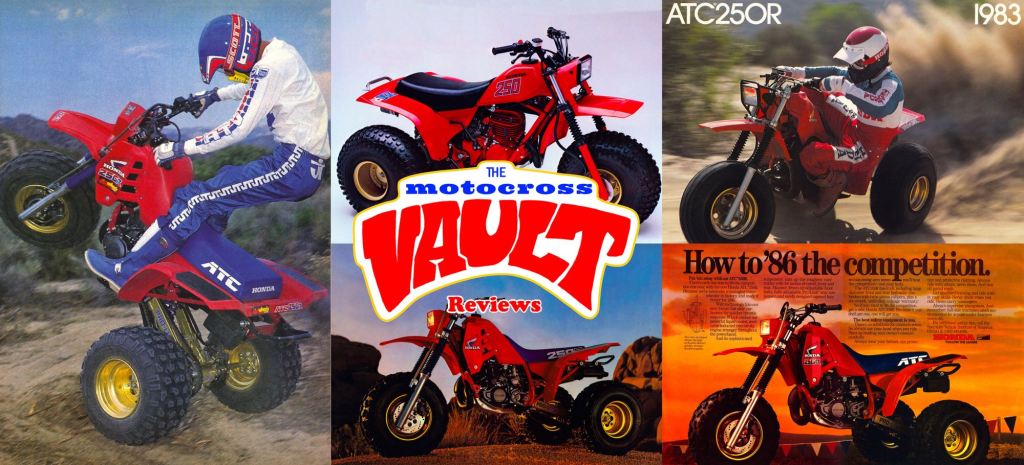
The Honda ATC250R was the first high-performance three-wheeler you could buy, sold in the U.S. from 1981 through 1986. It put a two-stroke engine, a manual clutch and real suspension on an ATC for the first time, went liquid-cooled for 1985, and its last two years are still the most loved three-wheelers ever built. Below you’ll find my video history, a year-by-year table, specs, how to tell the years apart, and what to look for if you buy one.
This is a look back at the history of Honda’s ATC and the iconic ATC250R. The ATC250R was the first high-performance three-wheeler to feature full suspension a manual clutch and a powerful two-stroke motor. From its introduction in 1981 until its retirement in 1986, it was one of the best-performing ATVs available.
Classic Steel #138: Honda ATC250R
Here is my full video history of the ATC250R, from the original ATC90 that started it all through the last 1986 model:
Honda ATC250R year-by-year at a glance
The 250R came in three generations: the air-cooled 1981–82, the Pro-Link 1983–84, and the liquid-cooled 1985–86. These are the changes I cover in the video. Little stuff like jetting is left out unless it helps you tell the years apart.
| Year | Key change |
|---|---|
| 1981 | All-new. Honda’s first high-performance ATC: 248cc air-cooled two-stroke loosely based on the CR250R, manual clutch, close-ratio five-speed, counterbalancer, 27mm carb. First Honda ATC with suspension at both ends: CR80-based forks with 6.7 in. of travel and a single rear shock with 4.3 in. Front disc brake, rear drum. |
| 1982 | Rear drum replaced by a hydraulic disc, so it has discs at both ends. New intake with a snorkel under the frame for cleaner air and less water. Engine and suspension otherwise unchanged. |
| 1983 | First big redesign: new frame, beefier forks, and Honda’s Pro-Link rear suspension with a laid-down shock, which roughly doubled rear travel while adding only about two inches of seat height. Carb up from 27mm to 30mm, new exhaust, air scoops on the tank, lower-profile tires. Still air-cooled. |
| 1984 | New shock with more stroke and revised Pro-Link linkage for a more progressive feel. New porting and a higher-compression head for a little more power. This is the year Kawasaki’s KXT250 Tecate gave it real competition. |
| 1985 | All-new and liquid-cooled for the first time (246cc), six-speed gearbox, 34mm carb, and about 42% more power than 1984. Forks grew from 35mm to 39mm with air valves, front travel went to 9.8 in., and the new Showa shock got 17 compression and 12 rebound adjustments. Lower, longer, wider chassis. Red with gold rims. |
| 1986 | Last year in the U.S. Taller seat, head angle changed by half a degree, new swingarm for easier chain adjustment, wheelbase up 0.4 in., rear axle 1.5 in. wider, Ohtsu tires in place of Dunlops, and a flat-slide Keihin carb for snappier low-to-mid power. |
Honda ATC250R specs at a glance
| 1981–1984 | 1985–1986 | |
|---|---|---|
| Engine | 248cc air-cooled two-stroke single, counterbalancer | 246cc liquid-cooled two-stroke single, counterbalancer, no power valve |
| Bore x stroke | 70 x 64.4mm | 66 x 72mm |
| Carburetor | 27mm Keihin (1981–82), 30mm (1983–84) | 34mm (1985), flat-slide Keihin (1986) |
| Transmission | Five-speed, manual clutch | Six-speed, manual clutch |
| Suspension | 1981–82: 6.7 in. front, 4.3 in. rear (single shock). 1983–84: Pro-Link rear | 39mm air-assisted forks with 9.8 in. of front travel, Pro-Link rear with an adjustable Showa shock |
| Brakes | Front disc, rear drum (1981); discs front and rear (1982 on) | Hydraulic discs front and rear |
| Throttle / start | Thumb throttle, kick start (it kicks forward to clear the footpeg) | |
Identify the year: how to tell ATC250Rs apart
Start with the 17-digit VIN on the frame. The 10th character is the model year: B = 1981, C = 1982, D = 1983, E = 1984, F = 1985, G = 1986. Then check these parts, because a lot of these trikes have been raced and pieced together over the years:
- Radiator: no radiator means an air-cooled 1981–1984. A radiator and coolant hoses mean a 1985 or 1986.
- Rear brake: a rear drum means a 1981. Every 250R after that has a rear disc.
- Rear shock: a plain single shock means 1981–82. The long, laid-down Pro-Link shock means 1983 or later.
- Gearbox: five speeds on the air-cooled bikes, six on the liquid-cooled ones.
- 1985 vs. 1986: the ’86 has the flat-slide carb, the newer swingarm and the wider rear axle, and it came on Ohtsu tires instead of Dunlops. Both wear the red bodywork with gold rims.
How the ATC250R stacked up, and buying one today
Honda invented the ATC and held the patents, so for the first few years the 250R had the high-performance class to itself. That changed in 1984, when Kawasaki’s liquid-cooled KXT250 Tecate showed up with a twist throttle and more top-end power. The Tecate walked away from the Honda once it got into the mid-range, but most people still thought the 250R was the better all-around handler. Honda answered with the liquid-cooled 1985 model, which had the best suspension in the class and, thanks to its counterbalancer, a lot less vibration than the Kawasaki. The Tecate kept the edge on top-end power, and Yamaha’s Tri-Z250 came in as the milder choice. The real threat turned out to be four wheels: Suzuki’s LT250R Quadracer in 1985 and Honda’s own FourTrax 250R in 1986 were simply more stable. In late 1987 the ATV makers agreed with the U.S. government to stop selling new three-wheelers, so the 1986 was the last ATC250R sold here.
For mixed riding, a little trail, some dunes and the odd motocross day, the ’85 and ’86 were the machines to have, and I still think they’re the best-looking three-wheelers ever made. They’re also a handful if you’re not used to a trike. I tended to run over my own leg and cartwheel them, which is why I liked my FourTrax better. If you’re shopping, check the VIN against the parts above, and expect the 1985–86 models to cost the most. The earlier air-cooled bikes are simpler and cheaper, but they’re much less of a performance machine. Any of them can be made fast: the 1985–86 engine is the same basic 246cc unit used in the TRX250R quad, and the aftermarket still supports it well.
Honda ATC250R FAQ
What years was the Honda ATC250R made?
It was sold in the U.S. for six model years, 1981 through 1986. The 1981–1984 models are air-cooled and the 1985–1986 models are liquid-cooled.
What year did the ATC250R become liquid-cooled?
1985. That year also brought the six-speed gearbox, 39mm forks, a 34mm carb and roughly 42% more power than the 1984.
What’s the difference between the 1985 and 1986 ATC250R?
Small refinements. The 1986 got a taller seat, a slightly changed head angle, a new swingarm, a 1.5 in. wider rear axle, Ohtsu tires and a flat-slide carb. It runs a little snappier and handles a little better, but they ride much the same.
Why did Honda stop making the ATC250R?
Three-wheelers were under heavy pressure from the federal government over safety, and four-wheel quads were clearly the future. In late 1987 the manufacturers agreed to stop selling new three-wheelers in the U.S., so 1986 was the last year.
More Honda ATC and ATV history in The Vault
- 1981 Honda ATC250R test, the very first 250R
- 1984 Kawasaki KXT250 Tecate test, the trike that finally took on the Honda
- Honda TRX250R FourTrax history, 1986–1989, the quad that used the same engine
- Classic magazine review: Dirt Wheels, May 1986
- Browse every Honda in the Bike Finder, or see the old Honda ads on the Ad Wall.