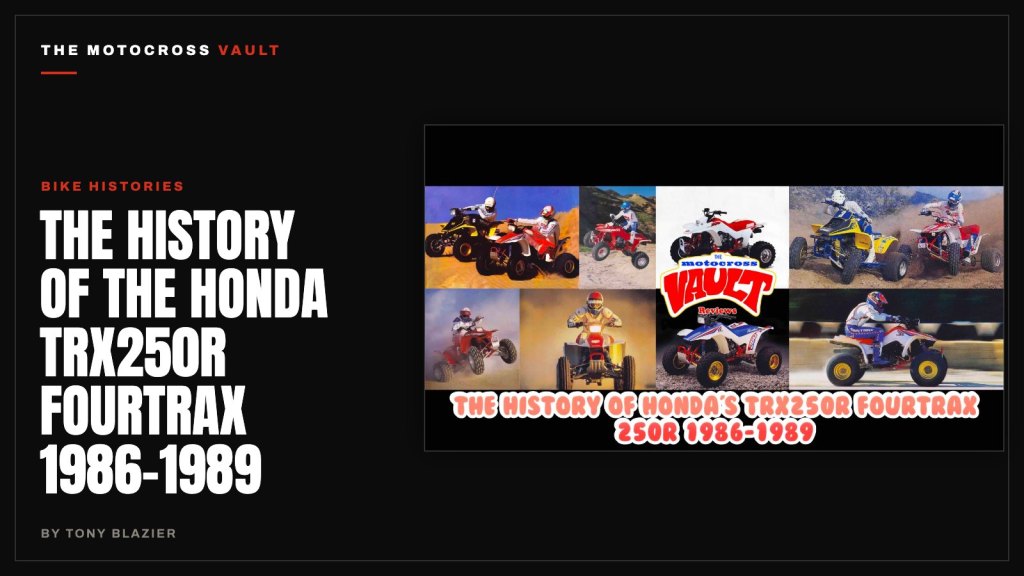
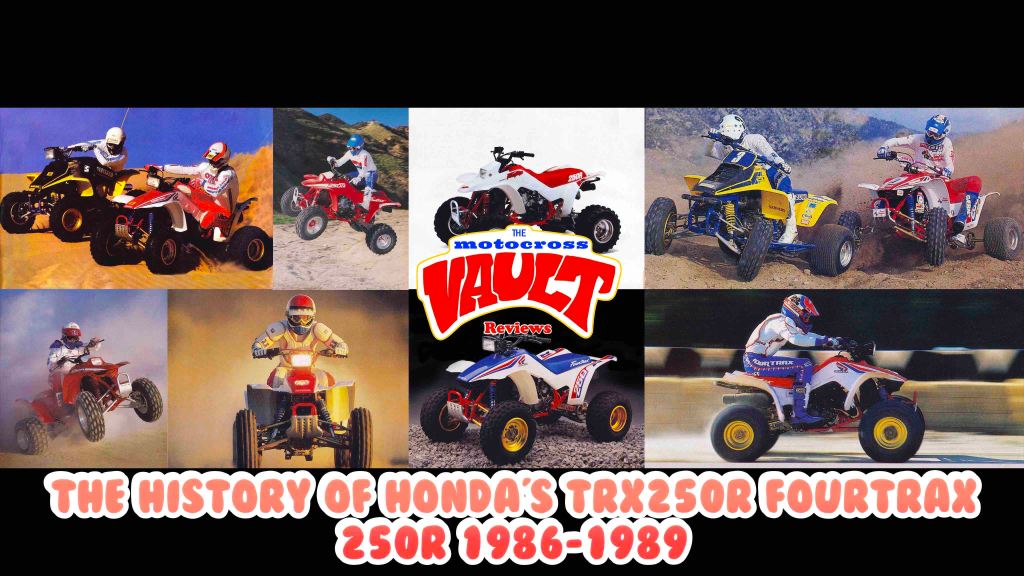
The Honda TRX250R FourTrax 250R was Honda’s two-stroke sport quad, built for only four model years, 1986 through 1989. It used a 246cc liquid-cooled engine from the ATC250R three-wheeler in a new four-wheel chassis with the best suspension in its class, and people kept racing it for more than a decade after Honda stopped building it. Below you’ll find my video history, a year-by-year table, specs, how to tell the years apart, and what to look for if you buy one.
This is my look back at the history of the most iconic quad of its era, the Honda Fourtrax 250R. Produced from 1986 through 1989, the Fourtrax 250R was the gold standard of high performance four-wheeled ATVs for over a decade.
Honda TRX250R year-by-year at a glance
The TRX250R only lasted four model years, so the list is short. These are the changes I cover in the video above. Small stuff like jetting and decal tweaks is left out unless it helps you tell one year from another.
| Year | Key change |
|---|---|
| 1986 | All-new FourTrax 250R, Honda’s first high-performance sport quad. 246cc liquid-cooled two-stroke borrowed from the ATC250R three-wheeler but tuned milder, six-speed gearbox, dual front shocks, Pro-Link rear, triple hydraulic disc brakes. Red/white or blue/white, gold rims and gold swingarm, handlebar-mounted headlight. |
| 1987 | Connecting rod 5mm longer with the wrist pin moved 5mm in the piston to match (same bore and stroke), new cylinder, quieter exhaust, keyed ignition. The FourTrax logo moves from the front fender to the seat. Same suspension travel. |
| 1988 | The big redesign: new frame, new aluminum swingarm about an inch shorter for a shorter wheelbase, new cylinder and porting, bigger intake tract, new reeds, Ohtsu radial tires, a taller seat, and the headlight moves into the front cowl. All-red bodywork, offered this year only. Honda claimed 1.5 more horsepower. |
| 1989 | Final year. White plastic with red trim, heel guards added, and a small front hub change. The price jumped to just over $4,000. |
Honda TRX250R specs at a glance
| Engine | 246cc liquid-cooled, reed-valve two-stroke single with a counterbalancer (no power valve, any year) |
| Bore x stroke | 66 x 72mm |
| Carburetor | 34mm Keihin |
| Transmission | Six-speed, manual clutch, no reverse |
| Front suspension | Dual A-arms, Showa shocks adjustable for preload, 7.9 in. travel |
| Rear suspension | Pro-Link single Showa shock with compression and rebound adjustment, about 9 in. travel |
| Brakes | Hydraulic discs, two front and one rear |
| Weight | About 350 lb with fuel (Dirt Wheels, 1989 model) |
| Original price | $2,798 (1987), $2,998 (1988), $4,098 (1989) |
Identify the year: how to tell TRX250Rs apart
Start with the 17-digit VIN on the frame. The 10th character is the model year: G = 1986, H = 1987, J = 1988, K = 1989. After that, these are the quick visual tells I look for:
- Headlight: on the handlebars means a 1986 or 1987. Built into the front cowl means a 1988 or 1989.
- Swingarm: the ’86 and ’87 have the gold steel swingarm. The ’88 and ’89 have the shorter aluminum one. A gold swingarm on a quad with a cowl headlight tells you parts have been swapped.
- Logo: on a 1986, the FourTrax logo is on the front fender. For 1987 it moved to the seat.
- Colors: 1986 and 1987 came in red/white or blue/white, and the tanks swap between the two (I put a red tank on my blue ’87). 1988 is all red. 1989 is white with red.
- Heel guards: factory heel guards mean a 1989.
How the TRX250R stacked up, and buying one today
When the FourTrax arrived in 1986, the only other sport quad was Suzuki’s LT250R Quadracer. In the shootouts I read from that year the Honda came out on top. Its suspension was rated the best in the class and Honda engineered most of the bump steer out of the front end. The one knock was that the long wheelbase made the first two years want to spin out in turns. For 1987 the competition got tougher with a new power-valve Quadracer and Kawasaki’s Tecate-4, but the Honda’s suspension was still the class benchmark. Honda sold about 35,000 TRX250Rs in 1986, 18,000 in 1987 and 25,000 in 1988. After the big 1989 price jump that fell to around 9,200.
I owned an ’87 and rode my buddy’s ’88 a lot. Stock, the engine is smooth and tractable with a wide, low-to-mid power band and no real hit, so it makes a great trail quad. The stock exhaust is heavy and very quiet, and that’s where most of the hidden power is. I was never a fan of the stock tires, bias-ply or radial, because they roll over in turns. If you’re shopping for one, budget for tires. On any year, verify the VIN against the parts listed above, because these were raced hard for more than a decade after Honda stopped building them, and swapped parts are common. The good news is that the aftermarket still supports these quads very well.
Honda TRX250R FAQ
What years was the Honda TRX250R made?
Only four: 1986, 1987, 1988 and 1989. 1989 was the last year, and Honda didn’t build another two-stroke sport quad after it.
What’s the difference between the 1986–87 and 1988–89 TRX250R?
The 1988 was the big redesign: a new frame, a shorter aluminum swingarm, a reworked cylinder, radial tires, a taller seat and a cowl-mounted headlight. The 1989 is basically a 1988 in white plastic with heel guards. The 1986 and 1987 share the first-generation chassis with the steel swingarm.
Does the TRX250R have a power valve?
No. Every TRX250R uses a simple reed-valve two-stroke with no exhaust valve, which is part of why it’s so smooth and easy to ride stock.
Why did Honda stop making the TRX250R?
Honda never gave an official reason. In the late ’80s ATVs were under heavy pressure from the government, the press and lawsuits, and high-performance machines took the most heat. I think that’s why Honda pulled out of the class after 1989, even though the quad was still selling.
More Honda ATV history in The Vault
- Honda ATC250R history, 1981–1986, the three-wheeler the FourTrax grew out of
- 1989 Honda TRX250R vs. Suzuki LT250R Quadracer shootout
- 1984 Kawasaki KXT250 Tecate test
- Classic magazine review: Dirt Wheels, May 1986
- Browse every Honda in the Bike Finder, or see the old Honda ads on the Ad Wall.