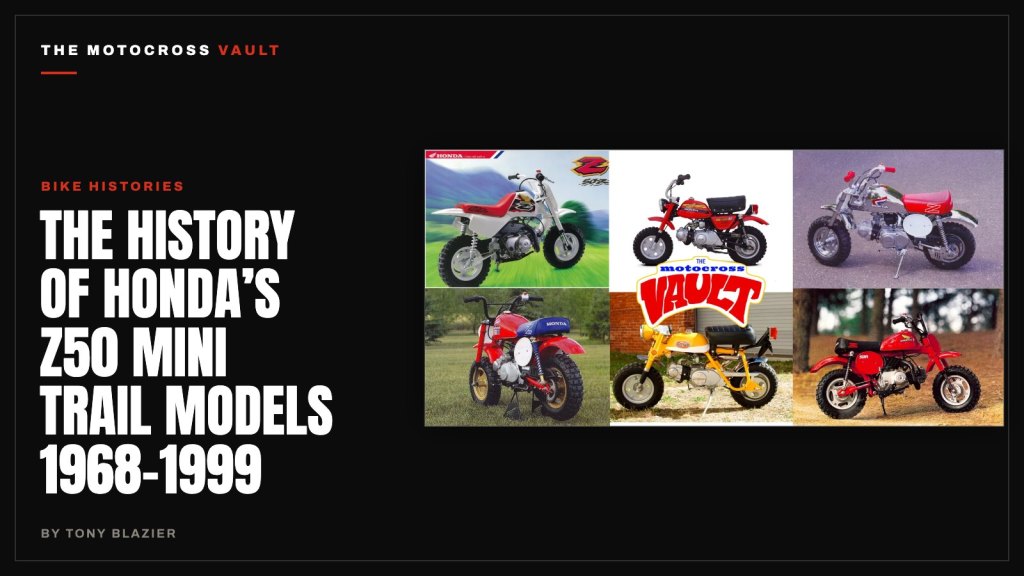
The Honda Z50 Mini Trail is the little 49cc four-stroke minibike Honda sold in the U.S. from 1968 through 1999: the Z50A from 1968 to 1978, then the Z50R from 1979 to 1999. It’s one of the most successful motorcycles Honda ever built, with well over a million Mini Trails sold, and for a lot of us it was the first bike we ever rode. Below you’ll find my video history, a year-by-year table, specs, how to tell the years apart, and what to look for if you’re buying one.
Honda Z50 Mini Trail History 1968-1999Shopping for a Honda Z50? Send Tony the listing before you buy. He checks the year, the parts and the price within 48 hours. Bike Check from $29 →
Honda Z50 Mini Trail year-by-year at a glance
These are the changes I cover in the video. Honda made running changes during some model years, especially 1968, so parts can vary on bikes built early or late in a year. Think of this as a guide to the main differences.
| Year | Key change |
|---|---|
| 1968 (Z50A K0) | First Mini Trail sold in the U.S. No headlight or taillight, so it was off-road only. Front forks but no rear suspension (a “hardtail”), folding handlebars so it fit in the back of a station wagon, white grips and white levers. Early bikes have the “slant guard” exhaust shield. Red or yellow. |
| 1969 (K1) | Headlight, taillight and a battery added. Lower bars, reshaped seat, chrome fenders, new chain guard and a real key switch. Yellow, candy red or candy blue. |
| 1970–1971 (K2) | Paint scheme flipped, with the color on top of the tank and white below, plus a new “Mini Trail” tank logo. Longer front and rear fenders, new taillight bracket, pebble-grain seat, aluminum levers. The battery was dropped, so the lights ran off the magneto (and were pretty dim). Candy sapphire blue, candy ruby red or Mexican yellow. |
| 1972 (K3) | The big one: first Z50 with rear shocks. New, taller tank with a larger Mini Trail graphic, studs on the side of the seat, and a big heat shield on the exhaust. Folding bars stayed. Ruby red or candy gold, both with black accents. |
| 1973 (K4) | Rubber street-bike footpegs replaced by serrated “alligator” pegs. Black chain guard instead of chrome, new graphics. Hawaiian blue metallic or candy orange. |
| 1974 (K5) | New graphics, otherwise the same bike. Candy sapphire blue or candy topaz orange. |
| 1975 (K6) | First year with only one color, candy ruby red, and the last year with a “K” in the name. Every Z50 after this came in a single color each year. |
| 1976 (Z50A) | Parakeet yellow. Triple clamps and the lower exhaust shield went from chrome to black. |
| 1977 | Tahitian red, and the first Z50 with the Honda wing on the tank. Black brake pedal and shifter. |
| 1978 | Last Z50A. First year with body-colored (red) fenders, plus 1970s-style stripes on the tank. |
| 1979 (Z50R) | First Z50R, styled like a mini CR. No lights, a CR-style front number plate, and a side plate on the left only. One-piece high-rise bars replaced the folding bars, a one-year-only setup. Tahitian red. |
| 1980 | Second side plate added, so there’s one on each side, which meant a new exhaust heat shield (used through 1987). Much lower bars, and a “Z” logo on the seat. This is where the Z50 became a kids’ bike first. |
| 1981 | New side-plate decal. Otherwise the same as 1980. |
| 1982 | Tahitian red replaced by the more orange “blaze red.” The Z and 50R decals swapped places between the seat and side plates. |
| 1983 | Logos swapped back, and new yellow side and front number plates, CR480R-style. |
| 1984 | First blue seat. Last year for the plain yellow-wing Honda logo on the tank. |
| 1985 | Last year for the yellow plates and first year for the red, white and blue Honda wing. |
| 1986 | White number plates, new tank logo, and gold rims and a gold shock. Honda also built the limited Z50RD “Christmas special,” finished almost entirely in chrome. |
| 1987 | White front fender and white frame with the gold rims and blue seat. Last year of this body style. |
| 1988 | Biggest redesign since 1972: all-new, modern CR-style bodywork with a tank that flows into the seat, and a gold-tinted engine finish. Same engine, three-speed and chassis basics. |
| 1989 | Only year with red fenders front and rear, matching the 1989 CRs. Mechanically the same as 1988. |
| 1990s | Small changes only. White bodywork with a red seat all decade, a silver-gray engine finish in place of the gold, side-panel graphics that went from blue to purple in the mid-’90s, and graphics that followed Honda’s redesigned 1997 CRs. 1999 was the last Z50R. |
| 2000 on | Replaced by the XR50R, which became the CRF50F for 2004. |
Honda Z50 specs at a glance
| Z50A (1968–1978) | Z50R (1979–1999) | |
|---|---|---|
| Engine | 49cc air-cooled, single-overhead-cam four-stroke single | |
| Bore x stroke | 39 x 41.4mm | |
| Claimed power | 3 hp at 7,500 rpm | — |
| Transmission | Three-speed with an automatic clutch (no clutch lever) | |
| Suspension | Front forks only (1968–1971); front forks and twin rear shocks (1972 on) | Front forks and twin rear shocks |
| Wheels and brakes | 8-inch wheels, drum brakes front and rear | |
| Weight | 128 lb | 122 lb with half a tank of gas (1979, Cycle World) |
| Original price | — | $448 (1979) |
Identify the year: how to tell Honda Z50s apart
A lot of these bikes have been handed down through three or four kids and pieced back together, so look at several clues together:
- Lights: no lights plus white grips and levers means a 1968 K0. A headlight and taillight means a 1969–1978 Z50A. No lights and number plates means a Z50R, 1979 or later.
- Rear suspension: no rear shocks means 1968–1971. Every Z50 from 1972 on has twin shocks.
- Handlebars: folding bars are a Z50A thing. Tall one-piece bars are a 1979, and low CR-style bars mean 1980 or later.
- Side plates: one plate on the left is a 1979. Plates on both sides is 1980 on.
- Plate color: yellow plates are 1983–1985; white plates are 1986 on.
- Gold rims and shock: 1986–1987. Almost all chrome is the 1986 Z50RD Christmas special.
- Bodywork: the modern tank-into-seat look is 1988–1999. Red fenders front and rear on that body means a 1989.
- Color: from 1975 on there was one color per year, so candy ruby red (1975), parakeet yellow (1976) and Tahitian red with the Honda wing (1977–1978) narrow it down fast.
How the Z50 stacked up, and buying one today
When the Mini Trail landed in 1968, most minibikes in America were homemade frames with a lawnmower engine bolted in. Honda gave people a real motorcycle in miniature, with a proper overhead-cam four-stroke from its Cub line, and early on it was clearly built so adults could ride it too (that’s where the “monkey bike” name comes from). Rivals in the early ’70s, like Suzuki’s MT50 Trailhopper and Benelli’s Dynamo, were two-strokes, and they were gone long before the Z50 was. By the time Cycle World tested the new 1979 Z50R at $448, the magazine wasn’t a fan: the automatic clutch could grab suddenly from a stop, they felt it suited kids around 9 or 10 better than true beginners, and they thought Suzuki’s JR50 handled better for less money. Honda kept building it for another 20 years anyway.
If you’re shopping, the engine is about as tough as they come, so condition and originality matter more than mechanics. On the 1968–1971 hardtails, check the frame closely, because frame cracking is the reason Honda added rear shocks for 1972. Collectors pay the most for original, unrestored bikes, and some parts are hard to find: the 1968’s early running-change parts, the 1978’s body-colored fenders (a one-year part), the 1979’s high-rise bars, and the 1986–87 gold rims. The 1986 Z50RD Christmas special is the most collectible of them all, so make sure a chrome bike really is one and not a regular Z50R that someone sent out for plating.
Honda Z50 FAQ
What years was the Honda Z50 made?
In the U.S., the Z50A was sold from 1968 through 1978 and the Z50R from 1979 through 1999. The XR50R took its place in 2000 and became the CRF50F for 2004.
What is the difference between a Honda Z50A and a Z50R?
The Z50A (1968–1978) is the original Mini Trail, with folding handlebars and, from 1969, a headlight and taillight. The Z50R (1979–1999) dropped the lights and folding bars and was styled like a mini CR motocrosser, aimed squarely at kids.
When did the Honda Z50 get rear suspension?
1972, with the K3 model. The 1968–1971 bikes are hardtails with front forks only.
What is the Honda Z50RD Christmas special?
It’s a limited-edition 1986 dealer model with almost everything in chrome, sold alongside the regular Z50R. It wasn’t a big seller back then, but today it’s one of the most collectible Z50s there is.
More Honda mini bike history on the Vault
- Honda XR75, XR80 and CRF80 history (1973–2013), the next step up from a Z50
- Honda CR80R and CR85R history
- Honda CR and CRF motocross machines, 1973–2021
- Honda’s 1981 ATC70 three-wheeler
- The Bike Finder to find every Vault post for your bike, and the Ad Wall for vintage Honda ads
 If you would like to contact Jeremy, you can reach him at Jpolsonz50@gmail.com