The Honda CR80R was Honda’s two-stroke mini motocross racer from 1980 to 2002, and the CR85R carried it on from 2003 until Honda moved the mini class to four-strokes after 2007. It changed almost every year early on, and from 1986 it had the motor that powered Honda’s mini for the next two decades. Below you’ll find the key changes by year, how to tell the years apart, the full story, the original brochures and my video.
Here are Honda’s two-stroke mini class motocross racers from the first CR80R in 1980, through the CR85R’s demise in 2007. While often not the best bikes in the class, the CR80R and CR85R could always be counted on to provide potent performance. In 2007, Honda made the unfortunate decision to abandon the two-strokes and move to four-strokes across the board. This signaled the end of the CR80/85 after 27 years of production.Shopping for a Honda CR80R or CR85R? Send Tony the listing before you buy. He checks the year, the parts and the price within 48 hours. Bike Check from $29 →
Although many feared the move to the CRF150R would signal the end of the oil burners in the mini division, Honda remains the only major manufacturer to abandon the two-strokes in the mini class. Vive le two-strokes! Honda CR80 CR85R History 1980-2007Honda CR80R and CR85R year-by-year at a glance
The big changes from 1980 to 2007. Years not listed were graphics only.
| Year | Key change |
|---|---|
| 1980 | First CR80R: air-cooled 79.7cc two-stroke, twin remote-reservoir shocks, six-speed, claimed 16.5 hp |
| 1981 | All-new suspension (8.5 in. front, 7.7 in. rear), longer swingarm, full 80cc, more low end |
| 1982 | Pro-Link single-shock rear, 31mm forks, new porting and pipe |
| 1983 | Liquid cooling, center-port exhaust, flash red with a blue seat |
| 1984 | New chassis, 33mm forks with 9.4 in. of travel, ATAC exhaust chamber |
| 1985 | Box-section downtube frame, 83cc, 28mm carb, Kayaba shock |
| 1986 | All-new motor without ATAC, Nikasil cylinder, new frame, first front disc brake |
| 1987 | 35mm forks, new porting and pipe |
| 1988 | Low-boy bodywork, unpainted cylinder, travel-sensitive fork damping |
| 1992 | Rear disc brake and much better suspension |
| 1996 | 37mm inverted Showa forks, aluminum swingarm and triple clamps, removable subframe, 220mm front disc; CR80R Expert added |
| 1999 | New frame, 20% stiffer, revised geometry |
| 2003 | Renamed CR85R (84.7cc), stronger third gear, faux radiator shroud on the right |
| 2007 | Last CR85R; Honda’s four-stroke CRF150R arrives |
Honda CR80R and CR85R year by year
The PDF above has the brochures. Here’s the short version of how Honda’s two-stroke mini changed from the first CR80R in 1980 to the last CR85R in 2007.
1980–1985: a new bike almost every year
1980: Honda was late to the two-stroke mini game; they had relied on the four-stroke XR75, which by 1979 was more of a play bike. The first CR80R looked like the dual-shock, air-cooled CR250 and CR125 of the day. It had a 79.7cc two-stroke with a 26mm Keihin carb, a reed valve, a close-ratio six-speed and a manual clutch, and Honda claimed 16.5 horsepower. Like its big brothers it was very fast but poorly suspended. The remote-reservoir shocks looked trick but bottomed easily, and the power had no low end, then hit hard in the midrange.
1981: All-new suspension after one year. Travel went from 6.7 inches front and 6.3 rear to 8.5 inches front and 7.7 rear. The swingarm was longer and stronger, the porting changed, displacement went to a full 80cc, and Honda claimed a little over 1.5 horsepower more. Most important, the low end was beefed up. It looks almost the same as the 1980, but it’s a much better bike.
1982: Another all-new bike, with a scaled-down Pro-Link single-shock rear end (compression adjustment only) and new 31mm forks with slightly more travel. New porting, expansion chamber and ignition, a larger reed valve and a slightly larger carb moved the power a little higher in the rpm range. Pro-Link beat the old dual shocks, but it was rated behind Yamaha’s monoshock and Suzuki’s Full Floater, and the KX80 had the best motor in the class.
1983: The third redesign in three years. New bodywork in the orange-ish flash red with a blue seat, just like the ’82 works Hondas, which is my favorite color of all time. The big change was liquid cooling. Bore and stroke stayed at 49.5 x 41.4mm, but the exhaust went from side port to center port, with a 26mm round-slide carb, fiber reeds and a larger airbox moved under the seat. Compression went from 6.5:1 to 7.6:1, the gearbox got new ratios and the clutch got tougher plates. Honda claimed 20 horsepower. It had a strong low-to-mid surge that novices loved, but the KX80 had the most power, the best suspension and the roomiest ergonomics.
1984: All-new again: a new chassis, 33mm forks with 9.4 inches of travel, and a new Pro-Link with 10 inches of travel. The engine got Honda’s ATAC chamber, a little sub-chamber on the exhaust meant to act like a torque pipe at low rpm and a rev pipe on top. Testers thought it actually had a little less grunt than the ’83. It finished second to the Kawasaki in Motocross Action’s shootout.
1985: One of my favorite designs to look at. A new frame with a box-section downtube, 83cc, 8.2:1 compression, a 28mm carb, a new ignition, all-new forks with 10.2 inches of travel and a redesigned Pro-Link with a Kayaba shock and 10.6 inches. ATAC still didn’t add much, and the KX80 smoked it, along with every other 80.
1986–1995: the motor of doom
1986: Maybe Honda’s best year ever across every class. ATAC was gone, and the all-new motor would power the CR80 for the next 20 years or so. It was strong down low for its time, came on with a huge burst in the midrange and screamed on top. On Dirt Rider’s dyno it made about four horsepower more than the ’85 (around 14.3 to 18). There was a new frame with slightly changed geometry and a front disc brake for the first time. The new Kawasaki was harder to ride, and most magazines picked the CR. The weak spot was the suspension: too soft, with flex in the 33mm forks. It also got a single-ring piston and the first Nikasil cylinder, which you can’t bore. Seize it and you buy a new cylinder.
1987: 35mm forks fixed the flex. A new ring design, new porting, a slightly larger reed valve and a new pipe broadened the power. For most riders above novice, it was the bike to buy.
1988: A new deep blood-red look with an unpainted silver cylinder and new low-boy bodywork with a lower tank and longer seat. The forks got Honda’s travel-sensitive damping, and the linkage got new bearings and bushings. The forks ended up too soft for the shock, so it still had the best engine in the class held back by suspension. It also had a loud, non-rebuildable steel silencer and a rear drum while Kawasaki had a rear disc.
1989–1991: Graphics only. The ’89 graphics are my favorite Honda graphics of all time. The power-valve RM80 jumped to the front of the class in 1989. 1990 went back to flash red, and 1991 added white shrouds and wild CR graphics.
1992: The pinkish “nuclear red” plastic, which faded fast in the sun. More importantly, a rear disc brake and stiffer springs with updated damping finally made the suspension much better.
1993–1995: Unchanged mechanically, still with a one-piece clutch perch and a steel silencer. The plastic got redder in ’93 and ’94, 1994 brought a Dunlop K695 tire, and 1995 had the purple seat.
1996–2007: the modern CR and the CR85R
1996: The first major redesign since 1986. The motor kept its basic design (still no power valve) but got a new shift drum, ratchet pawl and plunger. Everything else was new: a removable subframe, an aluminum swingarm and triple clamps, split perches, a 220mm front disc, 37mm inverted Showa cartridge forks with full adjustment, and a piggyback shock. The engine was painted silver. Honda also added the CR80R Expert, built to race in the Supermini class. Overall it was 1 or 1a in the class.
1997–1998: Graphics only. The ’97 with the white rear fender and the yellow Honda wing is my favorite; ’98 went to a black seat.
1999: A new frame that was 20% stiffer, with larger tubing and cross members, a slightly shorter wheelbase, and the steering head moved 10mm back and 10mm down. The suspension was revalved. The motor was the same.
2000–2002: Graphics only: a red seat and explosion-red plastic in 2000, a font and logo swap in 2001, and a black-top seat with the wing built into the graphics in 2002.
2003: Renamed the CR85R as the rules let displacement grow from 83cc to 84.7cc. It got a beefier third gear, a slightly stronger frame, new suspension settings, new brake pad material and big-bike looks with a faux radiator shroud on the right side.
2004–2007: Only small tweaks and graphics until Honda retired the CR85R in 2007 and replaced it with the four-stroke CRF150R.
How to identify the year of a Honda CR80R or CR85R
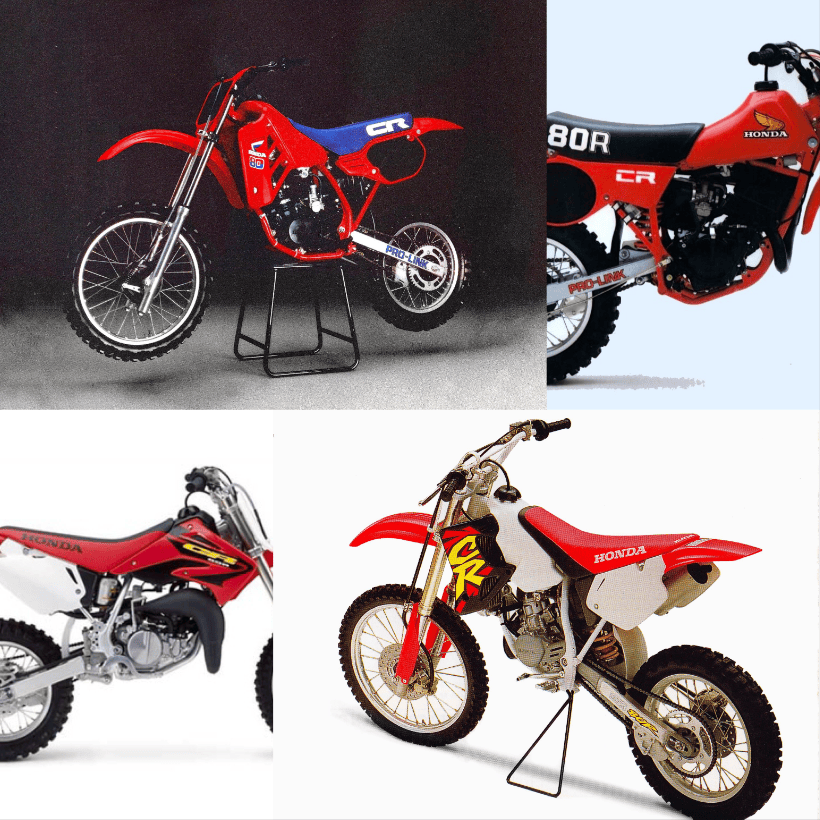
- 1980–1981: Air-cooled with twin shocks. They look almost the same, but the 1981 has a longer swingarm and more suspension travel.
- 1982: Single-shock Pro-Link, but still air-cooled.
- 1983: First radiator, in orange-ish flash red with a blue seat.
- 1984–1985: Look for the ATAC chamber on the exhaust. A box-section downtube means 1985.
- 1986–1987: Front disc brake and no ATAC. 35mm forks mean a 1987.
- 1988–1991: Low-boy bodywork and a silver cylinder, still with a rear drum. White shrouds point to 1991.
- 1992–1995: Rear disc brake. The pinkish “nuclear red” plastic is 1992, and the purple seat is 1995.
- 1996–2002: Inverted forks, aluminum swingarm and a silver-painted engine. The white rear fender with a yellow wing is a 1997, a black seat is 1998 and a red seat is 2000.
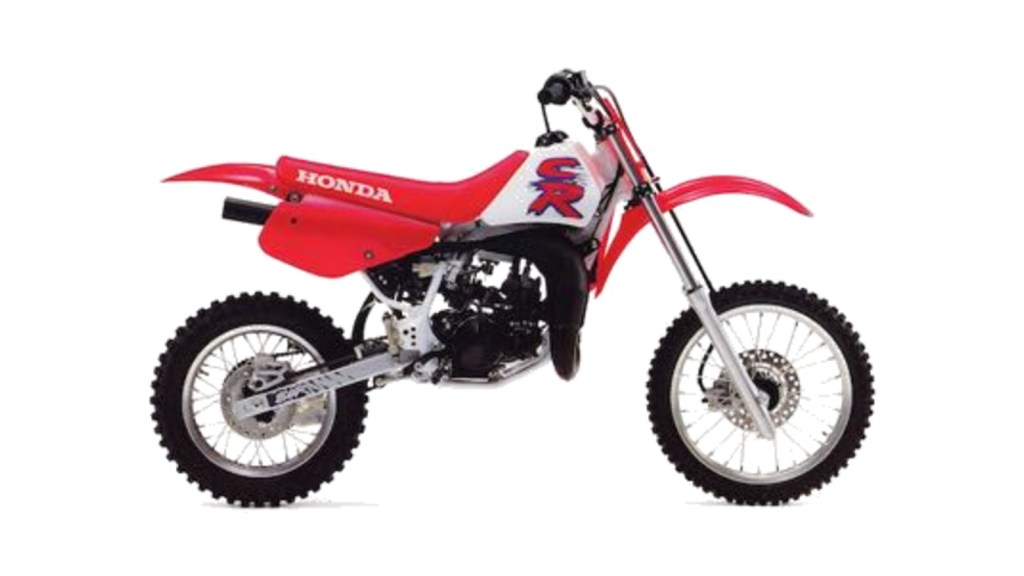
- 2003–2007: CR85R on the bike and a fake radiator shroud on the right side.
Buying a vintage Honda CR80R today
On any 1986 or later CR80R, ask about the top end before anything else. That was the first Nikasil cylinder, and you can’t bore it, so if it has been seized you can’t just go to an oversize piston. Plan on a new cylinder. On the 1986–1991 bikes, remember the rear brake is still a drum, and if you want the 1992 nuclear-red look, expect the original plastic to have faded. If you’re unsure about a bike, send me the listing through Bike Check before you buy it.
If you prefer a video, here is the video version from my YouTube channel.
Honda CR80R and CR85R FAQ
What year did the Honda CR80R get a disc brake?
The front disc came with the all-new 1986 model. The rear stayed a drum until 1992.
Did the Honda CR80R have a power valve?
No. Honda never put an exhaust power valve on the CR80R or CR85R. The motor introduced in 1986 kept its basic design to the end, while Suzuki put one on the RM80 in 1989.
When did the CR80R become the CR85R?
For 2003, when the rules let displacement grow, and Honda took it from 83cc to 84.7cc.
What replaced the Honda CR85R?
The four-stroke CRF150R, sold as a 2007 model after a rules change let 150cc four-strokes race in the 85cc two-stroke class. 2007 was the last year of the CR85R.
More Honda and mini history in the Vault
- Honda XR75, XR80 and CRF80 history 1973–2013, the four-stroke the CR80R replaced as Honda’s mini racer
- Kawasaki KX80, KX85 and KX100 history
- Yamaha YZ80 and YZ85 history and Suzuki RM80 and RM85 history
- Original brochures: 1981, 1995 and 2000
- Find any bike by year in the Bike Finder, or browse old Honda ads on the Ad Wall.