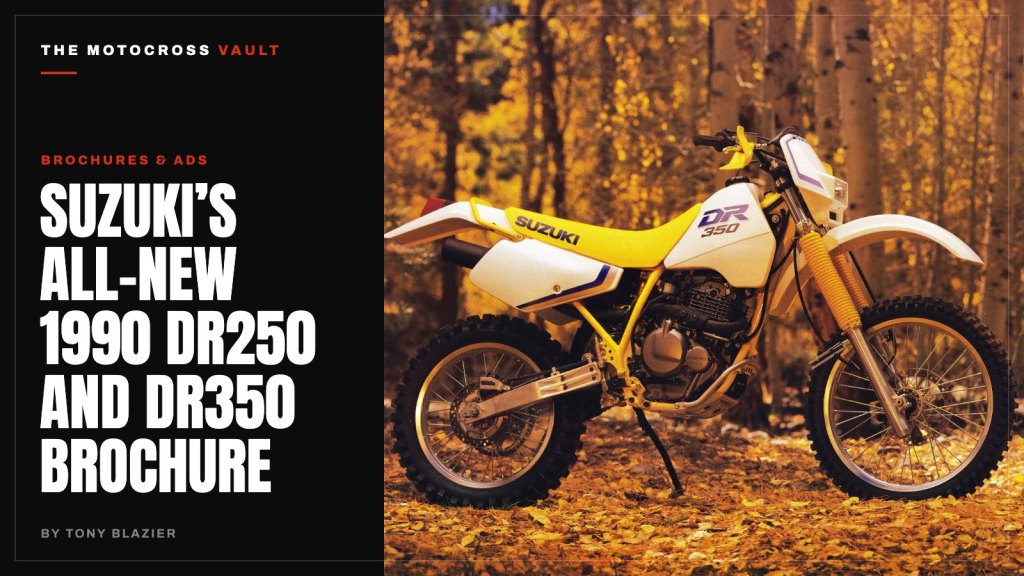
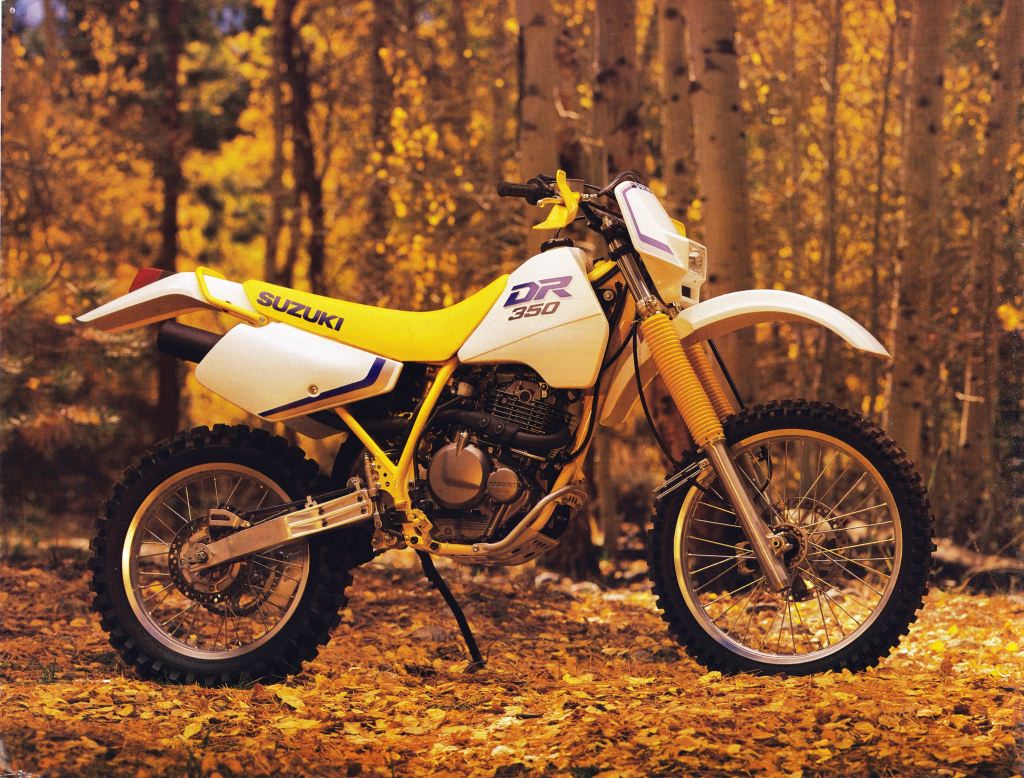
The Suzuki DR250 and DR350 were Suzuki’s all-new four-stroke off-road singles for 1990: 4-valve, overhead-cam thumpers built to give trail riders four-stroke manners without the usual weight and soft suspension. Both shared the same frame, 11 inches of travel at each end and a dry-sump engine that stored its oil in the frame, and the 350 went on to stay in Suzuki’s lineup through the 1990s. Below is the original 1990 brochure, the full factory spec sheet, and what to know if you’re shopping for one today.
This is the brochure for Suzuki’s all-new DR250 and DR350 four-stroke enduro machines for 1990. 1990 Suzuki DR250 and DR350 Brochure1990 Suzuki DR250 and DR350 specs at a glance
These numbers come straight from the specifications page of the 1990 brochure above, where the off-road models are listed as the DR250L and DR350L. The weights are Suzuki’s own dry claims. Notice how little separates the two: the 350 is the same motorcycle with a bigger engine, and Suzuki only listed it 2 pounds heavier.
| 1990 DR250L | 1990 DR350L | |
|---|---|---|
| Engine | 249cc four-stroke single, SOHC, 4-valve, air/oil cooled | 349cc four-stroke single, SOHC, 4-valve, air/oil cooled |
| Bore x stroke | 73 x 59.6mm | 79 x 71.2mm |
| Compression ratio | 10.0:1 | 9.5:1 |
| Carburetor | Mikuni TM31 | Mikuni TM33 |
| Ignition | Digital CDI | Digital CDI |
| Transmission | Six-speed | Six-speed |
| Final drive | #520 chain | #520 chain |
| Front suspension | Telescopic, leading axle, adjustable compression damping and spring preload, 11 in. travel | Same as DR250 |
| Rear suspension | Full Floater, adjustable spring preload, compression and rebound damping, 11 in. travel | Same as DR250 |
| Brakes | Single hydraulic disc front and rear | Single hydraulic disc front and rear |
| Tires | 80/100-21 front, 110/100-18 rear | 80/100-21 front, 110/100-18 rear |
| Seat height | 919mm (36.2 in.) | 919mm (36.2 in.) |
| Ground clearance | 310mm (12.2 in.) | 310mm (12.2 in.) |
| Wheelbase | 1,450mm (57.1 in.) | 1,450mm (57.1 in.) |
| Overall length / width / height | 2,164 / 912 / 1,250mm (85.2 / 35.9 / 49.2 in.) | Same as DR250 |
| Fuel capacity | 9.5 liters (2.5 gal.) | 9.5 liters (2.5 gal.) |
| Dry weight (claimed) | 112kg (247 lb) | 113kg (249 lb) |
What was new on the 1990 Suzuki DR250 and DR350
Suzuki opened the brochure by admitting that most riders didn’t take four-stroke off-road bikes very seriously, because most four-strokes had been built with hand-me-down technology years behind the two-strokes. The DRs were Suzuki’s answer, and they were developed and tested everywhere from the tight Michigan woods to the open California desert.
Engine: dry sump and Suzuki’s SACS oil cooling
Both DRs used a single-cylinder, 4-valve, overhead-cam engine with a counter-rotating balancer to smooth out vibration and a six-speed transmission. Instead of a conventional wet sump, they used a dry-sump system with the oil carried in a sealed reservoir built into the frame backbone and front downtube, which let Suzuki lower the engine and gain ground clearance. The Suzuki Advanced Cooling System (SACS) pumped high-volume oil flow through the engine to keep temperatures down, so the DRs got by without the weight and plumbing of water cooling. The valves sat at a narrow 40-degree included angle for a compact head, the Mikuni flat-slide carbs had an accelerator pump and a special pilot-jet circuit for crisp throttle response, and a digital CDI handled the spark.
DR350 vs. DR250: what’s the difference?
According to Suzuki, the DR350 was identical to the DR250 except for one thing: the engine. Bore and stroke went from 73.0 x 59.6mm to 79.0 x 71.2mm, the intake valves grew 2.3mm and the exhaust valves 2.0mm, and the carb went from a 31mm to a 33mm Mikuni. Suzuki said adding 100cc added only about 1 percent to the bike’s weight while horsepower went up more than 20 percent. When Cycle World tested the DR350 for its February 1990 issue, they called it a far better machine than either the Honda XR350 or the Yamaha TT350, the 350 four-strokes that came before it, said it started willingly with the help of a compression release, and found its low-end power was anything but anemic, though it didn’t feel as quick in a straight line as a 250 two-stroke.
Chassis: glued swingarm and 11 inches of travel
Suzuki designed the DR frames with Finite Element Method computer analysis, and the swingarm was a real head-turner: a forged aluminum arm joined to a cast aluminum pivot section with aerospace adhesives and threaded fasteners. Cycle World pointed out that it was glued rather than welded, a first for a motorcycle. Up front, cartridge forks with 43mm stanchion tubes gave 11 inches of travel, and the Full Floater rear end used a single remote-reservoir shock, also with 11 inches. Disc brakes at both ends, an RMX-style headlight and taillight, a U.S. Forest Service-approved spark arrester, a tripmeter and a quick-change rear wheel finished off a package that was ready for the trail right out of the crate.
Buying a 1990 Suzuki DR250 or DR350 today
The DR350 stayed in Suzuki’s lineup through the 1990s, picking up electric start with the DR350SE in 1994, and the DR-Z400 eventually took its place. That long run means a 350 is a lot easier to find than a DR250. If you’re after an original 1990 bike, look for the brochure details: a yellow frame, white plastic with the “DR” tank graphics, and the 31mm carb on the 250 or 33mm carb on the 350. Because the oil lives in the frame, check the dipstick in the frame backbone and look for leaks around the oil lines. Make sure the remote-reservoir shock isn’t leaking and the forks feel right, and look the bonded aluminum swingarm over carefully for damage. As with any old four-stroke, a cold start and a listen for top-end noise will tell you a lot.
Suzuki DR250 and DR350 FAQ
What year did the Suzuki DR350 come out?
The DR350 and DR250 were introduced as all-new models for 1990.
How much does a 1990 Suzuki DR350 weigh?
Suzuki claimed a dry weight of 113kg (249 pounds) for the 1990 DR350L. The DR250L was listed at 112kg (247 pounds).
Is the Suzuki DR350 air-cooled or liquid-cooled?
It’s air/oil cooled. Suzuki’s SACS system uses a high-volume flow of engine oil to carry heat away, and the oil is stored in the frame. There’s no radiator.
When did the DR350 get electric start?
Electric start arrived in 1994 with the DR350SE. The earlier DR350 and DR350S were kick-start only.
More Suzuki and four-stroke off-road history on the Vault
- 1990 Suzuki RMX250 Brochure
- 1993 Suzuki RM80, RM125, RM250 and RMX250 Brochure
- The History of Suzuki’s PE175 Enduro 1978-1984
- The History of the Honda XR350R and XR400R 1983-2004
- Honda XR250 and XR250R History 1979-2004
- The Bike Finder for every Vault post on your bike, and the Ad Wall for more vintage ads