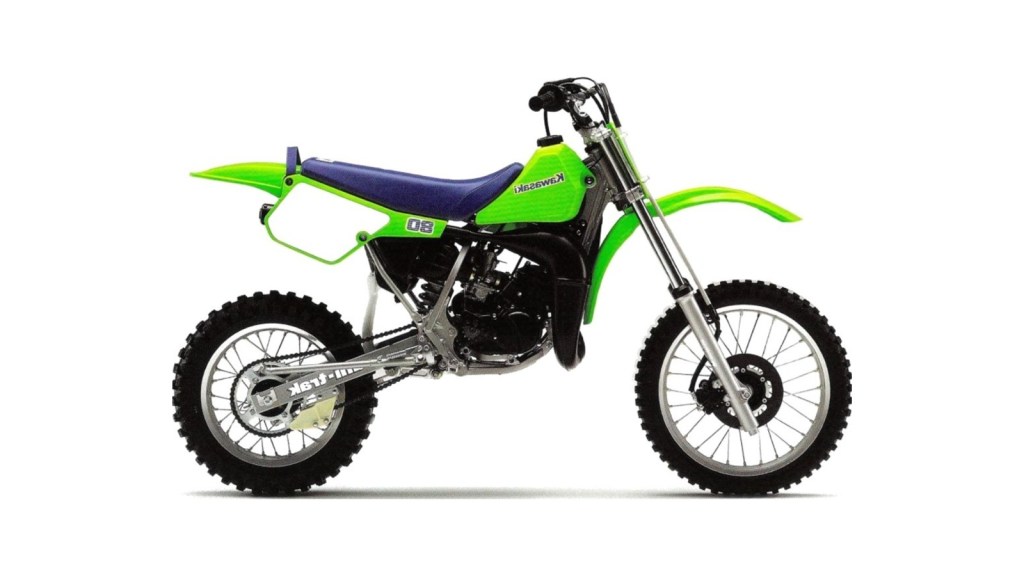
The Kawasaki KX80 is the bike a lot of us either raced as kids or watched the fast kid win on. Now those kids are grown up and want one back, either for their own kids or for the shelf. Kawasaki built the KX80 from 1979 until it became the KX85 for 2001, and those 22 years cover everything from an air-cooled drum-brake mini to a power-valve racer with inverted forks. Here’s how I’d shop for one.
Found one for sale? Send me the listing before you buy → Bike Check
I’ll look over the photos, numbers and price and tell you what I see. Starts at $29.
The short answer: which years to buy
- For the nostalgia and the motor: 1983–1985. The liquid-cooled KX80 that turned the mini class green. The motor had the strongest low end and midrange in the class, and from 1984 it had a front disc brake when every other 80 still ran drums. My 1984 KX80 review covers why it was so hard to beat.
- Know what you’re getting: 1986. All-new chassis, alloy swingarm and remote-reservoir shock, but the power moved way up the rev range. Even mini experts thought the old motor was better. It’s a great bike for a fast kid and a frustrating one for a beginner. Details are in my 1986 KX80 review.
- For riding: 1998–2000. The last KX80s got a redesigned motor with a two-way power valve, a stronger clutch and fully adjustable 36mm inverted forks.
- For taller kids: the KX80 Big Wheel arrived in 1987, and the KX100 took over that spot in 1995.
- The collector’s pick: the first-year 1979 KX80-A1, the first of the line.
Year-by-year changes that matter
- 1979: First KX80 (KX80-A1), air-cooled.
- 1981: Uni-Trak single-shock rear suspension. It’s printed right on the swingarm.
- 1983: All-new KX80 with liquid cooling, long-travel suspension and new styling. Still a front drum.
- 1984: Front disc brake, blue seat, 33mm Kayaba air forks, 29mm Mikuni oval-slide carb and an alloy silencer.
- 1986: All-new chassis with bottom-link Uni-Trak, square-section steel frame, alloy swingarm, remote-reservoir Kayaba shock, 35mm forks, removable subframe, four-petal reeds and a gear-driven water pump.
- 1987: KX80 Big Wheel joins the lineup.
- 1988: Rear disc brake.
- 1992: Inverted forks.
- 1995: KX100 appears.
- 1998: Redesigned motor with a two-way power valve, stronger clutch and fully adjustable 36mm inverted forks.
- 2001: The KX80 becomes the KX85. The 2000 KX80 was the last one.
The full story, with every model year from the brochures, is in my Kawasaki KX80, KX85 and KX100 history.
Common problems and weak points
- A hard life. Almost every KX80 spent years with a kid on board. Look for crash damage to the frame and pipe, and ask when the top end was last done.
- Air leaks on the early liquid-cooled bikes. Air leaks were a well-known Kawasaki issue back then. If a 1983–1985 bike pops at the top end, check the intake and the crank seals before you blame the jetting.
- Soft stock suspension. On the 1984 the forks were undersprung and underdamped and both ends bottomed if you pushed them. On the 1986 the forks were too soft and the shock too firm, so neither fast nor slow kids were happy. Plan on springs and fresh oil.
- The 1986 powerband. It’s not a defect, but it’s the biggest surprise for buyers. The ’86 needs lots of clutch to stay on the pipe, so it’s not the bike to teach a new rider on.
- Swapped parts. Minis get swapped, rebuilt and re-plasticked more than any other bikes. That’s next.
How to spot a correct bike vs a Frankenstein
Check the hard parts first and the colors second. Plastic and seat covers are the easiest things to change, so they’re the last thing I trust.
- 1979–1982: Air-cooled, so no radiators. From 1981 the swingarm says Uni-Trak.
- 1983: The first KX80 with radiators and shrouds, but it still has a front drum and a black seat.
- 1984–1985: Blue seat, front disc, rear drum, and the early “dog bone” Uni-Trak with a steel swingarm painted silver.
- 1986–1987: Alloy swingarm, remote-reservoir shock, the KX logo on top of the seat, and side panels without the old handholds.
- 1988 and later: Disc brakes at both ends. A rear drum on a bike sold as an ’88 or newer is wrong.
- 1992 and later: Inverted forks. Conventional forks on a ’92-up bike mean something’s been swapped.
- Big wheel vs standard: a Big Wheel KX80 or KX100 has a taller frame and bigger wheels. The KX100 runs a 19-inch front and 16-inch rear.
- Get the frame number. Ask for a clear photo of the number on the steering head and the engine number on the cases. If the frame says one year and the brakes, swingarm and forks say another, price it as a rider, not a correct bike.
What to pay
I’ll be straight with you: I couldn’t find enough recorded KX80 sales to give you a reliable price range. Most of these change hands locally on Facebook Marketplace and Craigslist, where sold prices never get recorded. The one public result I could verify was a first-year 1979 KX80, listed on Bring a Trailer, that sold for $5,355. It’s a first-year bike, so don’t treat it as the norm for a used ’90s KX80.
What I can tell you is what moves the price: original, matching hard parts for the year; an early liquid-cooled or first-year bike vs a common ’90s model; and a fresh top end and suspension vs “ran when parked.” If you’re not sure whether a price is fair, send me the listing.
Parts availability
The good news is that a lot of KX80 wear parts are still around. Aftermarket engine seal kits are sold for the 1998–2000 bikes, crank main bearings are listed for 1985–2000 models, and power valve governor assemblies for the 1998–2000 motor are still sold. Year-specific parts for the early bikes, like original plastic, seats and the 1984–1985 dog-bone linkage pieces, are much harder to find. If you want a correct early bike, buy the most complete one you can find. Original brochures, like my 1997 Kawasaki KX brochure, help you check the details.
KX80 pre-purchase checklist
- Photos of the frame number and engine number.
- Hard parts match the claimed year: cooling, brakes, swingarm, fork type, linkage.
- Cold start while you watch. Listen for popping that could mean an air leak.
- Ask when the top end was last done and if there’s a receipt.
- Check the frame, pipe and bars for crash damage and bends.
- Forks: no leaking seals and no pitted tubes. Shock: no oil on the body.
- Clutch engagement and a clean shift through all the gears.
- On 1998–2000 bikes, ask whether the power valve has been serviced.
- Big Wheel or standard? Make sure it fits the rider it’s for.
For more on what to look for, see my vintage dirt bike buyer’s checklist. Comparing minis? Read the Honda CR80R history, the Suzuki RM80 history and my 1986 Yamaha YZ80 review.
FAQ
What’s the best year Kawasaki KX80 to buy?
For nostalgia and a motor that’s easy to ride, 1983–1985. For a rider, the 1998–2000 bikes with the power valve and adjustable inverted forks. For a collector, the 1979 KX80-A1.
What year did the KX80 get disc brakes?
The front disc came in 1984 and the rear disc in 1988.
When did the KX80 become the KX85?
For 2001. The 2000 KX80 was the last one.
Is the 1986 KX80 a good bike for a beginner?
Not really. Its power came in high and needed a lot of clutch. It’s better for a fast, experienced kid.
What’s the difference between a KX80 Big Wheel and a KX100?
Both were built for bigger kids with a taller frame and bigger wheels. The Big Wheel arrived in 1987 and the KX100 took over that spot in 1995.
Found one for sale? Send me the listing before you buy → Bike Check
I’ll look over the photos, numbers and price and tell you what I see. Starts at $29.