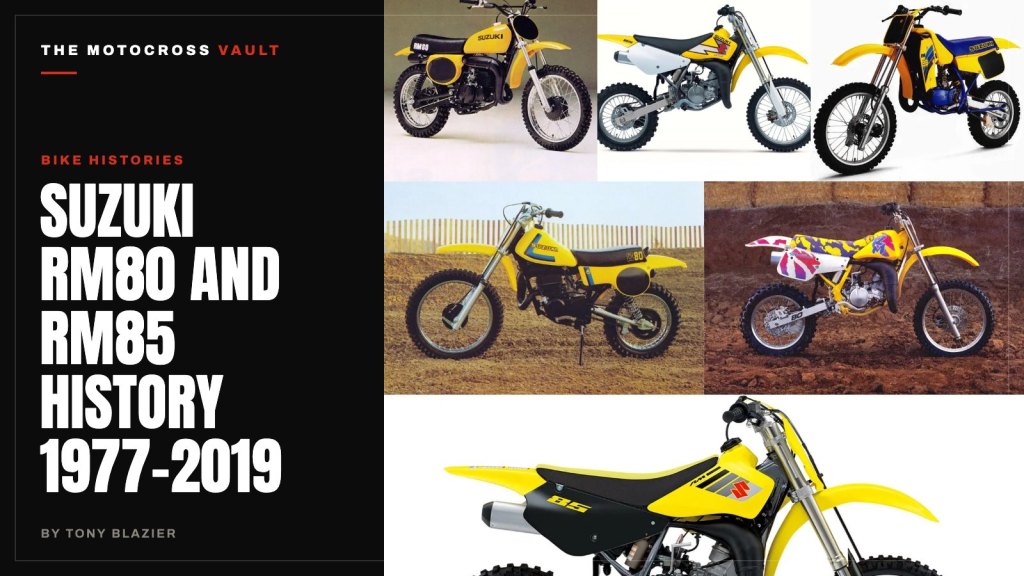
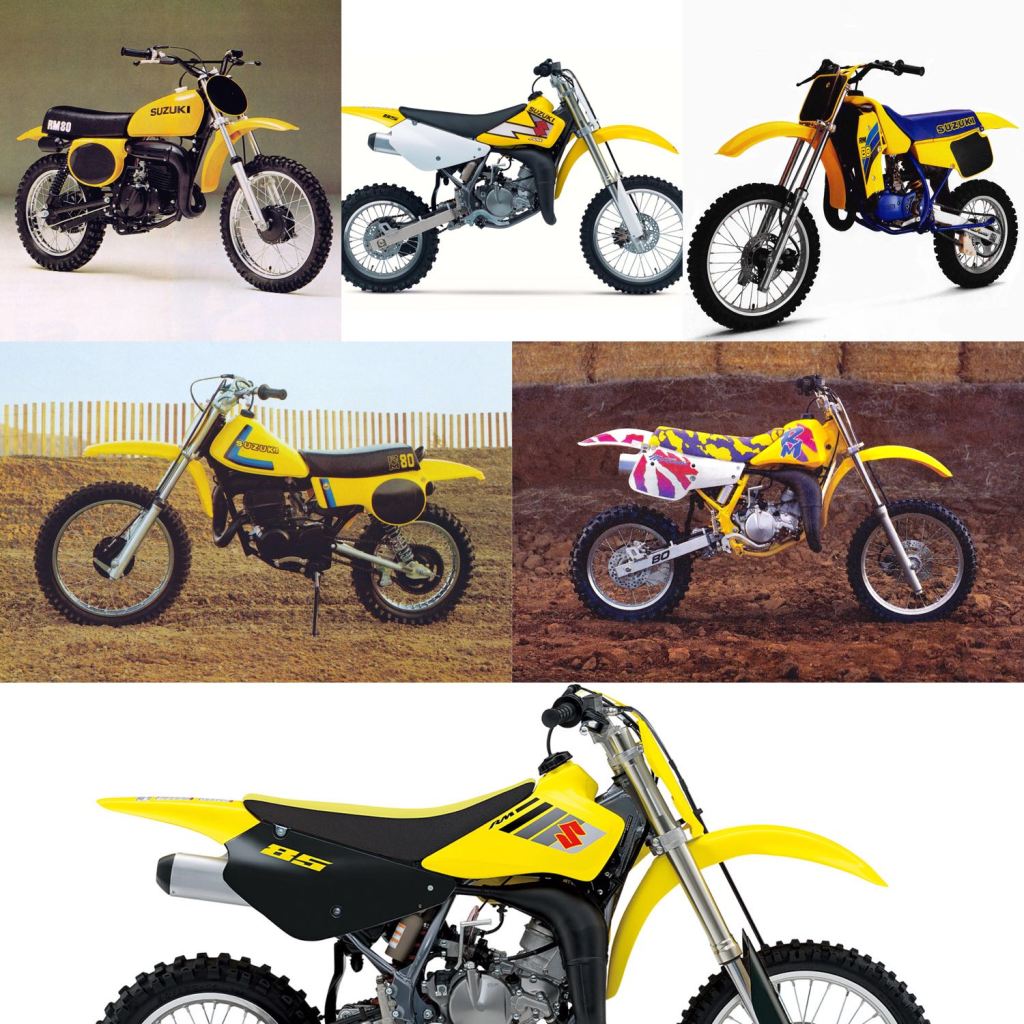
The Suzuki RM80 was Suzuki’s 80cc two-stroke mini motocross bike from 1977 until the RM85 replaced it for 2002, and the RM85 and big-wheel RM85L carried the yellow mini on from there. The RM80 was never the flashiest bike in the class, but it brought some big firsts, including Full Floater single-shock suspension in 1982 and, in 1989, the first exhaust power valve in the mini class. Below you’ll find every model year in the PDF, a year-by-year summary, how to tell the years apart, and quick answers to the questions I get most.
Over the last few years I have been working on accumulating nice clean photos of all the manufacturers’ motocross models going back to their inception. As it turns out, that is actually A LOT harder than it sounds because I was not looking for Googled photos of some guy’s Craig’s List ad, but the actual studio shots from when the bikes were new. For some models, that means going back to the early seventies and scrounging eBay for original brochures and magazine tests.Shopping for a Suzuki RM80 or RM85? Send Tony the listing before you buy. He checks the year, the parts and the price within 48 hours. Bike Check from $29 →
The results were a big hole in my bank account, but an awesome collection of classic motocross bike brochures. Personally, I love paper brochures and I lament the move to the internet for things like this. I use the photos and information in them quite a bit as well in crafting my Classic Steel articles for PulpMX.com. Maybe I am just old fashioned, but nothing beats seeing a classic bike when it was new and not yet run through the wringer by Billy Bob Mac and his cousin Ronnie. For this installment, I have gone through and accumulated all of Suzuki’s 80 class mini racers from 1977 through the latest 2019 model. The PDF below has them all featured in chronological order, with each year labeled to keep the yearly Bold New Graphics confusion to a minimum. I also did a YouTube video last year that I am including if you prefer to let the bikes just roll by with a little musical accompaniment. I hope everyone enjoys this walk through RM80/85 history. Blaze out. Suzuki RM80 and RM85 machines 1977-2019Suzuki RM80 and RM85 year-by-year at a glance
These are the big changes, pulled from the brochures, Suzuki’s spec sheets and the magazine tests of the day. Years not listed were mostly graphics.
| Year | Key change |
|---|---|
| 1977 | First RM80, an air-cooled two-stroke with Suzuki’s Power Reed intake |
| 1982 | Full Floater single-shock rear suspension and a 17-inch front wheel (up from 16) |
| 1983 | Liquid cooling arrives |
| 1986 | All-new bike: oval-tube cradle frame, bottom-link Full Floater, first front disc brake, 33mm Showa forks with 10.4 in. of travel, 28mm Mikuni flat-slide carb, alloy silencer. Rear brake still a drum. |
| 1989 | AETC exhaust power valve (the first in the mini class), 32mm Mikuni flat-slide, 35mm forks, 10.8 in. of travel at both ends, adjustable shock |
| 2001 | Last RM80: new-generation bodywork with the tank, seat and rear fender blended like the RM125 and RM250, discs front and rear, $3,049 MSRP |
| 2002 | RM85 replaces the RM80: 84.7cc (48.0 x 46.8mm), Keihin PE28 carb, 37mm Showa inverted forks, aluminum swingarm, discs front and rear |
| 2003 | RM85L big-wheel model added (19/16-inch wheels, 40mm longer wheelbase) |
| 2005 | Biggest RM85 update: new aluminum exhaust valves and actuator, revised fork valving, larger shock body, 220mm front rotor with a twin-piston caliper and a 200mm rear rotor |
How to identify the year of a Suzuki RM80 or RM85
Yellow is yellow, so start with the hardware and use the graphics to narrow it down.
- 1977–1981: Air-cooled with twin rear shocks.
- 1982: Still air-cooled, but with the single-shock Full Floater rear end.
- 1983–1985: Radiators, but drum brakes at both ends.
- 1986–1988: Front disc, bigger oval-tube frame and a taller seat. No power valve.
- 1989 and later: Look for the AETC power valve housing on the cylinder.
- Early 1990s: The wild white, pink and blue graphics showed up in 1991.
- 2001: Blended tank, seat and fender styling like the big RMs.
- 2002 and later: Called the RM85, with inverted forks. Later colors help with the year: a black seat with white fork guards in 2004, a light blue seat with yellow sides in 2006, a black rear fender in 2016 and a yellow one in 2017.
To tell an RM85L from an RM85, look at the wheels. The L runs a 19-inch front and 16-inch rear, while the standard bike uses 17 and 14 inches.
How the RM80 stacked up against the CR80, KX80 and YZ80
By 1985 the RM80 was undersized and down on power, and some magazines left it out of their mini shootouts completely. The all-new 1986 RM80 fixed a lot of that. Most testers still picked the Honda CR80R, but the RM was a close second, with more midrange than the Honda and the most comfortable layout of the ’86 minis for a lot of riders. You can see how it did against KTM in the 1986 RM80 vs. KTM 80MX shootout.
The 1989 RM80 is the one I’d point to as the high point. The power valve gave it strong power from bottom to top, almost like a little 250, and it was rated the best-suspended and best-handling 80 that year. Its weak spot was the rear drum brake, which was poor even by drum standards, while the Kawasaki KX80 already had a rear disc.
Buying a vintage Suzuki RM80 or RM85 today
On the 1986 and later RM80s, check the Full Floater linkage first. Its grease worked out of the bearings quickly, and a dry linkage makes the rear end feel terrible. Hard-ridden RM80s were also known to crack their frames, so look closely at the welds. Like any two-stroke mini, the motor goes flat fast if the top end gets ignored, so ask when it was last done. If you’re unsure about a bike, send me the listing through Bike Check before you buy it.
Suzuki RM80 and RM85 FAQ
What year did the Suzuki RM80 get a power valve?
1989. Suzuki’s AETC power valve on the 1989 RM80 was the first variable exhaust power valve in the mini class.
When did the RM80 get a front disc brake?
In 1986, when the whole bike was redesigned. Before that it used drums at both ends.
What year did the RM80 become the RM85?
The RM85 replaced the RM80 for 2002, and the big-wheel RM85L followed in 2003.
What is the difference between the RM85 and the RM85L?
Same 84.7cc engine. The RM85L has 19/16-inch wheels instead of 17/14, a 40mm longer wheelbase and a taller seat (875mm vs. 850mm) for bigger kids.
More Suzuki and mini history in the Vault
- Kawasaki KX80, KX85 and KX100 history 1979–2017
- Yamaha YZ80 and YZ85 history 1974–2019
- Honda CR80R and CR85R history 1980–2007
- 1989 Suzuki RM80, RM125 and RM250 brochure
- 1993 Suzuki RM80, RM125, RM250 and RMX250 brochure
- Find any bike by year in the Bike Finder, or browse old Suzuki ads on the Ad Wall.