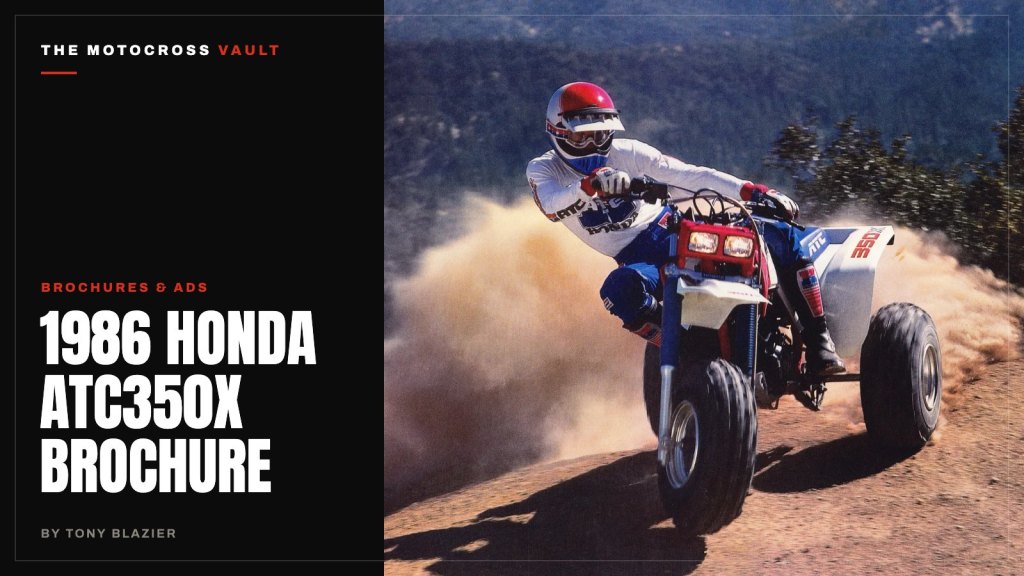
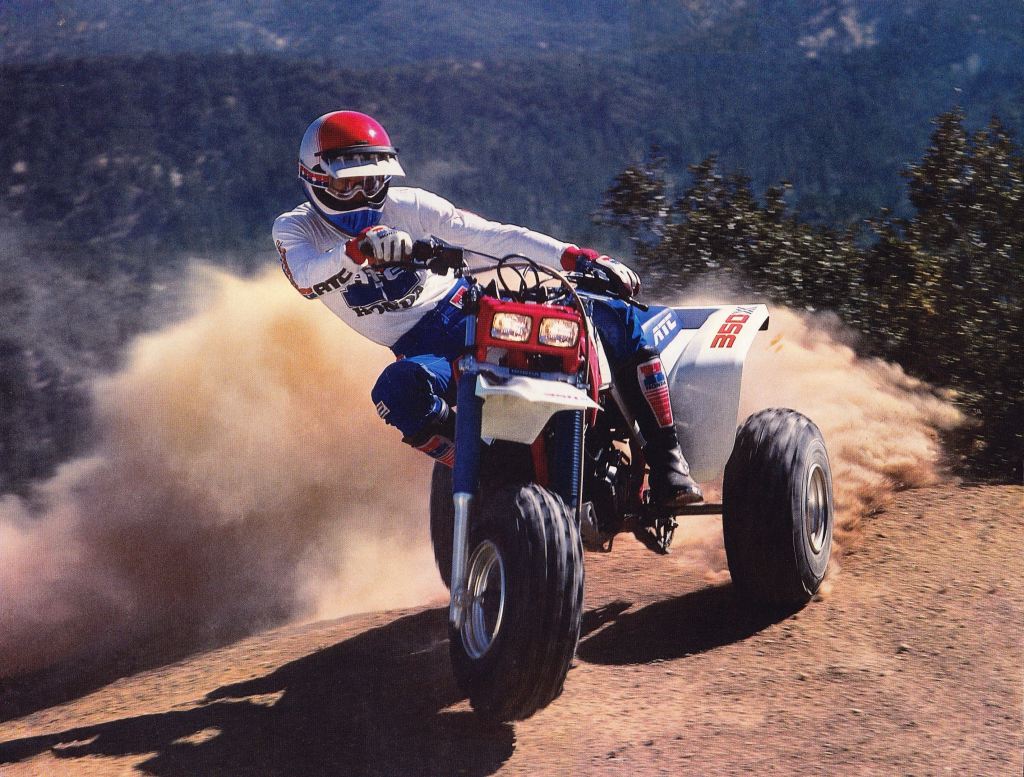
The Honda ATC350X was Honda’s biggest, most powerful sport three-wheeler: a 350cc four-stroke ATC sold in the U.S. for just two seasons, 1985 and 1986. It paired a four-valve, overhead-cam single and a six-speed gearbox with 8 inches of air-adjustable fork travel and hydraulic disc brakes at both ends, and it left the lineup after 1986, the same year as the legendary ATC250R. Below you’ll find the original 1986 brochure, the full factory spec sheet, and what to look for if you’re shopping for one today.
Here is the brochure for Honda’s iconic mid-eighties three-wheeled thoroughbred the ATC350X. 1986 Honda ATC350X Brochure1986 Honda ATC350X specs at a glance
These numbers come straight from the specifications page of the 1986 brochure above. The weight is Honda’s own dry figure. Honda never printed a horsepower number in this brochure, so I haven’t listed one.
| Engine | 350cc air-cooled OHC single-cylinder four-stroke, four-valve head |
| Bore x stroke | 81 x 68mm |
| Compression ratio | 8.5:1 |
| Carburetor | 34mm piston valve |
| Ignition | Solid-state CD |
| Starter | Primary kick, with automatic compression release |
| Transmission / clutch | Six-speed, manual clutch |
| Final drive | O-ring sealed chain |
| Front suspension | 35mm air-adjustable fork, 8.0 in. travel |
| Rear suspension | Single gas-charged shock with remote reservoir, adjustable compression and rebound damping, 7.6 in. travel |
| Brakes | Front: hydraulic disc with twin-piston caliper. Rear: hydraulic disc |
| Tires | Front: 23.5 x 8-11. Rear: 22 x 10-9 (high-flotation knobbies) |
| Length / width / height | 74.4 / 43.9 / 42.6 in. |
| Wheelbase | 50 in. |
| Seat height | 29.5 in. |
| Ground clearance | 4.7 in. |
| Fuel capacity | 2.6 gal., including 0.7 gal. reserve |
| Dry weight (claimed) | 320 lb |
| Color | White |
What Honda built into the 1986 ATC350X
Honda pitched the 350X as the biggest, most powerful four-stroke three-wheeler you could buy, and the brochure backs that up with a long list of serious hardware. The engine was a 350cc single with a single overhead cam and a four-valve head, and Honda bolted a gear-driven counterbalancer inside it to smooth out the vibration that big singles are known for. A close-ratio six-speed transmission and a heavy-duty manual clutch put the power down, an engine oil cooler helped it beat the heat, and a kick starter with automatic compression release made it easier to light. Maintenance was kept simple with an automatic cam-chain tensioner and maintenance-free solid-state CD ignition.
The chassis was just as serious. Up front, 35mm air-adjustable forks gave 8 inches of travel, while the gas-charged rear shock had a remote reservoir, four-way adjustable rebound damping and 17-way adjustable compression damping, with 7.6 inches of wheel travel. Hydraulic disc brakes sat at both ends, with an exclusive twin-piston caliper on the front. Honda also fitted aluminum alloy wheels, a large-diameter, narrow-section front tire for sharper steering, a front skid plate, a rear guard for the sprocket and brake disc, and a snorkel-type air intake for wet or muddy terrain. Dual halogen headlights and a six-month unlimited mileage warranty rounded out the package, and Honda offered a rear overfender, speedometer/odometer, rubber foot pegs and an ATV flag kit as optional Hondaline accessories.
How the ATC350X fit into Honda’s three-wheeler lineup
The ATC350X arrived for 1985 as the big brother to the ATC200X, which Honda had introduced in 1983. The 200X was the playful one, with solid power, excellent suspension and good handling for a three-wheeler. The 350X was another story. With its torquey four-stroke motor, high center of gravity and tall balloon tires, a stock 350X could be a real handful, especially for inexperienced riders. It was much more of an expert-only machine, and it was very easy to run out of talent long before the 350X ran out of performance.
On the two-stroke side, Honda’s ATC250R ruled the high-performance three-wheeled market from 1981 through 1986, so the 350X gave Honda a big-bore four-stroke option to sit beside it. Both were gone after the 1986 season. Honda ended ATC production altogether after 1987 and moved to a quad-only lineup, and the ATV Consent Decree that followed was the final nail in the coffin for three-wheelers in America. That two-year run is a big part of why the 350X is one of the rarer sport ATCs today.
Buying a Honda ATC350X today
The 350X was only sold for two seasons, so tracking down model-specific parts can take some hunting, and a complete, original machine is worth far more than a cheap one that’s missing pieces. Check the suspension first: make sure the air forks hold pressure and the remote-reservoir rear shock isn’t leaking, since that suspension was a big part of what made the 350X special. Look over the twin-piston front brake and the rear disc, the aluminum wheels, the dual headlights and the skid plates, and make sure the paperwork and frame number match the year the seller claims. And remember what I said about it in my Classic Ink column on Honda’s 1986 ATV lineup: this is a big, powerful three-wheeler with a high center of gravity, so it deserves respect and proper safety gear.
Honda ATC350X FAQ
What years was the Honda ATC350X made?
The ATC350X was sold in the United States for two model years, 1985 and 1986. It left Honda’s lineup after the 1986 season.
Is the Honda ATC350X a two-stroke or a four-stroke?
It’s a four-stroke. The ATC350X uses a 350cc air-cooled, single-overhead-cam single with a four-valve head, an 81 x 68mm bore and stroke and an 8.5:1 compression ratio.
How much does a Honda ATC350X weigh?
Honda’s 1986 brochure lists a dry weight of 320 pounds.
How much suspension travel does the ATC350X have?
The 35mm air-adjustable forks have 8 inches of travel, and the remote-reservoir rear shock gives 7.6 inches of wheel travel.
More Honda ATC and ATV history on the Vault
- Honda ATC250R History 1981-1986
- 1981 Honda ATC250R Test
- The History of the Honda TRX250R Fourtrax 1986-1989
- Honda’s ATC70 Three-Wheeler for 1981
- The Bike Finder for every Vault post on your machine, and the Ad Wall for more vintage ads