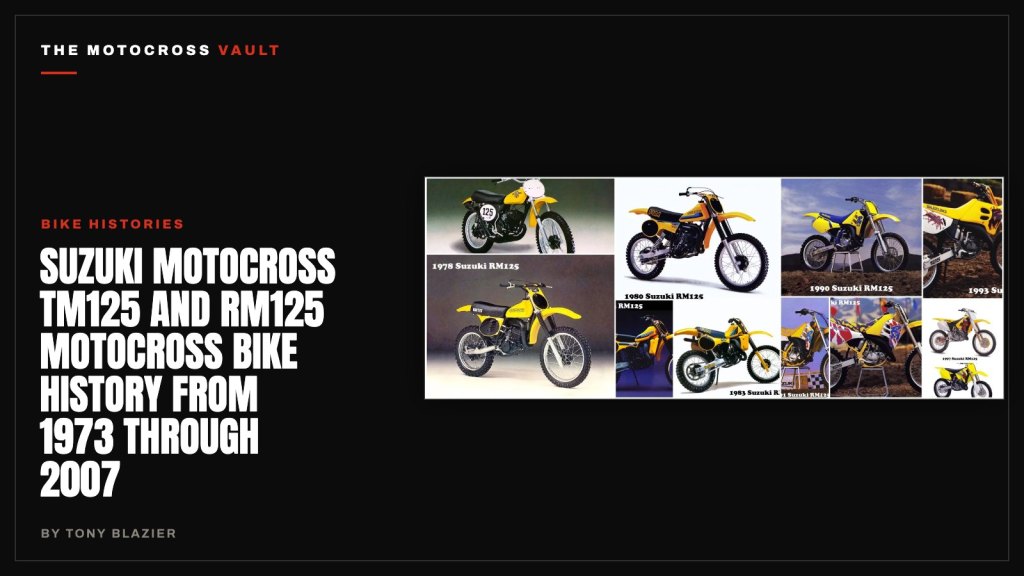
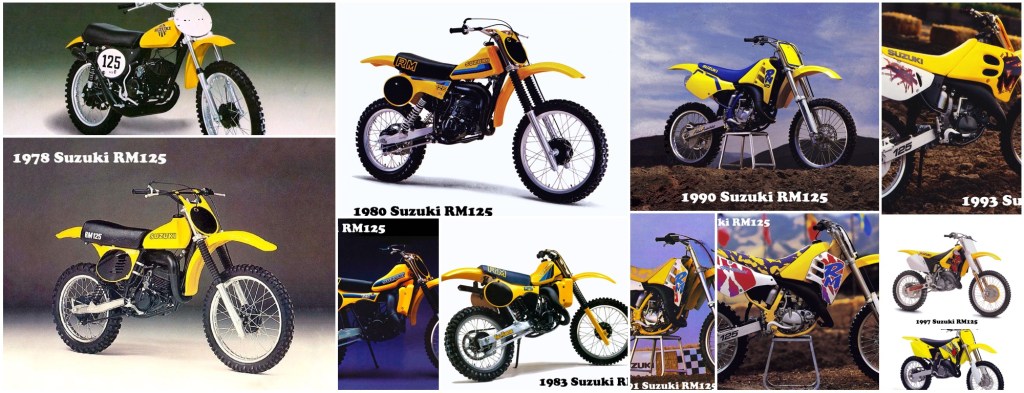
The Suzuki RM125 was Suzuki’s 125cc two-stroke motocross bike from 1975 to 2007, and it took over from the TM125 that started the line in 1973. It’s one of the most successful 125s ever built. Suzuki won the first ten 125cc World Championships, from 1975 to 1984, and the 1981 RM125 brought liquid cooling and the Full Floater single shock to the class.
Here is a collection I put together of Suzuki’s 125 Motocross bikes from 1973, until they were discontinued in 2007. The first few models were called TM’s then the RM line was introduced in 1975. The new RM125 dominated 125 racing through the seventies and into the early eighties until Kawasaki and Honda started to surpass their performance.Shopping for a Suzuki TM125 or RM125? Send Tony the listing before you buy. He checks the year, the parts and the price within 48 hours. Bike Check from $29 →
Suzuki TM125 and RM125 Motocross machines 1973-2007Suzuki TM125 and RM125 year-by-year at a glance
Here are the changes that mattered, pulled from the brochures in the PDF, the magazine tests of the day and my own Classic Steel research. Years not listed were mostly graphics and small updates.
| Year | Key change |
|---|---|
| 1973–1974 | The TM125, the first of Suzuki’s 125 motocross line. |
| 1975 | RM125 replaces the TM125: 123cc piston-port motor, 56 x 50mm, 28mm Mikuni, five-speed and an exhaust that ran under the engine. A hotter RM125S with new porting, a bigger carb and pipe followed mid-year. |
| 1976 | Reed-valve motor, six-speed gearbox, up-swept exhaust and a chromoly frame. |
| 1977 | Square 54 x 54mm bore and stroke for more bottom end, and leading-axle forks. |
| 1978 | Aluminum swingarm. |
| 1980 | Last air-cooled, twin-shock RM125. Mark Barnett won the AMA 125 National title on a prototype Full Floater works bike. |
| 1981 | All-new RM125X: liquid cooling and the Full Floater single-shock rear end, 38mm Kayaba air forks with 11.2 inches of travel and 12 inches out back. Barnett won his second 125 title. |
| 1982 | Mostly a carryover. Rivals caught up on power, but it kept its handling and suspension. |
| 1983 | Compression-adjustable forks and shock, 12.5 inches of rear travel, a longer swingarm, yellow forks and a blue seat. |
| 1984 | All-new motor, frame and airbox with a 32mm flat-slide Mikuni. Michele Rinaldi gave Suzuki its tenth straight 125 World Championship. |
| 1985 | 43mm Kayaba forks, a new rebuildable shock, the first front disc brake, a 34mm Mikuni and new porting. Last year of the original Full Floater. |
| 1986 | New, stronger frame, new Full Floater linkage, and a slimmer motor with the AEC exhaust control system. Blue-coated engine. |
| 1989 | New 124cc case-reed motor and inverted forks. |
| 1992 | All-new frame, about 25 percent stiffer, and very bold styling. |
| 1993 | All-yellow bodywork, a carbon gray frame, 45mm Showa forks with 12.2 inches of travel, a new cylinder, a 36mm Mikuni and wrap-around radiator shrouds. |
| 1994 | New porting, a 36mm Keihin PWK, carbon-fiber reeds, digital ignition and Showa twin-chamber forks. |
| 1996 | All-new frame, motor and bodywork, and a return to conventional forks: 49mm Showa twin-chamber units. |
| 1997–1998 | Motor updates: more midrange in 1997, and a high-revving top end in 1998. |
| 1999 | 49mm Showa inverted forks with 12.4 inches of travel, a longer rod, heavier flywheel, bigger carb, a 20mm larger rear rotor and much bigger radiator shrouds. |
| 2000 | Travis Pastrana won the AMA 125 National Motocross title on an RM125. |
| 2001 | All-new 54 x 54.5mm motor with a 38mm Mikuni TMX, a new chromoly frame, 47mm Showa forks and brighter “Champion Yellow” plastic. About four pounds lighter. Pastrana won the 125 East Supercross title. |
| 2004 | Longer rod, lighter flat-top piston, revised exhaust ports and valves, new suspension and rear linkage, a thicker fork, better brakes and a lower seat. |
| 2007 | Gripper seat cover, simpler graphics and lighter fork guards. The last year covered here. |
How to identify your Suzuki RM125’s year
- Air-cooled with twin shocks: 1975–1980. An exhaust running under the engine means 1975. Leading-axle forks point to 1977 or later, and an aluminum swingarm to 1978 or later.
- Liquid-cooled with a front drum brake: 1981–1984. Yellow forks and a blue seat point to a 1983.
- Front disc with conventional forks: 1985–1988. Gold rims and a silver motor are a 1985, and a blue-coated motor is a 1986.
- Inverted forks: 1989–1995. An all-yellow bike with a carbon gray frame is a 1993.
- Fat conventional forks: 1996–1998, the only modern RM125s without inverted forks.
- Inverted forks again: 1999 and later. Much bigger radiator shrouds arrived in 1999, while the brighter Champion Yellow plastic and slimmer frame are 2001 and later. A gripper seat cover and simple graphics mean 2007.
Always confirm with the frame and engine numbers, because a lot of these bikes have swapped forks and plastic over the years.
2007 Suzuki RM125 specs at a glance
| Engine | 124cc liquid-cooled two-stroke single, reed valve |
| Bore x stroke | 54 x 54.5mm |
| Compression | 9.9:1 |
| Carburetor | 38mm Mikuni TMX |
| Transmission | Six-speed |
| Suspension | Showa inverted fork, 12.2 in. travel; Showa piggyback-reservoir shock |
| Dry weight | 192 lb. (claimed) |
| Original MSRP | $5,099 (2007) |
The Suzuki RM125 story in a nutshell
In the 1970s the RM125 was the 125 to beat, and Suzuki’s world title streak ran through riders like Gaston Rahier, Harry Everts, Eric Geboers and Michele Rinaldi. In the US, Mark Barnett won three AMA 125 National titles, starting in 1980 on a prototype Full Floater. The 1981 RM125X was a landmark, but by 1983 the competition had caught up, and through the mid-1980s the RM had great suspension and not enough motor. In 1985 it was the only Japanese 125 without an exhaust valve.
Suzuki bounced back in the early 1990s, and from 1992 the RM was one of the best-balanced 125s you could buy. The Honda CR125R was faster and the Kawasaki KX125 was plusher, but nothing was as well rounded as the yellow bike, and I think 1993–1995 was its peak. The all-new 1996 bike had wonderful conventional forks, but Yamaha’s YZ125 owned the late 1990s. Travis Pastrana won the 2000 AMA 125 National title on an RM, then the 2001 125 East Supercross title on the redesigned 2001 bike, which was praised for its handling, suspension and midrange. The 2004 update added mid-to-high rpm power before the four-strokes took over.
If you’re buying one today, decide what you want it for. The 1981 RM125X is the landmark model for collectors. The 2001–2007 bikes are the ones to race, and the 2004–2007 models have the best motor and brakes. On any RM125, check the top end with a compression test, look for a seized or worn linkage, and send me the listing through Bike Check if you want a second opinion.
Suzuki RM125 FAQ
What year did the Suzuki RM125 become liquid cooled?
1981. The RM125X was also the first RM125 with the Full Floater single-shock rear suspension.
What is the difference between the Suzuki TM125 and RM125?
The TM125 came first, from 1973. The RM125 replaced it in 1975, and every Suzuki 125 motocrosser after that wore the RM name.
Which years of the RM125 have conventional forks?
Every RM125 up to 1988, and the 1996–1998 models, which used 49mm Showa twin-chamber conventional forks. Suzuki went back to inverted forks in 1999.
What was the last year of the Suzuki RM125?
This history runs through the 2007 model, which still used the 54 x 54.5mm motor from the 2001 redesign. Collector records also list a 2008 RM125 with only new graphics.
More Suzuki RM125 history in the Vault
- 1981 Suzuki RM125X review
- 1992 Motocross Action 125 shootout
- My 1996 Suzuki RM125
- 1999 Suzuki RM125 review
- Suzuki RM80 and RM85 history and Honda CR125R history
- Find any bike by year in the Bike Finder, or browse old Suzuki ads on the Ad Wall.