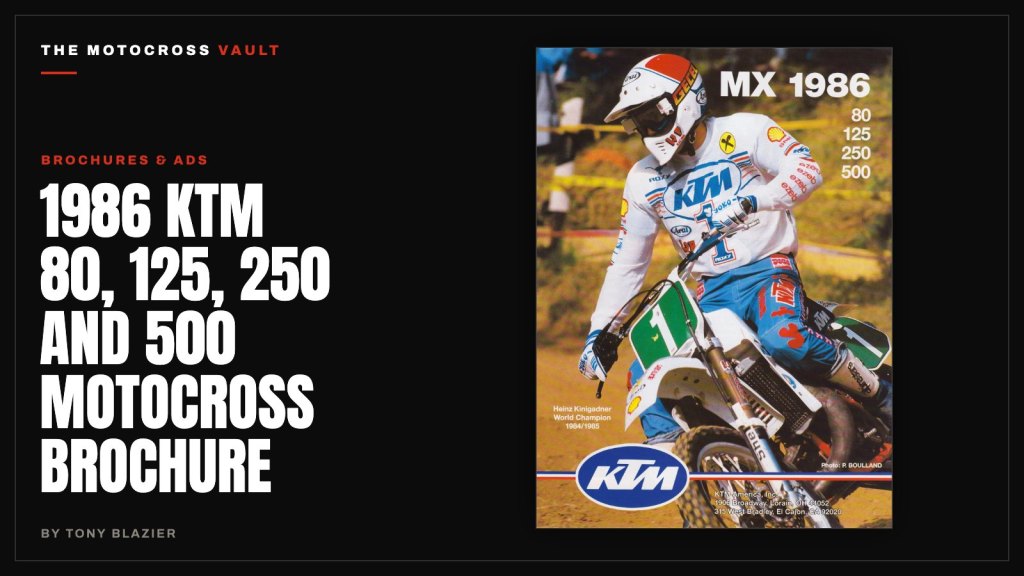
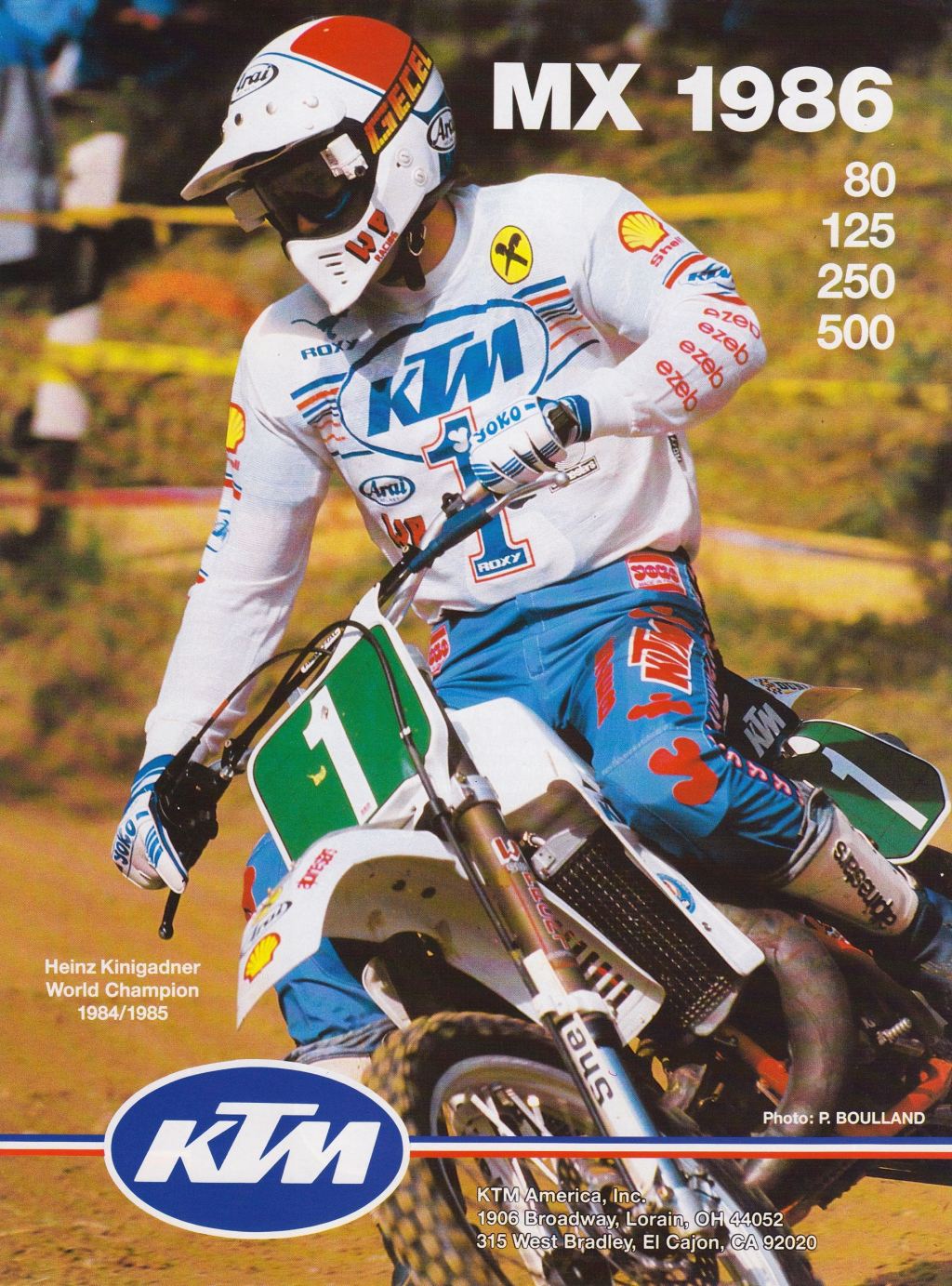
KTM’s 1986 motocross lineup was the 80 MX, 125 MX, 250 MX-DCI and 500 MX, built on the heels of Heinz Kinigadner’s back-to-back 250cc World Championships in 1984 and 1985. New for 1986 were rear disc brakes on everything but the 80, KTM’s computerized Digital Control Ignition on the 250, Dell’Orto Power Bore carbs on the 80 and 125, and an all-new 80 MX. Below you’ll find the original brochure, the full factory spec sheet, and what to know if you’re looking at one today.
In the 1980’s KTMs were common on the GP scene, but all but unheard of on this side of the pond. Originally sold as Pentons in America, KTMs were popular off-road, but always thought of as a step behind the best from Japan for motocross. In spite of this, KTM was able to capture consecutive 250 World Motocross titles in 1984 and 1985 and show many Japanese brands that they were actually ahead of them in areas like suspension design. In this brochure for the 1986 KTM lineup, you can see that KTM was offering upside-down White Power forks a full three years before any of the Big Four were willing to take the plunge. 1986 KTM 80, 125, 250 and 500 Brochure1986 KTM 80 MX, 125 MX, 250 MX and 500 MX specs at a glance
These numbers come straight from the spec page of the 1986 brochure above. Horsepower and weights are KTM’s own claims. Every bike is a liquid-cooled two-stroke with a Nikasil cylinder and reed-valve intake, and the 125, 250 and 500 share a double-downtube chromoly frame and the Pro Lever rear suspension with a White Power Super Adjuster shock.
| 80 MX | 125 MX | 250 MX-DCI | 500 MX | |
|---|---|---|---|---|
| Displacement | 78.12cc | 123.6cc | 247cc | 485cc |
| Bore x stroke | 46.5 x 46mm | 54 x 54mm | 67.5 x 69mm | 89 x 78mm |
| Claimed power | 23.5 hp at 11,500 rpm | 35.5 hp at 9,900 rpm | 46.5 hp at 7,800 rpm | 62 hp at 5,900 rpm |
| Transmission | Six-speed | Six-speed | Five-speed | Five-speed |
| Carburetor | 35mm Dell’Orto PHSB | 36mm Dell’Orto PHSB | 38mm Dell’Orto PHBE | 38mm Bing type 55 |
| Ignition | Motoplat CDI | Motoplat CDI | KTM Digital Control | Motoplat CDI |
| Fork | KTM 35mm | White Power type 4054 | White Power type 4054 | White Power type 4054 |
| Front / rear travel | 240 / 250mm (9.4 / 9.8 in.) | 290 / 320mm (11.4 / 12.6 in.) | 300 / 330mm (11.8 / 13.0 in.) | 300 / 330mm (11.8 / 13.0 in.) |
| Brakes (front / rear) | 200mm disc / 100mm drum | 240mm disc / 200mm disc | 240mm disc / 200mm disc | 240mm disc / 200mm disc |
| Tires (front / rear) | 2.75 x 17 / 4.10 x 14 | 3.00 x 21 / 4.60 x 18 | 3.00 x 21 / 4.60 x 18 | 3.00 x 21 / 5.10 x 18 |
| Seat height | 800mm (31.5 in.) | 950mm (37.4 in.) | 960mm (37.8 in.) | 960mm (37.8 in.) |
| Wheelbase | 1,220mm (48.0 in.) | 1,440mm (56.7 in.) | 1,485mm (58.5 in.) | 1,500mm (59.1 in.) |
| Dry weight (claimed) | 131.1 lb | 194.0 lb | 211.6 lb | 222.6 lb |
What was new on the 1986 KTM motocross bikes
1986 KTM 80 MX
The 80 MX was all-new for 1986 and was KTM’s shot at the Japanese-dominated mini class. It got a chromoly frame, a White Power Super Adjuster rear shock with adjustable damping and spring rate, a 35mm KTM fork, a front disc brake, and the new Dell’Orto Power Bore carb. It’s the only bike in the lineup that kept a rear drum brake. If you want to see how it did against the Japanese, check out my 1986 Suzuki RM80 vs. KTM 80MX shootout.
1986 KTM 125 MX
The 125 got a new frame that KTM said gave it a lower seat height, a lower center of gravity, more rigidity and a little less weight. The swingarm was redone to take the new rear disc brake, and the Dell’Orto Power Bore carb was there for more low-end and more top-end. KTM also listed an improved front brake and new damping specs for the shock and forks.
1986 KTM 250 MX-DCI
The 250 was the headliner. KTM’s Digital Control Ignition used an onboard computer to vary the spark advance through 255 separate steps across the rev range, where a normal CDI changes it once. KTM called it a first for an off-road motorcycle. The 250 also got new wheels with straight-pull spokes, a rear disc brake, improved suspension damping and a new intake, and the brochure bills it as the same machine Kinigadner rode to his second world title.
1986 KTM 500 MX
The big 500 was already a favorite of the magazines, and at a claimed 222.6 pounds dry it was very light for an Open bike. For 1986 it got the rear disc brake, new shock linkage for better reliability, a lower seat height, an improved front brake and a new swingarm.
How the 1986 KTMs stacked up, and buying one today
In Europe, KTM was a world-championship brand. Over here, KTMs were still rare at the local track and more of a curiosity than a real threat to the Japanese, even though the technology was right there in this brochure: computerized ignition, a disc brake on the back, and White Power suspension. The ’86 models had their weak spots, though. When I reviewed the 1987 250MX, I found its new chassis turned far better than the ’86, and its brakes were a huge improvement over the lackluster ’86 versions. Off-Road.com’s test of an ’86 250 MX also mentions a grabby, on-off clutch, notchy shifting and harsh suspension that needs setting up for your weight.
If you’re shopping for one, parts are the big issue. These were low-volume bikes in the U.S., so check that the bike is complete before you worry about anything else, especially the DCI ignition box on the 250 and the White Power suspension, which need a specialist if they’re worn out. Make sure the year matches the parts: a rear drum on a 125, 250 or 500 means you’re looking at an earlier bike or a mix of years. A rear disc, the Dell’Orto Power Bore carb on the smaller bikes and the “Digital Control” cover on the 250 are your 1986 tells.
1986 KTM FAQ
Did the 1986 KTM have a rear disc brake?
Yes. The 1986 KTM 125 MX, 250 MX and 500 MX all got a 200mm rear disc brake. The 80 MX kept a 100mm rear drum.
What is KTM DCI (Digital Control Ignition)?
It’s the computerized ignition KTM put on the 1986 250 MX. It varied the spark timing through 255 steps between idle and redline to give the most power at every rpm, instead of the single advance step of a normal ignition.
How much horsepower does a 1986 KTM 250 MX make?
KTM claimed 46.5 hp at 7,800 rpm for the 1986 250 MX. The 500 MX was rated at 62 hp at 5,900 rpm and the 125 MX at 35.5 hp at 9,900 rpm.
How much does a 1986 KTM 500 MX weigh?
KTM listed it at 222.6 pounds dry, only about 11 pounds more than the 250 MX.
More KTM history on the Vault
- Classic Bike Review: 1987 KTM 250MX
- KTM’s 1987 motocross lineup
- KTM’s 1984 motocross and off-road lineup
- The 1990 KTM motocross lineup
- The Bike Finder for every Vault post on your bike, and the Ad Wall for more vintage motocross ads